

Photoluminescent Printed Fabrics: Design and Development …
89
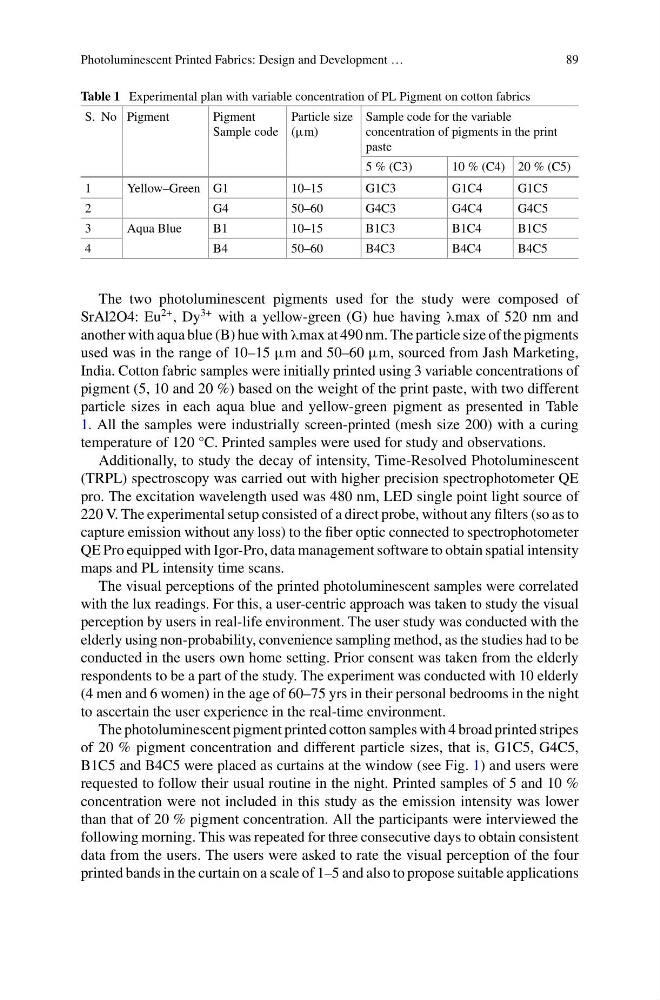
Table 1 Experimental plan with variable concentration of PL Pigment on cotton fabrics
S. No Pigment
Pigment
Sample code
Particle size
(μm)
Sample code for the variable
concentration of pigments in the print
paste
5 % (C3)
10 % (C4) 20 % (C5)
1
Yellow–Green G1
10–15
G1C3
G1C4
G1C5
2
G4
50–60
G4C3
G4C4
G4C5
3
Aqua Blue
B1
10–15
B1C3
B1C4
B1C5
4
B4
50–60
B4C3
B4C4
B4C5
The two photoluminescent pigments used for the study were composed of
SrAl2O4: Eu
2+ , Dy
3+ with a yellow-green (G) hue having λmax of 520 nm and
another with aqua blue (B) hue with λmax at 490 nm. The particle size of the pigments
used was in the range of 10–15 μm and 50–60 μm, sourced from Jash Marketing,
India. Cotton fabric samples were initially printed using 3 variable concentrations of
pigment (5, 10 and 20 %) based on the weight of the print paste, with two different
particle sizes in each aqua blue and yellow-green pigment as presented in Table
1. All the samples were industrially screen-printed (mesh size 200) with a curing
temperature of 120 °C. Printed samples were used for study and observations.
Additionally, to study the decay of intensity, Time-Resolved Photoluminescent
(TRPL) spectroscopy was carried out with higher precision spectrophotometer QE
pro. The excitation wavelength used was 480 nm, LED single point light source of
220 V. The experimental setup consisted of a direct probe, without any filters (so as to
capture emission without any loss) to the fiber optic connected to spectrophotometer
QE Pro equipped with Igor-Pro, data management software to obtain spatial intensity
maps and PL intensity time scans.
The visual perceptions of the printed photoluminescent samples were correlated
with the lux readings. For this, a user-centric approach was taken to study the visual
perception by users in real-life environment. The user study was conducted with the
elderly using non-probability, convenience sampling method, as the studies had to be
conducted in the users own home setting. Prior consent was taken from the elderly
respondents to be a part of the study. The experiment was conducted with 10 elderly
(4 men and 6 women) in the age of 60–75 yrs in their personal bedrooms in the night
to ascertain the user experience in the real-time environment.
The photoluminescent pigment printed cotton samples with 4 broad printed stripes
of 20 % pigment concentration and different particle sizes, that is, G1C5, G4C5,
B1C5 and B4C5 were placed as curtains at the window (see Fig. 1) and users were
requested to follow their usual routine in the night. Printed samples of 5 and 10 %
concentration were not included in this study as the emission intensity was lower
than that of 20 % pigment concentration. All the participants were interviewed the
following morning. This was repeated for three consecutive days to obtain consistent
data from the users. The users were asked to rate the visual perception of the four
printed bands in the curtain on a scale of 1–5 and also to propose suitable applications
89
Table 1 Experimental plan with variable concentration of PL Pigment on cotton fabrics
S. No Pigment
Pigment
Sample code
Particle size
(μm)
Sample code for the variable
concentration of pigments in the print
paste
5 % (C3)
10 % (C4) 20 % (C5)
1
Yellow–Green G1
10–15
G1C3
G1C4
G1C5
2
G4
50–60
G4C3
G4C4
G4C5
3
Aqua Blue
B1
10–15
B1C3
B1C4
B1C5
4
B4
50–60
B4C3
B4C4
B4C5
The two photoluminescent pigments used for the study were composed of
SrAl2O4: Eu
2+ , Dy
3+ with a yellow-green (G) hue having λmax of 520 nm and
another with aqua blue (B) hue with λmax at 490 nm. The particle size of the pigments
used was in the range of 10–15 μm and 50–60 μm, sourced from Jash Marketing,
India. Cotton fabric samples were initially printed using 3 variable concentrations of
pigment (5, 10 and 20 %) based on the weight of the print paste, with two different
particle sizes in each aqua blue and yellow-green pigment as presented in Table
1. All the samples were industrially screen-printed (mesh size 200) with a curing
temperature of 120 °C. Printed samples were used for study and observations.
Additionally, to study the decay of intensity, Time-Resolved Photoluminescent
(TRPL) spectroscopy was carried out with higher precision spectrophotometer QE
pro. The excitation wavelength used was 480 nm, LED single point light source of
220 V. The experimental setup consisted of a direct probe, without any filters (so as to
capture emission without any loss) to the fiber optic connected to spectrophotometer
QE Pro equipped with Igor-Pro, data management software to obtain spatial intensity
maps and PL intensity time scans.
The visual perceptions of the printed photoluminescent samples were correlated
with the lux readings. For this, a user-centric approach was taken to study the visual
perception by users in real-life environment. The user study was conducted with the
elderly using non-probability, convenience sampling method, as the studies had to be
conducted in the users own home setting. Prior consent was taken from the elderly
respondents to be a part of the study. The experiment was conducted with 10 elderly
(4 men and 6 women) in the age of 60–75 yrs in their personal bedrooms in the night
to ascertain the user experience in the real-time environment.
The photoluminescent pigment printed cotton samples with 4 broad printed stripes
of 20 % pigment concentration and different particle sizes, that is, G1C5, G4C5,
B1C5 and B4C5 were placed as curtains at the window (see Fig. 1) and users were
requested to follow their usual routine in the night. Printed samples of 5 and 10 %
concentration were not included in this study as the emission intensity was lower
than that of 20 % pigment concentration. All the participants were interviewed the
following morning. This was repeated for three consecutive days to obtain consistent
data from the users. The users were asked to rate the visual perception of the four
printed bands in the curtain on a scale of 1–5 and also to propose suitable applications