

Green Manufacturing Model for Indian Apparel Industry …
199
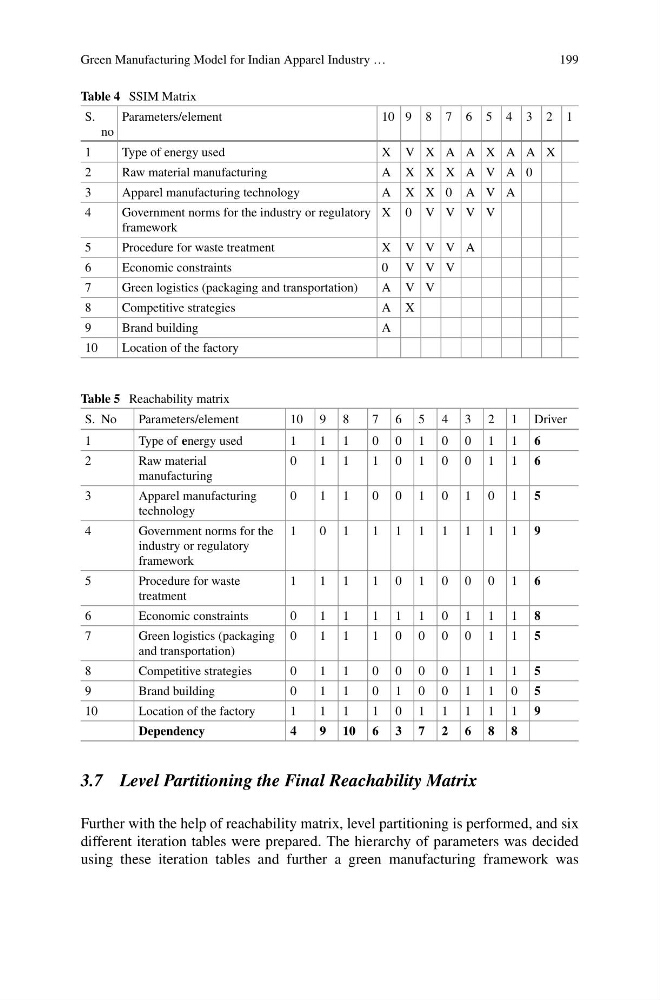
Table 4 SSIM Matrix
S.
no
Parameters/element
10 9 8 7 6 5 4 3 2 1
1
Type of energy used
X V X A A X A A X
2
Raw material manufacturing
A X X X A V A 0
3
Apparel manufacturing technology
A X X 0 A V A
4
Government norms for the industry or regulatory
framework
X 0 V V V V
5
Procedure for waste treatment
X V V V A
6
Economic constraints
0 V V V
7
Green logistics (packaging and transportation)
A V V
8
Competitive strategies
A X
9
Brand building
A
10
Location of the factory
Table 5 Reachability matrix
S. No
Parameters/element
10 9 8
7 6 5 4 3 2 1 Driver
1
Type of energy used
1
1 1
0 0 1 0 0 1 1 6
2
Raw material
manufacturing
0
1 1
1 0 1 0 0 1 1 6
3
Apparel manufacturing
technology
0
1 1
0 0 1 0 1 0 1 5
4
Government norms for the
industry or regulatory
framework
1
0 1
1 1 1 1 1 1 1 9
5
Procedure for waste
treatment
1
1 1
1 0 1 0 0 0 1 6
6
Economic constraints
0
1 1
1 1 1 0 1 1 1 8
7
Green logistics (packaging
and transportation)
0
1 1
1 0 0 0 0 1 1 5
8
Competitive strategies
0
1 1
0 0 0 0 1 1 1 5
9
Brand building
0
1 1
0 1 0 0 1 1 0 5
10
Location of the factory
1
1 1
1 0 1 1 1 1 1 9
Dependency
4
9 10 6 3 7 2 6 8 8
3.7 Level Partitioning the Final Reachability Matrix
Further with the help of reachability matrix, level partitioning is performed, and six
different iteration tables were prepared. The hierarchy of parameters was decided
using these iteration tables and further a green manufacturing framework was
199
Table 4 SSIM Matrix
S.
no
Parameters/element
10 9 8 7 6 5 4 3 2 1
1
Type of energy used
X V X A A X A A X
2
Raw material manufacturing
A X X X A V A 0
3
Apparel manufacturing technology
A X X 0 A V A
4
Government norms for the industry or regulatory
framework
X 0 V V V V
5
Procedure for waste treatment
X V V V A
6
Economic constraints
0 V V V
7
Green logistics (packaging and transportation)
A V V
8
Competitive strategies
A X
9
Brand building
A
10
Location of the factory
Table 5 Reachability matrix
S. No
Parameters/element
10 9 8
7 6 5 4 3 2 1 Driver
1
Type of energy used
1
1 1
0 0 1 0 0 1 1 6
2
Raw material
manufacturing
0
1 1
1 0 1 0 0 1 1 6
3
Apparel manufacturing
technology
0
1 1
0 0 1 0 1 0 1 5
4
Government norms for the
industry or regulatory
framework
1
0 1
1 1 1 1 1 1 1 9
5
Procedure for waste
treatment
1
1 1
1 0 1 0 0 0 1 6
6
Economic constraints
0
1 1
1 1 1 0 1 1 1 8
7
Green logistics (packaging
and transportation)
0
1 1
1 0 0 0 0 1 1 5
8
Competitive strategies
0
1 1
0 0 0 0 1 1 1 5
9
Brand building
0
1 1
0 1 0 0 1 1 0 5
10
Location of the factory
1
1 1
1 0 1 1 1 1 1 9
Dependency
4
9 10 6 3 7 2 6 8 8
3.7 Level Partitioning the Final Reachability Matrix
Further with the help of reachability matrix, level partitioning is performed, and six
different iteration tables were prepared. The hierarchy of parameters was decided
using these iteration tables and further a green manufacturing framework was