

200
A. Saxena and A. K. Khare
Table 6 Reachability matrix
Parameters/Element Reachability Set
Antecedent Set
Intersection Set Level
1
Type of Energy used 1,2,5,8,9,10
1,2,3,4,5,6,7,8,10
1,5,8,10
2
Raw Material
Manufacturing
1,2,5,7,8,9
1,2,4,7,8,9,10
2,7,8,9
3
Apparel
Manufacturing
Technology
1,3,5,8,9
3,4,6,8,9,10
3,8,9
4
Government Norms
for the Industry or
Regulatory
Framework
1,2,3,4,5,6,7,8,10 4,10
4,10
5
Procedure for Waste
Treatment
1,5,7,8,9,10
1,2,3,4,5,6,10
1,5,10
6
Economic
Constraints
1,2,3,5,6,7,8,9
4,6,9
6,9
7
Green Logistics
(Packaging and
Transportation)
1,2,7,8,9
2,4,5,6,7,10
2,7
8
Competitive
Strategies
1,2,3,8,9
1,2,3,4,5,6,7,8,9,10 1,2,3,8,9
I
9
Brand Building
2,3,6,8,9
1,2,3,5,6,7,8,9,10
2,3,6,8,9
I
10 Location of the
Factory
1,2,3,4,5,7,8,9,10 1,4,5,10
1,4,5,10
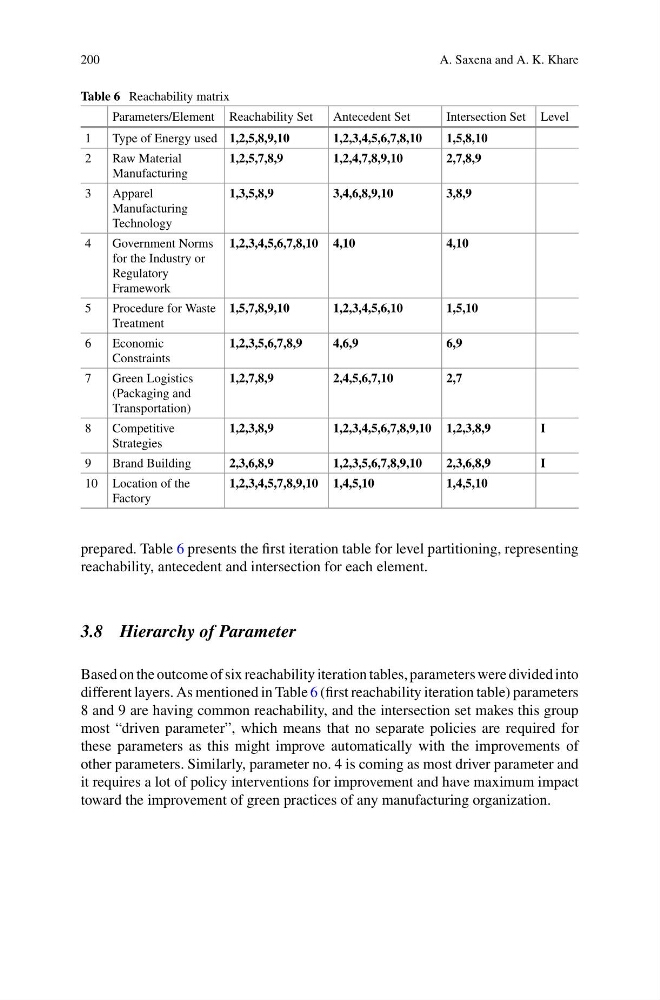
prepared. Table 6 presents the first iteration table for level partitioning, representing
reachability, antecedent and intersection for each element.
3.8 Hierarchy of Parameter
Based on the outcome of six reachability iteration tables, parameters were divided into
different layers. As mentioned in Table 6 (first reachability iteration table) parameters
8 and 9 are having common reachability, and the intersection set makes this group
most “driven parameter”, which means that no separate policies are required for
these parameters as this might improve automatically with the improvements of
other parameters. Similarly, parameter no. 4 is coming as most driver parameter and
it requires a lot of policy interventions for improvement and have maximum impact
toward the improvement of green practices of any manufacturing organization.
A. Saxena and A. K. Khare
Table 6 Reachability matrix
Parameters/Element Reachability Set
Antecedent Set
Intersection Set Level
1
Type of Energy used 1,2,5,8,9,10
1,2,3,4,5,6,7,8,10
1,5,8,10
2
Raw Material
Manufacturing
1,2,5,7,8,9
1,2,4,7,8,9,10
2,7,8,9
3
Apparel
Manufacturing
Technology
1,3,5,8,9
3,4,6,8,9,10
3,8,9
4
Government Norms
for the Industry or
Regulatory
Framework
1,2,3,4,5,6,7,8,10 4,10
4,10
5
Procedure for Waste
Treatment
1,5,7,8,9,10
1,2,3,4,5,6,10
1,5,10
6
Economic
Constraints
1,2,3,5,6,7,8,9
4,6,9
6,9
7
Green Logistics
(Packaging and
Transportation)
1,2,7,8,9
2,4,5,6,7,10
2,7
8
Competitive
Strategies
1,2,3,8,9
1,2,3,4,5,6,7,8,9,10 1,2,3,8,9
I
9
Brand Building
2,3,6,8,9
1,2,3,5,6,7,8,9,10
2,3,6,8,9
I
10 Location of the
Factory
1,2,3,4,5,7,8,9,10 1,4,5,10
1,4,5,10
prepared. Table 6 presents the first iteration table for level partitioning, representing
reachability, antecedent and intersection for each element.
3.8 Hierarchy of Parameter
Based on the outcome of six reachability iteration tables, parameters were divided into
different layers. As mentioned in Table 6 (first reachability iteration table) parameters
8 and 9 are having common reachability, and the intersection set makes this group
most “driven parameter”, which means that no separate policies are required for
these parameters as this might improve automatically with the improvements of
other parameters. Similarly, parameter no. 4 is coming as most driver parameter and
it requires a lot of policy interventions for improvement and have maximum impact
toward the improvement of green practices of any manufacturing organization.