

Developing Organic Fabric from Aquatic Cellulosic Waste
173
2.3.1 Identification of the Fiber Through Microscopic, Burning
and Solubility Tests: Microscopic Test
Longitudinal view of the fibers was observed under the compound microscope with
the magnification of 10× and 45×.
Cross-sectional view of the fiber was tested at Bombay Textile Research Association (BTRA), Ghatkopar Mumbai. For the cross-section, fibers were first coated
in JEC gold-plated twin coater, and cross-sectional view was observed using JSM
scanning electron microscope with the magnification of 50× to 3500×.
Burning test
To recognize the fiber by burning test, the fiber was moved slowly toward the flame
and the reaction of heat was observed. One end of the fiber was put directly into
the flame to determine the burning rate and characteristics. The burning odor was
noticed.
Solubility test
Fibers were treated with acids and alkalies in both hot and cold conditions.
2.3.2 Material Characterization of the Fiber
Chemical constituents of the raw fibers were determined as per the test suggested by
Turner and Doree [8].
2.3.3 Physical Properties of Fiber
Determination of fiber length:
To determine the length of lotus fiber, the fiber was first placed against the dark
surface and the length was measured with the steel ruler. An average of 50 readings
was taken.
Determination of fiber fineness:
Following the ASTM-D 7025-09 standard [9], fiber fineness was tested. Bundle fiber
was taken for testing the fineness. In the direct system of yarn numbering, denier
was determined by taking the average weight of 20 readings of 80 cm length of the
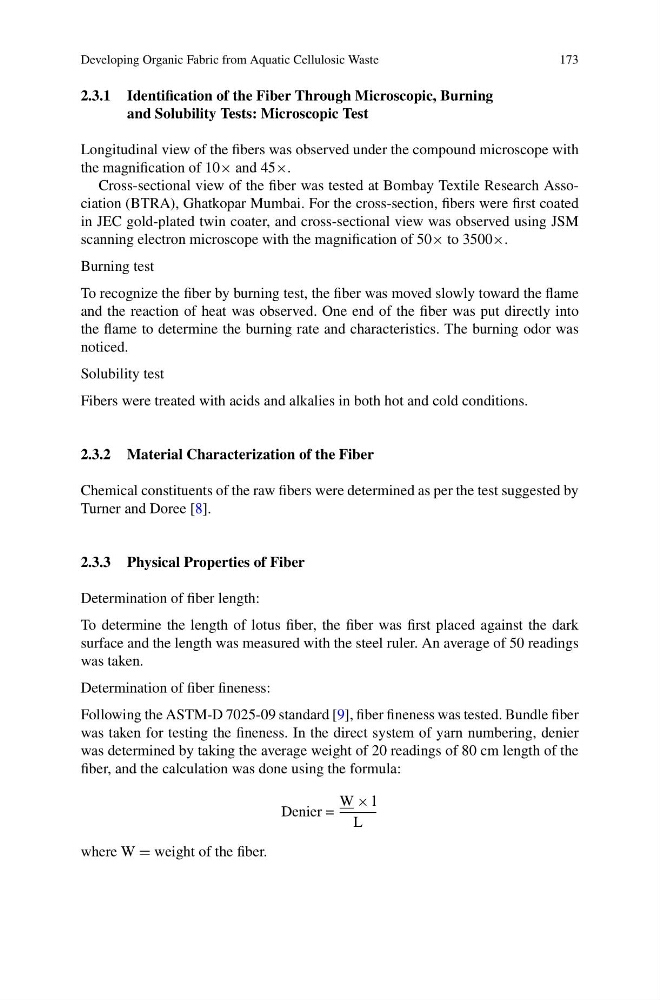
fiber, and the calculation was done using the formula:
Denier =
W × l
L
where W = weight of the fiber.
173
2.3.1 Identification of the Fiber Through Microscopic, Burning
and Solubility Tests: Microscopic Test
Longitudinal view of the fibers was observed under the compound microscope with
the magnification of 10× and 45×.
Cross-sectional view of the fiber was tested at Bombay Textile Research Association (BTRA), Ghatkopar Mumbai. For the cross-section, fibers were first coated
in JEC gold-plated twin coater, and cross-sectional view was observed using JSM
scanning electron microscope with the magnification of 50× to 3500×.
Burning test
To recognize the fiber by burning test, the fiber was moved slowly toward the flame
and the reaction of heat was observed. One end of the fiber was put directly into
the flame to determine the burning rate and characteristics. The burning odor was
noticed.
Solubility test
Fibers were treated with acids and alkalies in both hot and cold conditions.
2.3.2 Material Characterization of the Fiber
Chemical constituents of the raw fibers were determined as per the test suggested by
Turner and Doree [8].
2.3.3 Physical Properties of Fiber
Determination of fiber length:
To determine the length of lotus fiber, the fiber was first placed against the dark
surface and the length was measured with the steel ruler. An average of 50 readings
was taken.
Determination of fiber fineness:
Following the ASTM-D 7025-09 standard [9], fiber fineness was tested. Bundle fiber
was taken for testing the fineness. In the direct system of yarn numbering, denier
was determined by taking the average weight of 20 readings of 80 cm length of the
fiber, and the calculation was done using the formula:
Denier =
W × l
L
where W = weight of the fiber.