

174
M. Sharan and S. Haldar
L = length of the sample
l = unit length of the system
The count of the fibers was also determined by indirect system of yarn numbering
using Beasley’s yarn balance. The instrument consists of hook at one end and a
pointer at the other end. A standard weight (0.040 g) was hung on the notch of the
beam. Template was used to cut the length of fibers based on cotton count system.
The fibers were kept on the hook until the pointer reaches the datum line. The count
is the number of short length filament fibers used to balance the beam.
Determination of fiber diameter:
Compound microscope with micrometer lens was used to measure the fiber diameter.
An average of 50 readings was taken to determine the fiber diameter. Single fiber
from the petiole was taken to test the diameter.
Determination of fiber strength:
Following the ASTM-D 3822-07 standard [10], fiber strength was tested. LLOYD
tensile testing instrument was used. The sample length was 10 cm. The instrument
worked on constant rate of elongation principle (CRE). The capacity of the instrument
was 2500N. Pulling speed was 100 mm/min. Bundle of the fiber was taken from the
petiole for testing the strength.
Moisture testing.
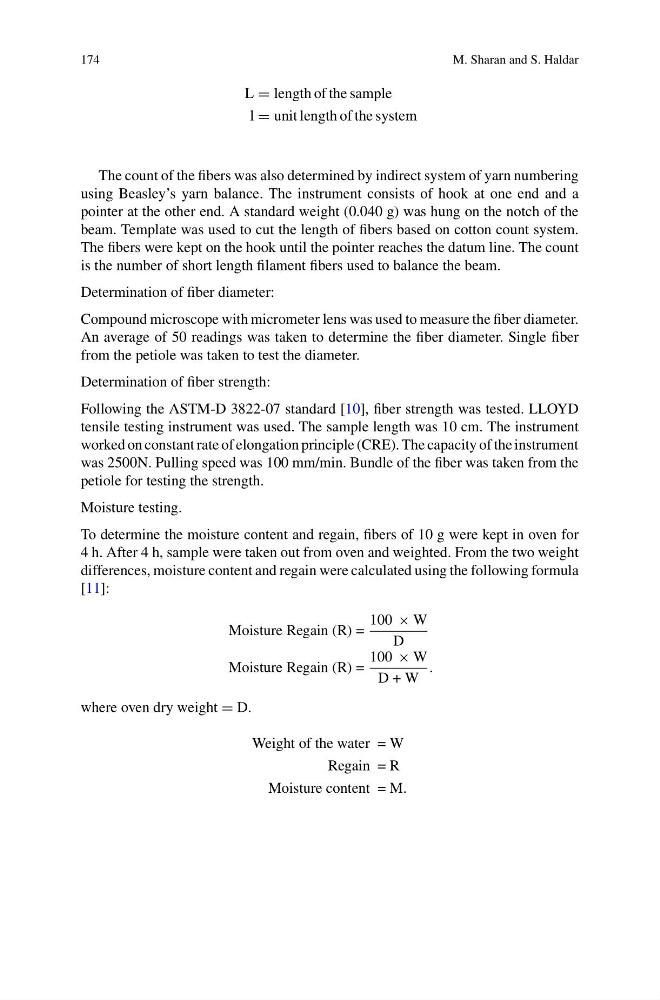
To determine the moisture content and regain, fibers of 10 g were kept in oven for
4 h. After 4 h, sample were taken out from oven and weighted. From the two weight
differences, moisture content and regain were calculated using the following formula
[11]:
Moisture Regain (R) =
100 × W
D
Moisture Regain (R) =
100 × W
D + W
.
where oven dry weight = D.
Weight of the water = W
Regain = R
Moisture content = M.
M. Sharan and S. Haldar
L = length of the sample
l = unit length of the system
The count of the fibers was also determined by indirect system of yarn numbering
using Beasley’s yarn balance. The instrument consists of hook at one end and a
pointer at the other end. A standard weight (0.040 g) was hung on the notch of the
beam. Template was used to cut the length of fibers based on cotton count system.
The fibers were kept on the hook until the pointer reaches the datum line. The count
is the number of short length filament fibers used to balance the beam.
Determination of fiber diameter:
Compound microscope with micrometer lens was used to measure the fiber diameter.
An average of 50 readings was taken to determine the fiber diameter. Single fiber
from the petiole was taken to test the diameter.
Determination of fiber strength:
Following the ASTM-D 3822-07 standard [10], fiber strength was tested. LLOYD
tensile testing instrument was used. The sample length was 10 cm. The instrument
worked on constant rate of elongation principle (CRE). The capacity of the instrument
was 2500N. Pulling speed was 100 mm/min. Bundle of the fiber was taken from the
petiole for testing the strength.
Moisture testing.
To determine the moisture content and regain, fibers of 10 g were kept in oven for
4 h. After 4 h, sample were taken out from oven and weighted. From the two weight
differences, moisture content and regain were calculated using the following formula
[11]:
Moisture Regain (R) =
100 × W
D
Moisture Regain (R) =
100 × W
D + W
.
where oven dry weight = D.
Weight of the water = W
Regain = R
Moisture content = M.