

172
M. Sharan and S. Haldar
from 50 to 115 cm and color varies from light to dark green and spikes were seen on
the surface of petiole.
2.2 Fiber Extraction
Petioles were washed and wiped. It was not possible to extract fibers from single/two
petioles, so a bunch of three petioles was taken and slit into 5–7 sections as per its
length with the help of a sharp knife. After one slit a bunch of three petioles was
slowly stretched and fibers were laid on a wooden slab. End-to-end points were joined
by palm twisting and the yarns were wounded on the pern.
2.3 Fiber Testing
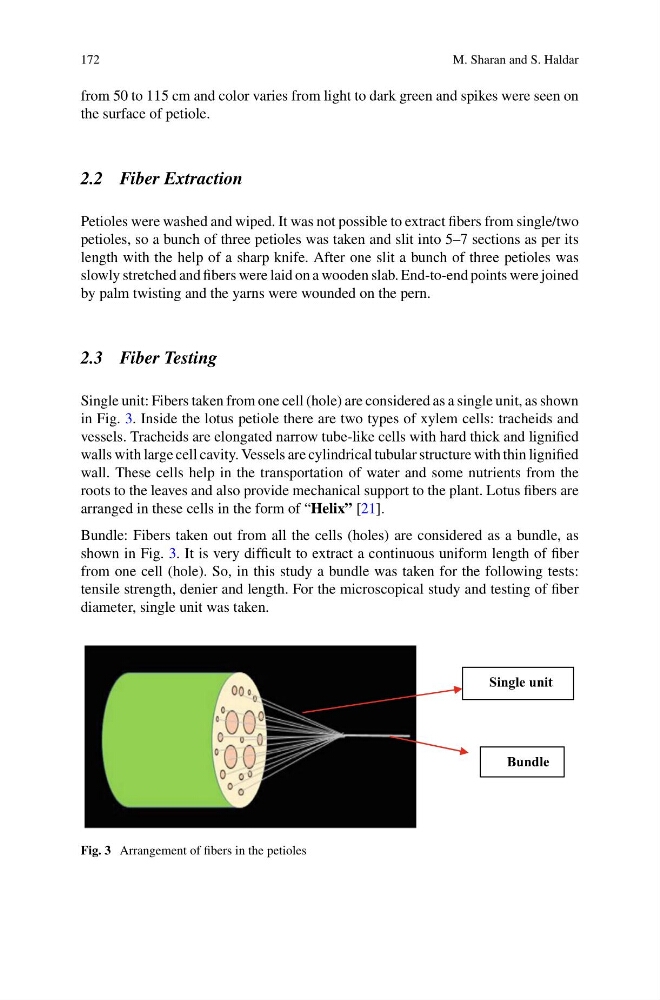
Single unit: Fibers taken from one cell (hole) are considered as a single unit, as shown
in Fig. 3. Inside the lotus petiole there are two types of xylem cells: tracheids and
vessels. Tracheids are elongated narrow tube-like cells with hard thick and lignified
walls with large cell cavity. Vessels are cylindrical tubular structure with thin lignified
wall. These cells help in the transportation of water and some nutrients from the
roots to the leaves and also provide mechanical support to the plant. Lotus fibers are
arranged in these cells in the form of “Helix” [21].
Bundle: Fibers taken out from all the cells (holes) are considered as a bundle, as
shown in Fig. 3. It is very difficult to extract a continuous uniform length of fiber
from one cell (hole). So, in this study a bundle was taken for the following tests:
tensile strength, denier and length. For the microscopical study and testing of fiber
diameter, single unit was taken.
Single unit
Bundle
Fig. 3 Arrangement of fibers in the petioles
M. Sharan and S. Haldar
from 50 to 115 cm and color varies from light to dark green and spikes were seen on
the surface of petiole.
2.2 Fiber Extraction
Petioles were washed and wiped. It was not possible to extract fibers from single/two
petioles, so a bunch of three petioles was taken and slit into 5–7 sections as per its
length with the help of a sharp knife. After one slit a bunch of three petioles was
slowly stretched and fibers were laid on a wooden slab. End-to-end points were joined
by palm twisting and the yarns were wounded on the pern.
2.3 Fiber Testing
Single unit: Fibers taken from one cell (hole) are considered as a single unit, as shown
in Fig. 3. Inside the lotus petiole there are two types of xylem cells: tracheids and
vessels. Tracheids are elongated narrow tube-like cells with hard thick and lignified
walls with large cell cavity. Vessels are cylindrical tubular structure with thin lignified
wall. These cells help in the transportation of water and some nutrients from the
roots to the leaves and also provide mechanical support to the plant. Lotus fibers are
arranged in these cells in the form of “Helix” [21].
Bundle: Fibers taken out from all the cells (holes) are considered as a bundle, as
shown in Fig. 3. It is very difficult to extract a continuous uniform length of fiber
from one cell (hole). So, in this study a bundle was taken for the following tests:
tensile strength, denier and length. For the microscopical study and testing of fiber
diameter, single unit was taken.
Single unit
Bundle
Fig. 3 Arrangement of fibers in the petioles