

164
P. Giri et al.
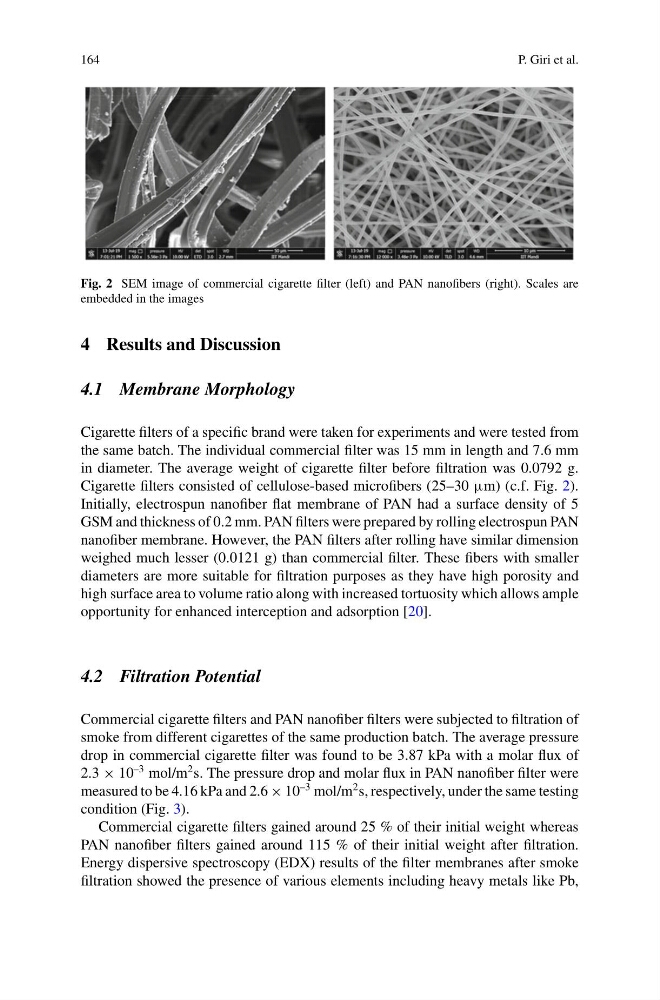
Fig. 2 SEM image of commercial cigarette filter (left) and PAN nanofibers (right). Scales are
embedded in the images
4 Results and Discussion
4.1 Membrane Morphology
Cigarette filters of a specific brand were taken for experiments and were tested from
the same batch. The individual commercial filter was 15 mm in length and 7.6 mm
in diameter. The average weight of cigarette filter before filtration was 0.0792 g.
Cigarette filters consisted of cellulose-based microfibers (25–30 µm) (c.f. Fig. 2).
Initially, electrospun nanofiber flat membrane of PAN had a surface density of 5
GSM and thickness of 0.2 mm. PAN filters were prepared by rolling electrospun PAN
nanofiber membrane. However, the PAN filters after rolling have similar dimension
weighed much lesser (0.0121 g) than commercial filter. These fibers with smaller
diameters are more suitable for filtration purposes as they have high porosity and
high surface area to volume ratio along with increased tortuosity which allows ample
opportunity for enhanced interception and adsorption [20].
4.2 Filtration Potential
Commercial cigarette filters and PAN nanofiber filters were subjected to filtration of
smoke from different cigarettes of the same production batch. The average pressure
drop in commercial cigarette filter was found to be 3.87 kPa with a molar flux of
2.3 × 10
–3 mol/m
2 s. The pressure drop and molar flux in PAN nanofiber filter were
measured to be 4.16 kPa and 2.6 × 10
–3 mol/m
2 s, respectively, under the same testing
condition (Fig. 3).
Commercial cigarette filters gained around 25 % of their initial weight whereas
PAN nanofiber filters gained around 115 % of their initial weight after filtration.
Energy dispersive spectroscopy (EDX) results of the filter membranes after smoke
filtration showed the presence of various elements including heavy metals like Pb,
P. Giri et al.
Fig. 2 SEM image of commercial cigarette filter (left) and PAN nanofibers (right). Scales are
embedded in the images
4 Results and Discussion
4.1 Membrane Morphology
Cigarette filters of a specific brand were taken for experiments and were tested from
the same batch. The individual commercial filter was 15 mm in length and 7.6 mm
in diameter. The average weight of cigarette filter before filtration was 0.0792 g.
Cigarette filters consisted of cellulose-based microfibers (25–30 µm) (c.f. Fig. 2).
Initially, electrospun nanofiber flat membrane of PAN had a surface density of 5
GSM and thickness of 0.2 mm. PAN filters were prepared by rolling electrospun PAN
nanofiber membrane. However, the PAN filters after rolling have similar dimension
weighed much lesser (0.0121 g) than commercial filter. These fibers with smaller
diameters are more suitable for filtration purposes as they have high porosity and
high surface area to volume ratio along with increased tortuosity which allows ample
opportunity for enhanced interception and adsorption [20].
4.2 Filtration Potential
Commercial cigarette filters and PAN nanofiber filters were subjected to filtration of
smoke from different cigarettes of the same production batch. The average pressure
drop in commercial cigarette filter was found to be 3.87 kPa with a molar flux of
2.3 × 10
–3 mol/m
2 s. The pressure drop and molar flux in PAN nanofiber filter were
measured to be 4.16 kPa and 2.6 × 10
–3 mol/m
2 s, respectively, under the same testing
condition (Fig. 3).
Commercial cigarette filters gained around 25 % of their initial weight whereas
PAN nanofiber filters gained around 115 % of their initial weight after filtration.
Energy dispersive spectroscopy (EDX) results of the filter membranes after smoke
filtration showed the presence of various elements including heavy metals like Pb,