

Reuse of Cigarette Filters for Energy Applications
165
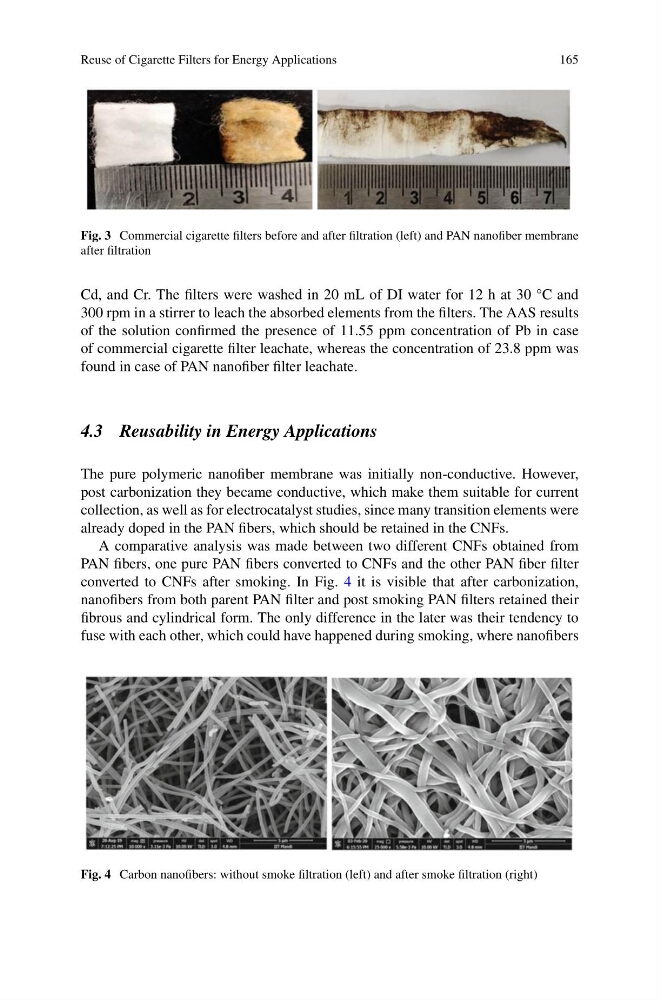
Fig. 3 Commercial cigarette filters before and after filtration (left) and PAN nanofiber membrane
after filtration
Cd, and Cr. The filters were washed in 20 mL of DI water for 12 h at 30 °C and
300 rpm in a stirrer to leach the absorbed elements from the filters. The AAS results
of the solution confirmed the presence of 11.55 ppm concentration of Pb in case
of commercial cigarette filter leachate, whereas the concentration of 23.8 ppm was
found in case of PAN nanofiber filter leachate.
4.3 Reusability in Energy Applications
The pure polymeric nanofiber membrane was initially non-conductive. However,
post carbonization they became conductive, which make them suitable for current
collection, as well as for electrocatalyst studies, since many transition elements were
already doped in the PAN fibers, which should be retained in the CNFs.
A comparative analysis was made between two different CNFs obtained from
PAN fibers, one pure PAN fibers converted to CNFs and the other PAN fiber filter
converted to CNFs after smoking. In Fig. 4 it is visible that after carbonization,
nanofibers from both parent PAN filter and post smoking PAN filters retained their
fibrous and cylindrical form. The only difference in the later was their tendency to
fuse with each other, which could have happened during smoking, where nanofibers
Fig. 4 Carbon nanofibers: without smoke filtration (left) and after smoke filtration (right)
165
Fig. 3 Commercial cigarette filters before and after filtration (left) and PAN nanofiber membrane
after filtration
Cd, and Cr. The filters were washed in 20 mL of DI water for 12 h at 30 °C and
300 rpm in a stirrer to leach the absorbed elements from the filters. The AAS results
of the solution confirmed the presence of 11.55 ppm concentration of Pb in case
of commercial cigarette filter leachate, whereas the concentration of 23.8 ppm was
found in case of PAN nanofiber filter leachate.
4.3 Reusability in Energy Applications
The pure polymeric nanofiber membrane was initially non-conductive. However,
post carbonization they became conductive, which make them suitable for current
collection, as well as for electrocatalyst studies, since many transition elements were
already doped in the PAN fibers, which should be retained in the CNFs.
A comparative analysis was made between two different CNFs obtained from
PAN fibers, one pure PAN fibers converted to CNFs and the other PAN fiber filter
converted to CNFs after smoking. In Fig. 4 it is visible that after carbonization,
nanofibers from both parent PAN filter and post smoking PAN filters retained their
fibrous and cylindrical form. The only difference in the later was their tendency to
fuse with each other, which could have happened during smoking, where nanofibers
Fig. 4 Carbon nanofibers: without smoke filtration (left) and after smoke filtration (right)