

142
K. Mishra and E. Dedhia
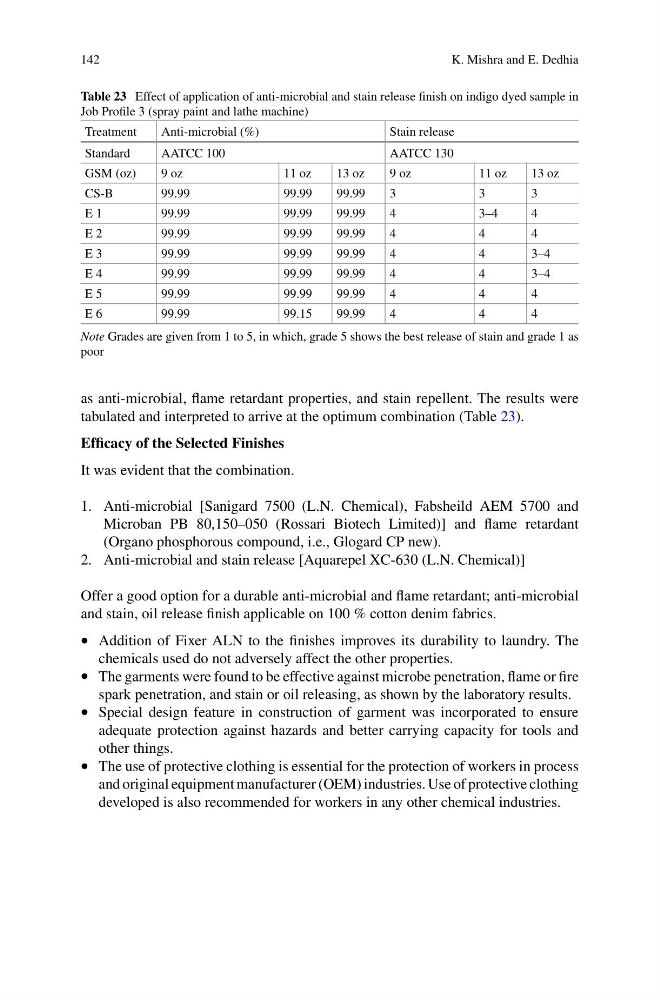
Table 23 Effect of application of anti-microbial and stain release finish on indigo dyed sample in
Job Profile 3 (spray paint and lathe machine)
Treatment
Anti-microbial (%)
Stain release
Standard
AATCC 100
AATCC 130
GSM (oz)
9 oz
11 oz
13 oz
9 oz
11 oz
13 oz
CS-B
99.99
99.99
99.99
3
3
3
E 1
99.99
99.99
99.99
4
3–4
4
E 2
99.99
99.99
99.99
4
4
4
E 3
99.99
99.99
99.99
4
4
3–4
E 4
99.99
99.99
99.99
4
4
3–4
E 5
99.99
99.99
99.99
4
4
4
E 6
99.99
99.15
99.99
4
4
4
Note Grades are given from 1 to 5, in which, grade 5 shows the best release of stain and grade 1 as
poor
as anti-microbial, flame retardant properties, and stain repellent. The results were
tabulated and interpreted to arrive at the optimum combination (Table 23).
Efficacy of the Selected Finishes
It was evident that the combination.
1. Anti-microbial [Sanigard 7500 (L.N. Chemical), Fabsheild AEM 5700 and
Microban PB 80,150–050 (Rossari Biotech Limited)] and flame retardant
(Organo phosphorous compound, i.e., Glogard CP new).
2. Anti-microbial and stain release [Aquarepel XC-630 (L.N. Chemical)]
Offer a good option for a durable anti-microbial and flame retardant; anti-microbial
and stain, oil release finish applicable on 100 % cotton denim fabrics.
• Addition of Fixer ALN to the finishes improves its durability to laundry. The
chemicals used do not adversely affect the other properties.
• The garments were found to be effective against microbe penetration, flame or fire
spark penetration, and stain or oil releasing, as shown by the laboratory results.
• Special design feature in construction of garment was incorporated to ensure
adequate protection against hazards and better carrying capacity for tools and
other things.
• The use of protective clothing is essential for the protection of workers in process
and original equipment manufacturer (OEM) industries. Use of protective clothing
developed is also recommended for workers in any other chemical industries.
K. Mishra and E. Dedhia
Table 23 Effect of application of anti-microbial and stain release finish on indigo dyed sample in
Job Profile 3 (spray paint and lathe machine)
Treatment
Anti-microbial (%)
Stain release
Standard
AATCC 100
AATCC 130
GSM (oz)
9 oz
11 oz
13 oz
9 oz
11 oz
13 oz
CS-B
99.99
99.99
99.99
3
3
3
E 1
99.99
99.99
99.99
4
3–4
4
E 2
99.99
99.99
99.99
4
4
4
E 3
99.99
99.99
99.99
4
4
3–4
E 4
99.99
99.99
99.99
4
4
3–4
E 5
99.99
99.99
99.99
4
4
4
E 6
99.99
99.15
99.99
4
4
4
Note Grades are given from 1 to 5, in which, grade 5 shows the best release of stain and grade 1 as
poor
as anti-microbial, flame retardant properties, and stain repellent. The results were
tabulated and interpreted to arrive at the optimum combination (Table 23).
Efficacy of the Selected Finishes
It was evident that the combination.
1. Anti-microbial [Sanigard 7500 (L.N. Chemical), Fabsheild AEM 5700 and
Microban PB 80,150–050 (Rossari Biotech Limited)] and flame retardant
(Organo phosphorous compound, i.e., Glogard CP new).
2. Anti-microbial and stain release [Aquarepel XC-630 (L.N. Chemical)]
Offer a good option for a durable anti-microbial and flame retardant; anti-microbial
and stain, oil release finish applicable on 100 % cotton denim fabrics.
• Addition of Fixer ALN to the finishes improves its durability to laundry. The
chemicals used do not adversely affect the other properties.
• The garments were found to be effective against microbe penetration, flame or fire
spark penetration, and stain or oil releasing, as shown by the laboratory results.
• Special design feature in construction of garment was incorporated to ensure
adequate protection against hazards and better carrying capacity for tools and
other things.
• The use of protective clothing is essential for the protection of workers in process
and original equipment manufacturer (OEM) industries. Use of protective clothing
developed is also recommended for workers in any other chemical industries.