

Application of Protective Finishes on Denim and Analysis …
141
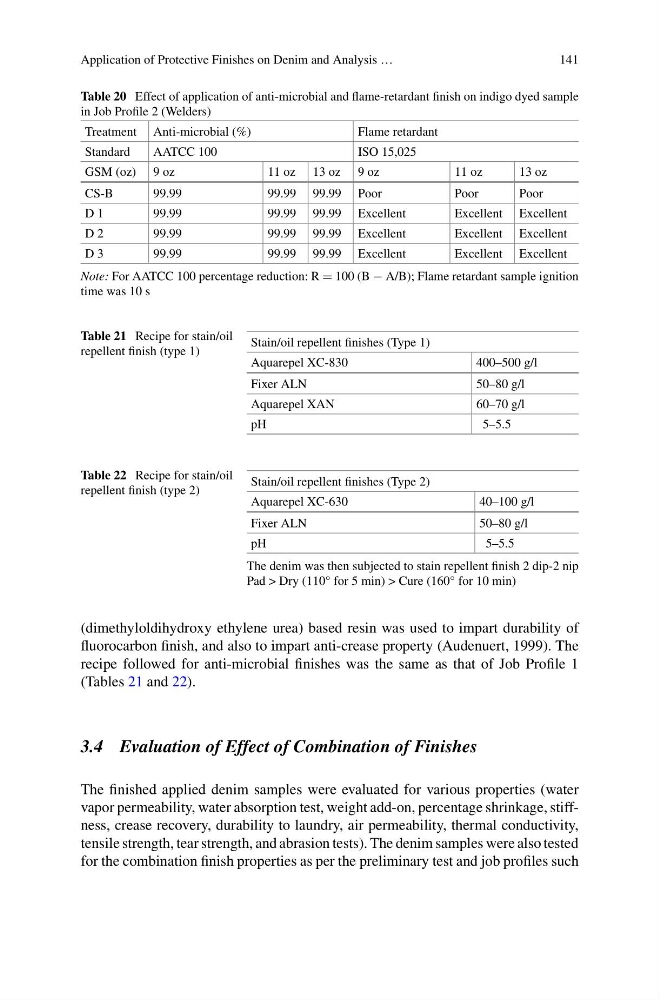
Table 20 Effect of application of anti-microbial and flame-retardant finish on indigo dyed sample
in Job Profile 2 (Welders)
Treatment Anti-microbial (%)
Flame retardant
Standard
AATCC 100
ISO 15,025
GSM (oz) 9 oz
11 oz 13 oz 9 oz
11 oz
13 oz
CS-B
99.99
99.99 99.99 Poor
Poor
Poor
D 1
99.99
99.99 99.99 Excellent
Excellent Excellent
D 2
99.99
99.99 99.99 Excellent
Excellent Excellent
D 3
99.99
99.99 99.99 Excellent
Excellent Excellent
Note: For AATCC 100 percentage reduction: R = 100 (B − A/B); Flame retardant sample ignition
time was 10 s
Table 21 Recipe for stain/oil
repellent finish (type 1)
Stain/oil repellent finishes (Type 1)
Aquarepel XC-830
400–500 g/l
Fixer ALN
50–80 g/l
Aquarepel XAN
60–70 g/l
pH
5–5.5
Table 22 Recipe for stain/oil
repellent finish (type 2)
Stain/oil repellent finishes (Type 2)
Aquarepel XC-630
40–100 g/l
Fixer ALN
50–80 g/l
pH
5–5.5
The denim was then subjected to stain repellent finish 2 dip-2 nip
Pad > Dry (110° for 5 min) > Cure (160° for 10 min)
(dimethyloldihydroxy ethylene urea) based resin was used to impart durability of
fluorocarbon finish, and also to impart anti-crease property (Audenuert, 1999). The
recipe followed for anti-microbial finishes was the same as that of Job Profile 1
(Tables 21 and 22).
3.4 Evaluation of Effect of Combination of Finishes
The finished applied denim samples were evaluated for various properties (water
vapor permeability, water absorption test, weight add-on, percentage shrinkage, stiffness, crease recovery, durability to laundry, air permeability, thermal conductivity,
tensile strength, tear strength, and abrasion tests). The denim samples were also tested
for the combination finish properties as per the preliminary test and job profiles such
141
Table 20 Effect of application of anti-microbial and flame-retardant finish on indigo dyed sample
in Job Profile 2 (Welders)
Treatment Anti-microbial (%)
Flame retardant
Standard
AATCC 100
ISO 15,025
GSM (oz) 9 oz
11 oz 13 oz 9 oz
11 oz
13 oz
CS-B
99.99
99.99 99.99 Poor
Poor
Poor
D 1
99.99
99.99 99.99 Excellent
Excellent Excellent
D 2
99.99
99.99 99.99 Excellent
Excellent Excellent
D 3
99.99
99.99 99.99 Excellent
Excellent Excellent
Note: For AATCC 100 percentage reduction: R = 100 (B − A/B); Flame retardant sample ignition
time was 10 s
Table 21 Recipe for stain/oil
repellent finish (type 1)
Stain/oil repellent finishes (Type 1)
Aquarepel XC-830
400–500 g/l
Fixer ALN
50–80 g/l
Aquarepel XAN
60–70 g/l
pH
5–5.5
Table 22 Recipe for stain/oil
repellent finish (type 2)
Stain/oil repellent finishes (Type 2)
Aquarepel XC-630
40–100 g/l
Fixer ALN
50–80 g/l
pH
5–5.5
The denim was then subjected to stain repellent finish 2 dip-2 nip
Pad > Dry (110° for 5 min) > Cure (160° for 10 min)
(dimethyloldihydroxy ethylene urea) based resin was used to impart durability of
fluorocarbon finish, and also to impart anti-crease property (Audenuert, 1999). The
recipe followed for anti-microbial finishes was the same as that of Job Profile 1
(Tables 21 and 22).
3.4 Evaluation of Effect of Combination of Finishes
The finished applied denim samples were evaluated for various properties (water
vapor permeability, water absorption test, weight add-on, percentage shrinkage, stiffness, crease recovery, durability to laundry, air permeability, thermal conductivity,
tensile strength, tear strength, and abrasion tests). The denim samples were also tested
for the combination finish properties as per the preliminary test and job profiles such