

140
K. Mishra and E. Dedhia
Table 18 Concentration in
recipe for anti-microbial
finishes
Anti-microbial
finishes
Concentration (% o.w.f.)
Fabric weight
9 oz
11 oz
13 oz
Sanigard-7500
0.5
1
2
Microban PB
80,150–050
0.5
1
2
Fabshield AEM
7500
0.5
1
2
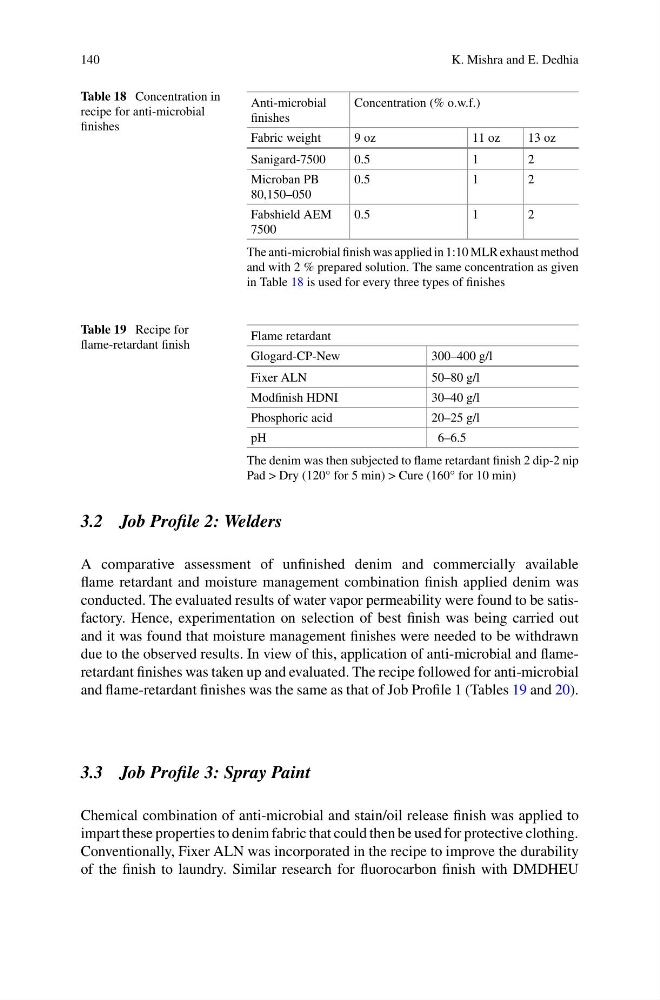
The anti-microbial finish was applied in 1:10 MLR exhaust method
and with 2 % prepared solution. The same concentration as given
in Table 18 is used for every three types of finishes
Table 19 Recipe for
flame-retardant finish
Flame retardant
Glogard-CP-New
300–400 g/l
Fixer ALN
50–80 g/l
Modfinish HDNI
30–40 g/l
Phosphoric acid
20–25 g/l
pH
6–6.5
The denim was then subjected to flame retardant finish 2 dip-2 nip
Pad > Dry (120° for 5 min) > Cure (160° for 10 min)
3.2 Job Profile 2: Welders
A comparative assessment of unfinished denim and commercially available
flame retardant and moisture management combination finish applied denim was
conducted. The evaluated results of water vapor permeability were found to be satisfactory. Hence, experimentation on selection of best finish was being carried out
and it was found that moisture management finishes were needed to be withdrawn
due to the observed results. In view of this, application of anti-microbial and flameretardant finishes was taken up and evaluated. The recipe followed for anti-microbial
and flame-retardant finishes was the same as that of Job Profile 1 (Tables 19 and 20).
3.3 Job Profile 3: Spray Paint
Chemical combination of anti-microbial and stain/oil release finish was applied to
impart these properties to denim fabric that could then be used for protective clothing.
Conventionally, Fixer ALN was incorporated in the recipe to improve the durability
of the finish to laundry. Similar research for fluorocarbon finish with DMDHEU
K. Mishra and E. Dedhia
Table 18 Concentration in
recipe for anti-microbial
finishes
Anti-microbial
finishes
Concentration (% o.w.f.)
Fabric weight
9 oz
11 oz
13 oz
Sanigard-7500
0.5
1
2
Microban PB
80,150–050
0.5
1
2
Fabshield AEM
7500
0.5
1
2
The anti-microbial finish was applied in 1:10 MLR exhaust method
and with 2 % prepared solution. The same concentration as given
in Table 18 is used for every three types of finishes
Table 19 Recipe for
flame-retardant finish
Flame retardant
Glogard-CP-New
300–400 g/l
Fixer ALN
50–80 g/l
Modfinish HDNI
30–40 g/l
Phosphoric acid
20–25 g/l
pH
6–6.5
The denim was then subjected to flame retardant finish 2 dip-2 nip
Pad > Dry (120° for 5 min) > Cure (160° for 10 min)
3.2 Job Profile 2: Welders
A comparative assessment of unfinished denim and commercially available
flame retardant and moisture management combination finish applied denim was
conducted. The evaluated results of water vapor permeability were found to be satisfactory. Hence, experimentation on selection of best finish was being carried out
and it was found that moisture management finishes were needed to be withdrawn
due to the observed results. In view of this, application of anti-microbial and flameretardant finishes was taken up and evaluated. The recipe followed for anti-microbial
and flame-retardant finishes was the same as that of Job Profile 1 (Tables 19 and 20).
3.3 Job Profile 3: Spray Paint
Chemical combination of anti-microbial and stain/oil release finish was applied to
impart these properties to denim fabric that could then be used for protective clothing.
Conventionally, Fixer ALN was incorporated in the recipe to improve the durability
of the finish to laundry. Similar research for fluorocarbon finish with DMDHEU