

Experimental Investigation on Geometric Error …
87
angle have depth of 50 mm. From preliminary tests and observations, it is seen that
the bending is more in the top region of pyramid. This is due to absence of proper
support to the sheet. This contributes in severe geometric error.
To overcome this, a height allowance of (say 10–20 mm) from top of square
pyramid is considered. Thus, the effective height of 52.5° wall angle square pyramid
is around 40 mm. Minor post-processing work may be required to cut maximum
bending region from the formed part. This facilitates the removal of bending zone
which contributes in geometric error. This is done by designing the part geometry in
such a way that after cutting the bending region, cut-out part is the desired part with
required dimensions (i.e., by considering height allowance). This extra 10–12 mm
height can be removed with the help of abrasive water jet machining, wire electro
discharge machining, or laser machining process.
3 Results and Discussion
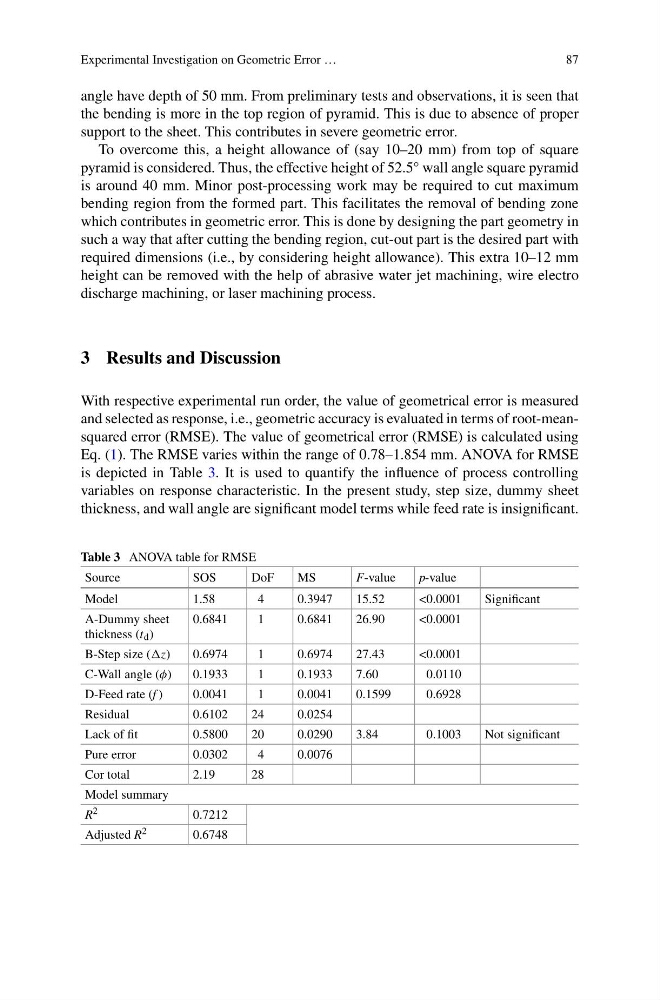
With respective experimental run order, the value of geometrical error is measured
and selected as response, i.e., geometric accuracy is evaluated in terms of root-meansquared error (RMSE). The value of geometrical error (RMSE) is calculated using
Eq. (1). The RMSE varies within the range of 0.78–1.854 mm. ANOVA for RMSE
is depicted in Table 3. It is used to quantify the influence of process controlling
variables on response characteristic. In the present study, step size, dummy sheet
thickness, and wall angle are significant model terms while feed rate is insignificant.
Table 3 ANOVA table for RMSE
Source
SOS
DoF
MS
F-value
p-value
Model
1.58
4
0.3947
15.52
<0.0001
Significant
A-Dummy sheet
thickness (t d )
0.6841
1
0.6841
26.90
<0.0001
B-Step size (z)
0.6974
1
0.6974
27.43
<0.0001
C-Wall angle (φ)
0.1933
1
0.1933
7.60
0.0110
D-Feed rate (f )
0.0041
1
0.0041
0.1599
0.6928
Residual
0.6102
24
0.0254
Lack of fit
0.5800
20
0.0290
3.84
0.1003
Not significant
Pure error
0.0302
4
0.0076
Cor total
2.19
28
Model summary
R 2
0.7212
Adjusted R 2
0.6748
87
angle have depth of 50 mm. From preliminary tests and observations, it is seen that
the bending is more in the top region of pyramid. This is due to absence of proper
support to the sheet. This contributes in severe geometric error.
To overcome this, a height allowance of (say 10–20 mm) from top of square
pyramid is considered. Thus, the effective height of 52.5° wall angle square pyramid
is around 40 mm. Minor post-processing work may be required to cut maximum
bending region from the formed part. This facilitates the removal of bending zone
which contributes in geometric error. This is done by designing the part geometry in
such a way that after cutting the bending region, cut-out part is the desired part with
required dimensions (i.e., by considering height allowance). This extra 10–12 mm
height can be removed with the help of abrasive water jet machining, wire electro
discharge machining, or laser machining process.
3 Results and Discussion
With respective experimental run order, the value of geometrical error is measured
and selected as response, i.e., geometric accuracy is evaluated in terms of root-meansquared error (RMSE). The value of geometrical error (RMSE) is calculated using
Eq. (1). The RMSE varies within the range of 0.78–1.854 mm. ANOVA for RMSE
is depicted in Table 3. It is used to quantify the influence of process controlling
variables on response characteristic. In the present study, step size, dummy sheet
thickness, and wall angle are significant model terms while feed rate is insignificant.
Table 3 ANOVA table for RMSE
Source
SOS
DoF
MS
F-value
p-value
Model
1.58
4
0.3947
15.52
<0.0001
Significant
A-Dummy sheet
thickness (t d )
0.6841
1
0.6841
26.90
<0.0001
B-Step size (z)
0.6974
1
0.6974
27.43
<0.0001
C-Wall angle (φ)
0.1933
1
0.1933
7.60
0.0110
D-Feed rate (f )
0.0041
1
0.0041
0.1599
0.6928
Residual
0.6102
24
0.0254
Lack of fit
0.5800
20
0.0290
3.84
0.1003
Not significant
Pure error
0.0302
4
0.0076
Cor total
2.19
28
Model summary
R 2
0.7212
Adjusted R 2
0.6748