

Assessment of Local Pressure Coefficient …
327
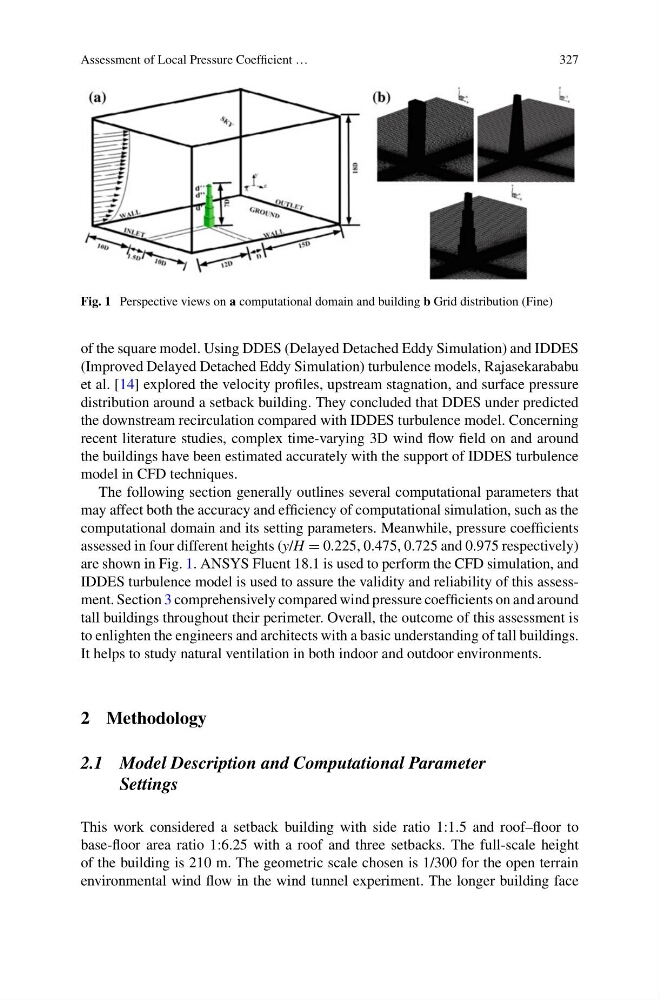
Fig. 1 Perspective views on a computational domain and building b Grid distribution (Fine)
of the square model. Using DDES (Delayed Detached Eddy Simulation) and IDDES
(Improved Delayed Detached Eddy Simulation) turbulence models, Rajasekarababu
et al. [14] explored the velocity profiles, upstream stagnation, and surface pressure
distribution around a setback building. They concluded that DDES under predicted
the downstream recirculation compared with IDDES turbulence model. Concerning
recent literature studies, complex time-varying 3D wind flow field on and around
the buildings have been estimated accurately with the support of IDDES turbulence
model in CFD techniques.
The following section generally outlines several computational parameters that
may affect both the accuracy and efficiency of computational simulation, such as the
computational domain and its setting parameters. Meanwhile, pressure coefficients
assessed in four different heights (y/H = 0.225, 0.475, 0.725 and 0.975 respectively)
are shown in Fig. 1. ANSYS Fluent 18.1 is used to perform the CFD simulation, and
IDDES turbulence model is used to assure the validity and reliability of this assessment. Section 3 comprehensively compared wind pressure coefficients on and around
tall buildings throughout their perimeter. Overall, the outcome of this assessment is
to enlighten the engineers and architects with a basic understanding of tall buildings.
It helps to study natural ventilation in both indoor and outdoor environments.
2 Methodology
2.1 Model Description and Computational Parameter
Settings
This work considered a setback building with side ratio 1:1.5 and roof–floor to
base-floor area ratio 1:6.25 with a roof and three setbacks. The full-scale height
of the building is 210 m. The geometric scale chosen is 1/300 for the open terrain
environmental wind flow in the wind tunnel experiment. The longer building face
327
Fig. 1 Perspective views on a computational domain and building b Grid distribution (Fine)
of the square model. Using DDES (Delayed Detached Eddy Simulation) and IDDES
(Improved Delayed Detached Eddy Simulation) turbulence models, Rajasekarababu
et al. [14] explored the velocity profiles, upstream stagnation, and surface pressure
distribution around a setback building. They concluded that DDES under predicted
the downstream recirculation compared with IDDES turbulence model. Concerning
recent literature studies, complex time-varying 3D wind flow field on and around
the buildings have been estimated accurately with the support of IDDES turbulence
model in CFD techniques.
The following section generally outlines several computational parameters that
may affect both the accuracy and efficiency of computational simulation, such as the
computational domain and its setting parameters. Meanwhile, pressure coefficients
assessed in four different heights (y/H = 0.225, 0.475, 0.725 and 0.975 respectively)
are shown in Fig. 1. ANSYS Fluent 18.1 is used to perform the CFD simulation, and
IDDES turbulence model is used to assure the validity and reliability of this assessment. Section 3 comprehensively compared wind pressure coefficients on and around
tall buildings throughout their perimeter. Overall, the outcome of this assessment is
to enlighten the engineers and architects with a basic understanding of tall buildings.
It helps to study natural ventilation in both indoor and outdoor environments.
2 Methodology
2.1 Model Description and Computational Parameter
Settings
This work considered a setback building with side ratio 1:1.5 and roof–floor to
base-floor area ratio 1:6.25 with a roof and three setbacks. The full-scale height
of the building is 210 m. The geometric scale chosen is 1/300 for the open terrain
environmental wind flow in the wind tunnel experiment. The longer building face