

326
K. B. Rajasekarababu and G. Vinayagamurthy
1 Introduction
In developed countries, there is an extensive emergence of tall structures. They are
highly sensitive to the action of wind force which is a challenging task for the structural engineers and architects terms of habitability, serviceability, and survivability.
And the assurance of essential structural performance also becomes difficult to vindicate. The influence of the intensity of the strong wind excitation on tall buildings is
effectively felt on adjacent buildings and wind environments outdoor. It inevitably
affects wind acceleration at the ground level, wind noise, vegetation and the comfort
of the pedestrian. Wind tunnel testing and field investigations are the two notable
methods used to investigate and study the wind flow around the buildings. Both
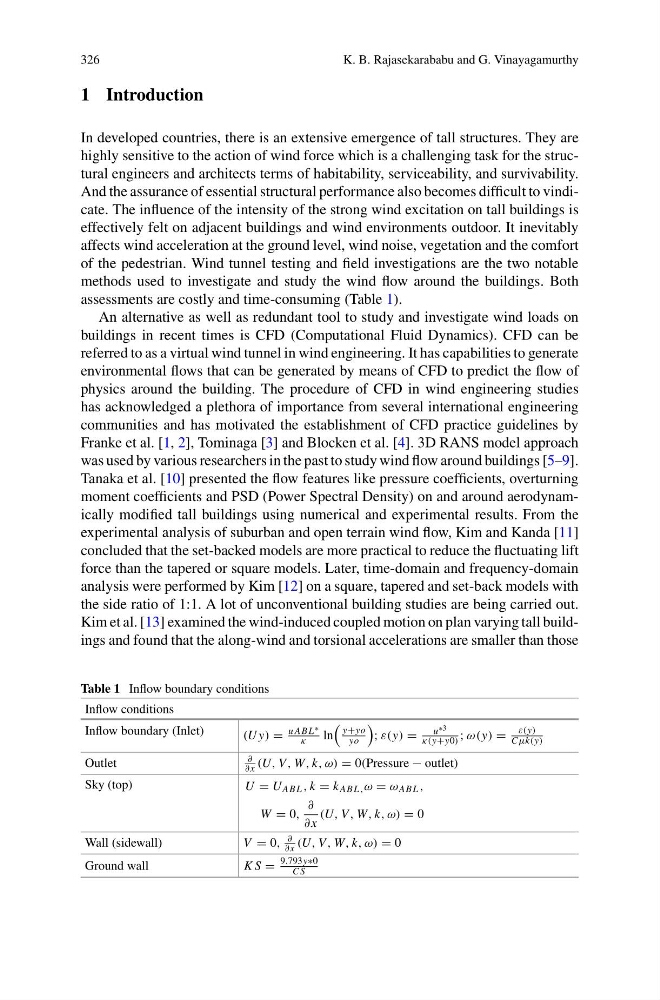
assessments are costly and time-consuming (Table 1).
An alternative as well as redundant tool to study and investigate wind loads on
buildings in recent times is CFD (Computational Fluid Dynamics). CFD can be
referred to as a virtual wind tunnel in wind engineering. It has capabilities to generate
environmental flows that can be generated by means of CFD to predict the flow of
physics around the building. The procedure of CFD in wind engineering studies
has acknowledged a plethora of importance from several international engineering
communities and has motivated the establishment of CFD practice guidelines by
Franke et al. [1, 2], Tominaga [3] and Blocken et al. [4]. 3D RANS model approach
was used by various researchers in the past to study wind flow around buildings [5–9].
Tanaka et al. [10] presented the flow features like pressure coefficients, overturning
moment coefficients and PSD (Power Spectral Density) on and around aerodynamically modified tall buildings using numerical and experimental results. From the
experimental analysis of suburban and open terrain wind flow, Kim and Kanda [11]
concluded that the set-backed models are more practical to reduce the fluctuating lift
force than the tapered or square models. Later, time-domain and frequency-domain
analysis were performed by Kim [12] on a square, tapered and set-back models with
the side ratio of 1:1. A lot of unconventional building studies are being carried out.
Kim et al. [13] examined the wind-induced coupled motion on plan varying tall buildings and found that the along-wind and torsional accelerations are smaller than those
Table 1 Inflow boundary conditions
Inflow conditions
Inflow boundary (Inlet)
(U y) =
u ABL ∗
κ
ln
y+yo
yo
; ε(y) =
u ∗3
κ(y+y0) ; ω(y) =
ε(y)
Cμk(y)
Outlet
∂
∂ x (U, V, W, k, ω) = 0(Pressure − outlet)
Sky (top)
U = U AB L , k = k AB L, ω = ω AB L ,
W = 0,
∂
∂ x
(U, V, W, k, ω) = 0
Wall (sidewall)
V = 0,
∂
∂ x (U, V, W, k, ω) = 0
Ground wall
K S =
9.793y∗0
C S
K. B. Rajasekarababu and G. Vinayagamurthy
1 Introduction
In developed countries, there is an extensive emergence of tall structures. They are
highly sensitive to the action of wind force which is a challenging task for the structural engineers and architects terms of habitability, serviceability, and survivability.
And the assurance of essential structural performance also becomes difficult to vindicate. The influence of the intensity of the strong wind excitation on tall buildings is
effectively felt on adjacent buildings and wind environments outdoor. It inevitably
affects wind acceleration at the ground level, wind noise, vegetation and the comfort
of the pedestrian. Wind tunnel testing and field investigations are the two notable
methods used to investigate and study the wind flow around the buildings. Both
assessments are costly and time-consuming (Table 1).
An alternative as well as redundant tool to study and investigate wind loads on
buildings in recent times is CFD (Computational Fluid Dynamics). CFD can be
referred to as a virtual wind tunnel in wind engineering. It has capabilities to generate
environmental flows that can be generated by means of CFD to predict the flow of
physics around the building. The procedure of CFD in wind engineering studies
has acknowledged a plethora of importance from several international engineering
communities and has motivated the establishment of CFD practice guidelines by
Franke et al. [1, 2], Tominaga [3] and Blocken et al. [4]. 3D RANS model approach
was used by various researchers in the past to study wind flow around buildings [5–9].
Tanaka et al. [10] presented the flow features like pressure coefficients, overturning
moment coefficients and PSD (Power Spectral Density) on and around aerodynamically modified tall buildings using numerical and experimental results. From the
experimental analysis of suburban and open terrain wind flow, Kim and Kanda [11]
concluded that the set-backed models are more practical to reduce the fluctuating lift
force than the tapered or square models. Later, time-domain and frequency-domain
analysis were performed by Kim [12] on a square, tapered and set-back models with
the side ratio of 1:1. A lot of unconventional building studies are being carried out.
Kim et al. [13] examined the wind-induced coupled motion on plan varying tall buildings and found that the along-wind and torsional accelerations are smaller than those
Table 1 Inflow boundary conditions
Inflow conditions
Inflow boundary (Inlet)
(U y) =
u ABL ∗
κ
ln
y+yo
yo
; ε(y) =
u ∗3
κ(y+y0) ; ω(y) =
ε(y)
Cμk(y)
Outlet
∂
∂ x (U, V, W, k, ω) = 0(Pressure − outlet)
Sky (top)
U = U AB L , k = k AB L, ω = ω AB L ,
W = 0,
∂
∂ x
(U, V, W, k, ω) = 0
Wall (sidewall)
V = 0,
∂
∂ x (U, V, W, k, ω) = 0
Ground wall
K S =
9.793y∗0
C S