

96
L. Prabhu et al.
p nsr (M) =
1 +
2γ ×
M
2
− 1
γ + 1
−1
(4)
PRC(M) =
1 +
2γ ×
M
2
s
− 1
γ + 1
−
1
γ −1
×
M
2
s (γ + 1)
(γ − 1)M 2
s + 2
γ
γ −1
(5)
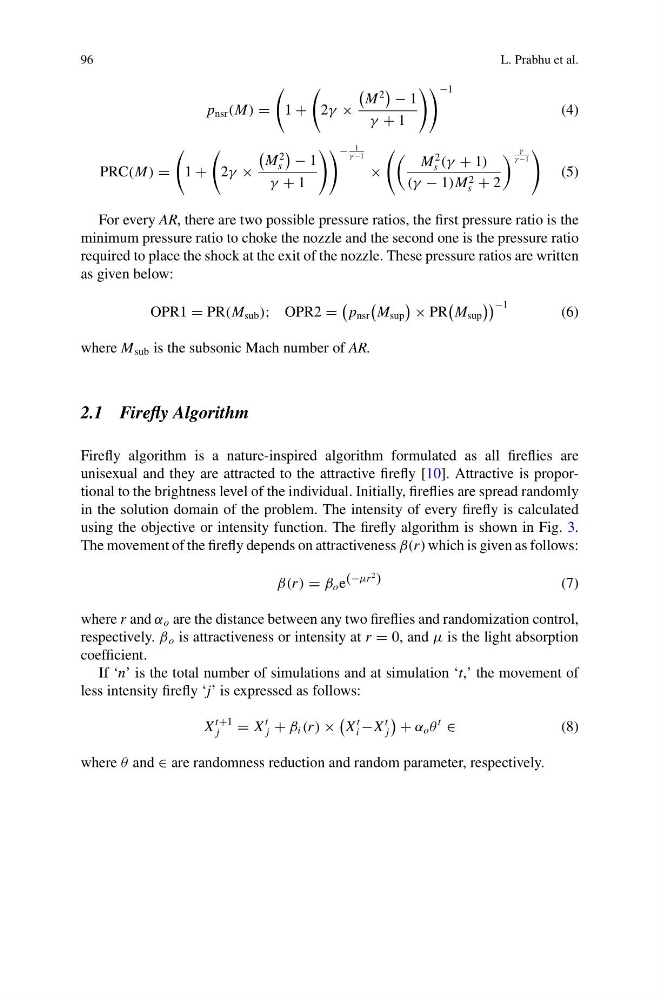
For every AR, there are two possible pressure ratios, the first pressure ratio is the
minimum pressure ratio to choke the nozzle and the second one is the pressure ratio
required to place the shock at the exit of the nozzle. These pressure ratios are written
as given below:
OPR1 = PR(M sub ); OPR2 =
p nsr
M sup
× PR
M sup
−1
(6)
where M sub is the subsonic Mach number of AR.
2.1 Firefly Algorithm
Firefly algorithm is a nature-inspired algorithm formulated as all fireflies are
unisexual and they are attracted to the attractive firefly [10]. Attractive is proportional to the brightness level of the individual. Initially, fireflies are spread randomly
in the solution domain of the problem. The intensity of every firefly is calculated
using the objective or intensity function. The firefly algorithm is shown in Fig. 3.
The movement of the firefly depends on attractiveness β(r) which is given as follows:
β(r ) = β o e (−μr
2
)
(7)
where r and α o are the distance between any two fireflies and randomization control,
respectively. β o is attractiveness or intensity at r = 0, and μ is the light absorption
coefficient.
If ‘n’ is the total number of simulations and at simulation ‘t,’ the movement of
less intensity firefly ‘j’ is expressed as follows:
X
t+1
j
= X
t
j + β i (r ) ×
X
t
i −X
t
j
+ α o θ
t
∈
(8)
where θ and ∈ are randomness reduction and random parameter, respectively.
L. Prabhu et al.
p nsr (M) =
1 +
2γ ×
M
2
− 1
γ + 1
−1
(4)
PRC(M) =
1 +
2γ ×
M
2
s
− 1
γ + 1
−
1
γ −1
×
M
2
s (γ + 1)
(γ − 1)M 2
s + 2
γ
γ −1
(5)
For every AR, there are two possible pressure ratios, the first pressure ratio is the
minimum pressure ratio to choke the nozzle and the second one is the pressure ratio
required to place the shock at the exit of the nozzle. These pressure ratios are written
as given below:
OPR1 = PR(M sub ); OPR2 =
p nsr
M sup
× PR
M sup
−1
(6)
where M sub is the subsonic Mach number of AR.
2.1 Firefly Algorithm
Firefly algorithm is a nature-inspired algorithm formulated as all fireflies are
unisexual and they are attracted to the attractive firefly [10]. Attractive is proportional to the brightness level of the individual. Initially, fireflies are spread randomly
in the solution domain of the problem. The intensity of every firefly is calculated
using the objective or intensity function. The firefly algorithm is shown in Fig. 3.
The movement of the firefly depends on attractiveness β(r) which is given as follows:
β(r ) = β o e (−μr
2
)
(7)
where r and α o are the distance between any two fireflies and randomization control,
respectively. β o is attractiveness or intensity at r = 0, and μ is the light absorption
coefficient.
If ‘n’ is the total number of simulations and at simulation ‘t,’ the movement of
less intensity firefly ‘j’ is expressed as follows:
X
t+1
j
= X
t
j + β i (r ) ×
X
t
i −X
t
j
+ α o θ
t
∈
(8)
where θ and ∈ are randomness reduction and random parameter, respectively.