

Numerical Investigation on Optimized Convergent Divergent …
95
2 Mathematical Modelling
The mathematical modelling of a nozzle is based on the one-dimensional flow
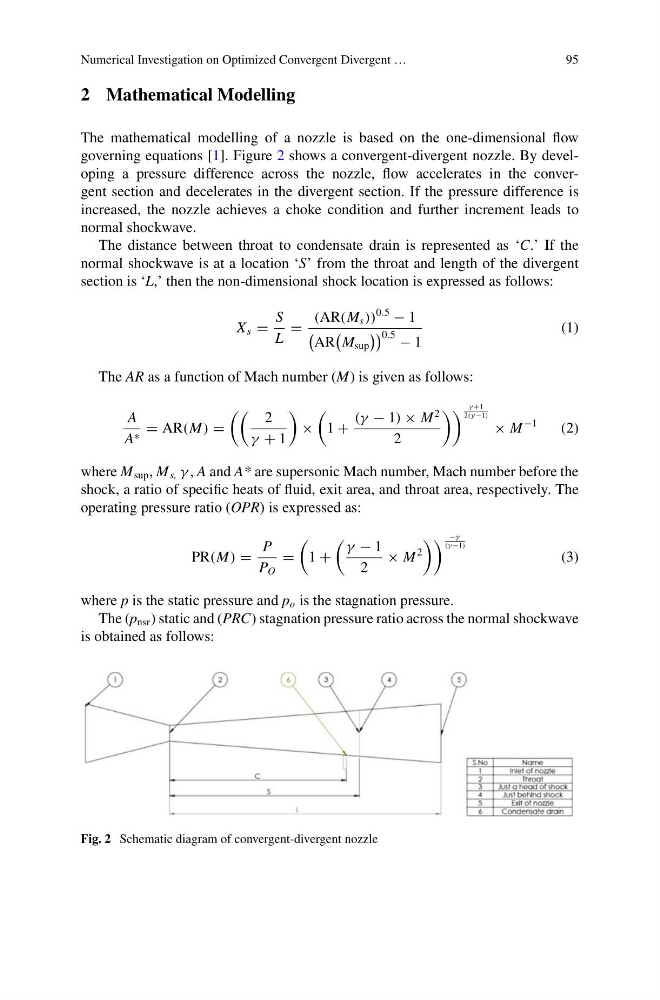
governing equations [1]. Figure 2 shows a convergent-divergent nozzle. By developing a pressure difference across the nozzle, flow accelerates in the convergent section and decelerates in the divergent section. If the pressure difference is
increased, the nozzle achieves a choke condition and further increment leads to
normal shockwave.
The distance between throat to condensate drain is represented as ‘C.’ If the
normal shockwave is at a location ‘S’ from the throat and length of the divergent
section is ‘L,’ then the non-dimensional shock location is expressed as follows:
X s =
S
L
=
(AR(M s ))
0.5
− 1
AR
M sup
0.5 − 1
(1)
The AR as a function of Mach number (M) is given as follows:
A
A ∗ = AR(M) =
2
γ + 1
×
1 +
(γ − 1) × M
2
2
γ +1
2(γ −1)
× M
−1
(2)
where M sup , M s, γ , A and A* are supersonic Mach number, Mach number before the
shock, a ratio of specific heats of fluid, exit area, and throat area, respectively. The
operating pressure ratio (OPR) is expressed as:
PR(M) =
P
P O
=
1 +
γ − 1
2
× M
2
−γ
(γ −1)
(3)
where p is the static pressure and p o is the stagnation pressure.
The (p nsr ) static and (PRC) stagnation pressure ratio across the normal shockwave
is obtained as follows:
Fig. 2 Schematic diagram of convergent-divergent nozzle
95
2 Mathematical Modelling
The mathematical modelling of a nozzle is based on the one-dimensional flow
governing equations [1]. Figure 2 shows a convergent-divergent nozzle. By developing a pressure difference across the nozzle, flow accelerates in the convergent section and decelerates in the divergent section. If the pressure difference is
increased, the nozzle achieves a choke condition and further increment leads to
normal shockwave.
The distance between throat to condensate drain is represented as ‘C.’ If the
normal shockwave is at a location ‘S’ from the throat and length of the divergent
section is ‘L,’ then the non-dimensional shock location is expressed as follows:
X s =
S
L
=
(AR(M s ))
0.5
− 1
AR
M sup
0.5 − 1
(1)
The AR as a function of Mach number (M) is given as follows:
A
A ∗ = AR(M) =
2
γ + 1
×
1 +
(γ − 1) × M
2
2
γ +1
2(γ −1)
× M
−1
(2)
where M sup , M s, γ , A and A* are supersonic Mach number, Mach number before the
shock, a ratio of specific heats of fluid, exit area, and throat area, respectively. The
operating pressure ratio (OPR) is expressed as:
PR(M) =
P
P O
=
1 +
γ − 1
2
× M
2
−γ
(γ −1)
(3)
where p is the static pressure and p o is the stagnation pressure.
The (p nsr ) static and (PRC) stagnation pressure ratio across the normal shockwave
is obtained as follows:
Fig. 2 Schematic diagram of convergent-divergent nozzle