

34
3 Finite-Time Robust Filtering for Multi-model Jumping System
E
e
−ηt V ( ˜
x(t), i)
< e
−ηt E
γ
2 e
−ηT
ω
T
(t)ω(t) − ν
T
(t)ν(t)
(3.17)
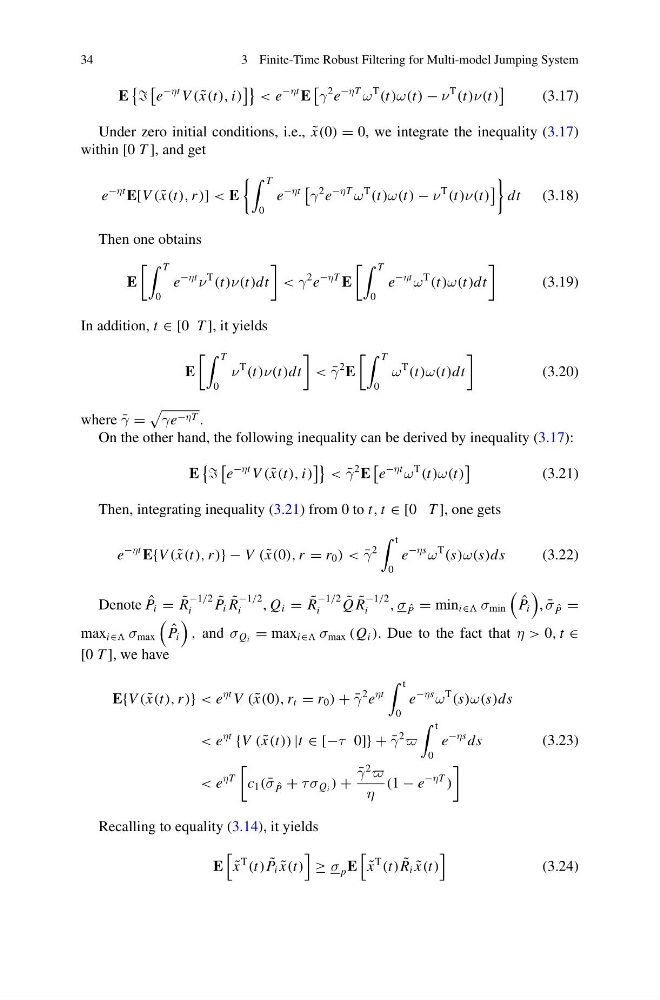
Under zero initial conditions, i.e., ˜
x(0) = 0, we integrate the inequality (3.17)
within [0 T ], and get
e
−ηt E[V ( ˜
x(t), r )] < E
T
0
e
−ηt
γ
2 e
−ηT
ω
T
(t)ω(t) − ν
T
(t)ν(t)
dt (3.18)
Then one obtains
E
T
0
e
−ηt
ν
T
(t)ν(t)dt
< γ
2 e
−ηT E
T
0
e
−ηt
ω
T
(t)ω(t)dt
(3.19)
In addition, t ∈ [0 T ], it yields
E
T
0
ν
T
(t)ν(t)dt
< ¯
γ
2 E
T
0
ω
T
(t)ω(t)dt
(3.20)
where ¯
γ =
γe −ηT .
On the other hand, the following inequality can be derived by inequality (3.17):
E
e
−ηt V ( ˜
x(t), i)
< ¯
γ
2 E
e
−ηt
ω
T
(t)ω(t)
(3.21)
Then, integrating inequality (3.21) from 0 to t, t ∈ [0 T ], one gets
e
−ηt E{V ( ˜
x(t), r )} − V ( ˜
x(0), r = r 0 ) < ¯
γ
2
t
0
e
−ηs
ω
T
(s)ω(s)ds
(3.22)
Denote ˆ
P i = ˜
R
−1/2
i
˜
P i ˜
R
−1/2
i
, Q i = ˜
R
−1/2
i
˜
Q ˜
R
−1/2
i
, σ ˆ
P = min i∈ σ min
ˆ
P i
, ¯
σ ˆ
P =
max i∈ σ max
ˆ
P i
, and σ Q i = max i∈ σ max (Q i ). Due to the fact that η > 0, t ∈
[0 T ], we have
E{V ( ˜
x(t), r )} < e
ηt V ( ˜
x(0), r t = r 0 ) + ¯
γ
2 e
ηt
t
0
e
−ηs
ω
T
(s)ω(s)ds
< e
ηt
{V ( ˜
x(t)) |t ∈ [−τ 0]} + ¯
γ
2
t
0
e
−ηs ds
< e
ηT
c 1 ( ¯
σ ˆ
P + τ σ Q i ) +
¯
γ
2
η
(1 − e
−ηT
)
(3.23)
Recalling to equality (3.14), it yields
E
˜
x
T
(t) ˜
P i ˜
x(t)
≥ σ p E
˜
x
T
(t) ˜
R i ˜
x(t)
(3.24)
3 Finite-Time Robust Filtering for Multi-model Jumping System
E
e
−ηt V ( ˜
x(t), i)
< e
−ηt E
γ
2 e
−ηT
ω
T
(t)ω(t) − ν
T
(t)ν(t)
(3.17)
Under zero initial conditions, i.e., ˜
x(0) = 0, we integrate the inequality (3.17)
within [0 T ], and get
e
−ηt E[V ( ˜
x(t), r )] < E
T
0
e
−ηt
γ
2 e
−ηT
ω
T
(t)ω(t) − ν
T
(t)ν(t)
dt (3.18)
Then one obtains
E
T
0
e
−ηt
ν
T
(t)ν(t)dt
< γ
2 e
−ηT E
T
0
e
−ηt
ω
T
(t)ω(t)dt
(3.19)
In addition, t ∈ [0 T ], it yields
E
T
0
ν
T
(t)ν(t)dt
< ¯
γ
2 E
T
0
ω
T
(t)ω(t)dt
(3.20)
where ¯
γ =
γe −ηT .
On the other hand, the following inequality can be derived by inequality (3.17):
E
e
−ηt V ( ˜
x(t), i)
< ¯
γ
2 E
e
−ηt
ω
T
(t)ω(t)
(3.21)
Then, integrating inequality (3.21) from 0 to t, t ∈ [0 T ], one gets
e
−ηt E{V ( ˜
x(t), r )} − V ( ˜
x(0), r = r 0 ) < ¯
γ
2
t
0
e
−ηs
ω
T
(s)ω(s)ds
(3.22)
Denote ˆ
P i = ˜
R
−1/2
i
˜
P i ˜
R
−1/2
i
, Q i = ˜
R
−1/2
i
˜
Q ˜
R
−1/2
i
, σ ˆ
P = min i∈ σ min
ˆ
P i
, ¯
σ ˆ
P =
max i∈ σ max
ˆ
P i
, and σ Q i = max i∈ σ max (Q i ). Due to the fact that η > 0, t ∈
[0 T ], we have
E{V ( ˜
x(t), r )} < e
ηt V ( ˜
x(0), r t = r 0 ) + ¯
γ
2 e
ηt
t
0
e
−ηs
ω
T
(s)ω(s)ds
< e
ηt
{V ( ˜
x(t)) |t ∈ [−τ 0]} + ¯
γ
2
t
0
e
−ηs ds
< e
ηT
c 1 ( ¯
σ ˆ
P + τ σ Q i ) +
¯
γ
2
η
(1 − e
−ηT
)
(3.23)
Recalling to equality (3.14), it yields
E
˜
x
T
(t) ˜
P i ˜
x(t)
≥ σ p E
˜
x
T
(t) ˜
R i ˜
x(t)
(3.24)