

3.1 Finite-Time Robust H ∞ Filtering for Multi-model Jumping System
33
word, the designed finite-time H ∞ filter is supposed to satisfy inequality (3.8) with
an attenuation index γ.
3.1.2 Design of Jumping Finite-Time H ∞ Filter
Theorem 3.1 Given T > 0, η > 0, c 1 > 0, > 0, ˜
R i > 0, the error dynamic multimodel jumping system (3.5) is stochastically FTB in relation to (c 1 c 2 T ˜
R i ) and
satisfies a prescribed H ∞ performance for all permitable ω(t) with the restriction
(3.6), if there exist scalars γ > 0, c 2 > 0, symmetric positive-definite matrices ˜
R i ,
such that the following relations hold:
⎡
⎢
⎢
⎣
˜
P i ˜
A i + ˜
A
T
i
˜
P i +
N
i=1 π ik ˜
P k − η ˜
P i + ˜
Q ˜
P i ˜
A hi
˜
P i ˜
B i
˜
C
T
i
∗
− ˜
Q
0
0
∗
∗ − γ
2 e
−ηT I 0
∗
∗
∗
− I
⎤
⎥
⎥
⎦ < 0 (3.12)
c 1 ( ¯
σ ˆ
P + τ σ Q i ) +
¯
γ
2
η
(1 − e
−ηT
) < c 2 e
−ηT
σ ˆ
P
(3.13)
Proof We select the following Lyapunov–Krasovskii functional as:
V ( ˜
x(t), r ) = ˜
x
T
(t) ˜
P i ˜
x(t) +
t
t−τ
˜
x
T
(s) ˜
Q ˜
x(s)ds,
(3.14)
where ˜
P i and ˜
Q are symmetric positive-definite matrices.
Recalling to Definition 1.6 and the error dynamic multi-model jumping system
(3.5), it yields:
V ( ˜
x(t), i) = ˜
x
T
(t)
⎛
⎝ ˜
P i ˜
A i + ˜
A
T
i
˜
P i +
N
j=1
π i j ˜
P j + ˜
Q
⎞
⎠ ˜
x(t)
+ 2 ˜
x
T
(t) ˜
P i ˜
A hi ˜
x h + 2 ˜
x
T
(t) ˜
P i ˜
B i ω(t)
(3.15)
− ˜
x
T
h
˜
Q ˜
x h .
Then we introduce
E[[V ( ˜
x(t), i)] < ηE[V ( ˜
x(t), i)] + γ
2 e
−ηT
ω
T
(t)ω(t) − E
ν
T
(t)ν(t)
(3.16)
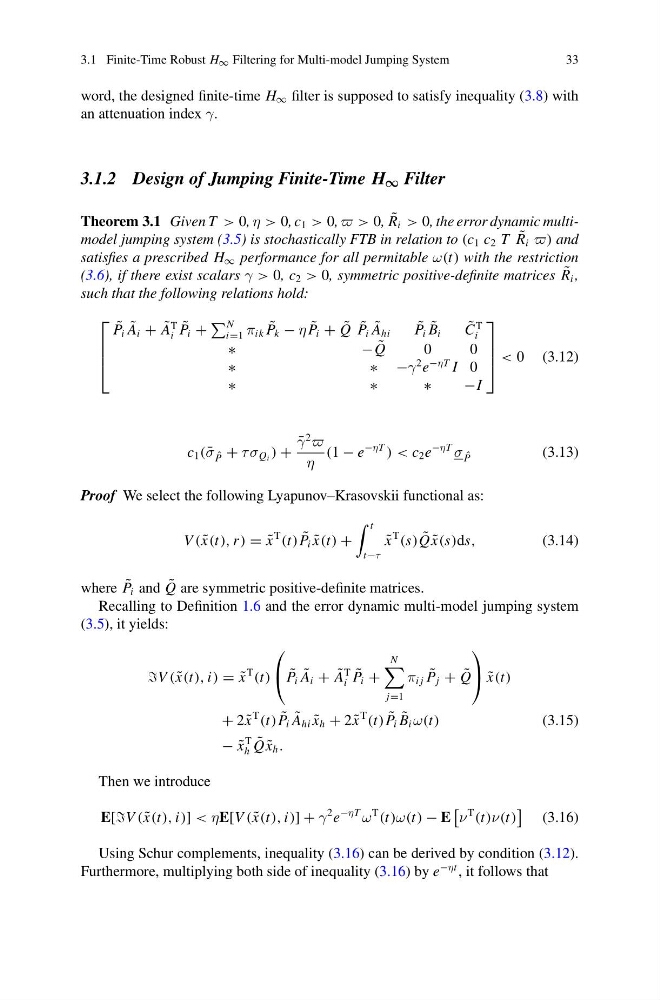
Using Schur complements, inequality (3.16) can be derived by condition (3.12).
Furthermore, multiplying both side of inequality (3.16) by e
−ηt , it follows that
33
word, the designed finite-time H ∞ filter is supposed to satisfy inequality (3.8) with
an attenuation index γ.
3.1.2 Design of Jumping Finite-Time H ∞ Filter
Theorem 3.1 Given T > 0, η > 0, c 1 > 0, > 0, ˜
R i > 0, the error dynamic multimodel jumping system (3.5) is stochastically FTB in relation to (c 1 c 2 T ˜
R i ) and
satisfies a prescribed H ∞ performance for all permitable ω(t) with the restriction
(3.6), if there exist scalars γ > 0, c 2 > 0, symmetric positive-definite matrices ˜
R i ,
such that the following relations hold:
⎡
⎢
⎢
⎣
˜
P i ˜
A i + ˜
A
T
i
˜
P i +
N
i=1 π ik ˜
P k − η ˜
P i + ˜
Q ˜
P i ˜
A hi
˜
P i ˜
B i
˜
C
T
i
∗
− ˜
Q
0
0
∗
∗ − γ
2 e
−ηT I 0
∗
∗
∗
− I
⎤
⎥
⎥
⎦ < 0 (3.12)
c 1 ( ¯
σ ˆ
P + τ σ Q i ) +
¯
γ
2
η
(1 − e
−ηT
) < c 2 e
−ηT
σ ˆ
P
(3.13)
Proof We select the following Lyapunov–Krasovskii functional as:
V ( ˜
x(t), r ) = ˜
x
T
(t) ˜
P i ˜
x(t) +
t
t−τ
˜
x
T
(s) ˜
Q ˜
x(s)ds,
(3.14)
where ˜
P i and ˜
Q are symmetric positive-definite matrices.
Recalling to Definition 1.6 and the error dynamic multi-model jumping system
(3.5), it yields:
V ( ˜
x(t), i) = ˜
x
T
(t)
⎛
⎝ ˜
P i ˜
A i + ˜
A
T
i
˜
P i +
N
j=1
π i j ˜
P j + ˜
Q
⎞
⎠ ˜
x(t)
+ 2 ˜
x
T
(t) ˜
P i ˜
A hi ˜
x h + 2 ˜
x
T
(t) ˜
P i ˜
B i ω(t)
(3.15)
− ˜
x
T
h
˜
Q ˜
x h .
Then we introduce
E[[V ( ˜
x(t), i)] < ηE[V ( ˜
x(t), i)] + γ
2 e
−ηT
ω
T
(t)ω(t) − E
ν
T
(t)ν(t)
(3.16)
Using Schur complements, inequality (3.16) can be derived by condition (3.12).
Furthermore, multiplying both side of inequality (3.16) by e
−ηt , it follows that