

164
9 Neural Network-Based Robust Fault Detection …
V (e(t), x(t), i)
x
T
(t)) 1i x(t) + 2x
T
(t) (A i − H i C i )
T P 2i e(t)
+ 2x
T
(t)P 1i (A hi + A hi ) x h (t) + e
T
(t)) 2i e(t)
+ 2e
T
(t)) 3i x h (t) − x
T
h (t)Qx h (t)
=
x
T
(t) e
T
(t) x
T
h (t)
x
T
(t) e
T
(t) x
T
h (t)
T .
(9.18)
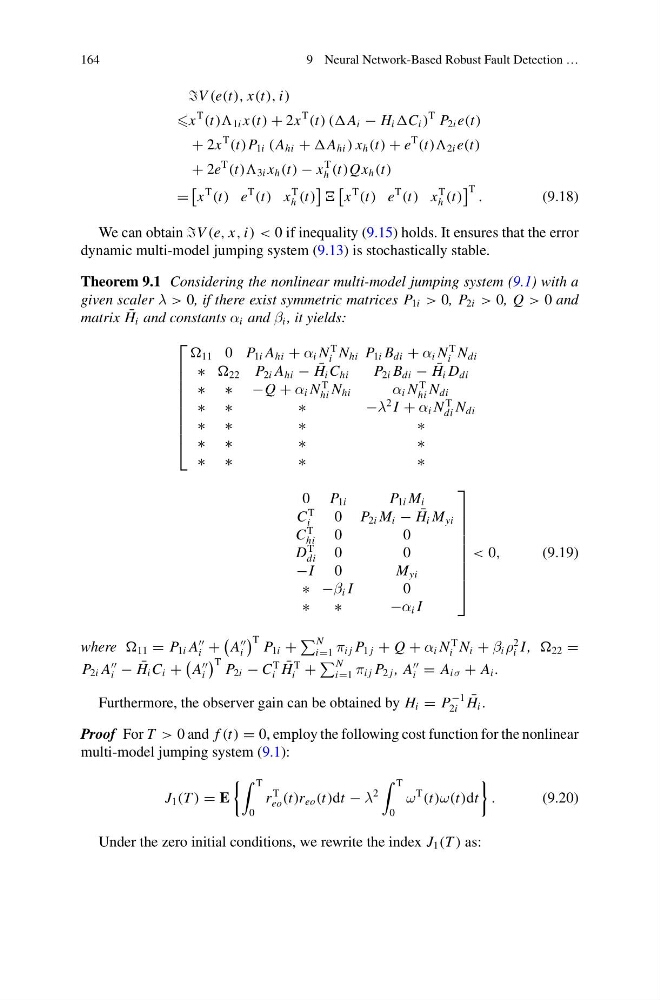
We can obtain V (e, x, i) < 0 if inequality (9.15) holds. It ensures that the error
dynamic multi-model jumping system (9.13) is stochastically stable.
Theorem 9.1 Considering the nonlinear multi-model jumping system (9.1) with a
given scaler λ > 0, if there exist symmetric matrices P 1i > 0, P 2i > 0, Q > 0 and
matrix ¯
H i and constants α i and β i , it yields:
⎡
⎢
⎢
⎢
⎢
⎢
⎢
⎢
⎢
⎣
11 0 P 1i A hi + α i N
T
i N hi P 1i B di + α i N
T
i N di
∗ 22 P 2i A hi − ¯
H i C hi
P 2i B di − ¯
H i D di
∗ ∗ −Q + α i N
T
hi N hi
α i N
T
hi N di
∗ ∗
∗
−λ
2 I + α i N
T
di N di
∗ ∗
∗
∗
∗ ∗
∗
∗
∗ ∗
∗
∗
0 P 1i
P 1i M i
C
T
i
0 P 2i M i − ¯
H i M yi
C
T
hi
0
0
D
T
di
0
0
−I 0
M yi
∗ −β i I
0
∗
∗
−α i I
⎤
⎥
⎥
⎥
⎥
⎥
⎥
⎥
⎥
⎦
< 0,
(9.19)
where 11 = P 1i A
i +
A
i
T P 1i +
N
i=1 π i j P 1 j + Q + α i N
T
i N i + β i ρ
2
i I , 22 =
P 2i A
i − ¯
H i C i +
A
i
T P 2i − C
T
i
¯
H
T
i +
N
i=1 π i j P 2 j , A
i = A iσ + A i .
Furthermore, the observer gain can be obtained by H i = P
−1
2i
¯
H i .
Proof For T > 0 and f (t) = 0, employ the following cost function for the nonlinear
multi-model jumping system (9.1):
J 1 (T ) = E
T
0
r
T
eo (t)r eo (t)dt − λ
2
T
0
ω
T
(t)ω(t)dt
.
(9.20)
Under the zero initial conditions, we rewrite the index J 1 (T ) as:
9 Neural Network-Based Robust Fault Detection …
V (e(t), x(t), i)
x
T
(t)) 1i x(t) + 2x
T
(t) (A i − H i C i )
T P 2i e(t)
+ 2x
T
(t)P 1i (A hi + A hi ) x h (t) + e
T
(t)) 2i e(t)
+ 2e
T
(t)) 3i x h (t) − x
T
h (t)Qx h (t)
=
x
T
(t) e
T
(t) x
T
h (t)
x
T
(t) e
T
(t) x
T
h (t)
T .
(9.18)
We can obtain V (e, x, i) < 0 if inequality (9.15) holds. It ensures that the error
dynamic multi-model jumping system (9.13) is stochastically stable.
Theorem 9.1 Considering the nonlinear multi-model jumping system (9.1) with a
given scaler λ > 0, if there exist symmetric matrices P 1i > 0, P 2i > 0, Q > 0 and
matrix ¯
H i and constants α i and β i , it yields:
⎡
⎢
⎢
⎢
⎢
⎢
⎢
⎢
⎢
⎣
11 0 P 1i A hi + α i N
T
i N hi P 1i B di + α i N
T
i N di
∗ 22 P 2i A hi − ¯
H i C hi
P 2i B di − ¯
H i D di
∗ ∗ −Q + α i N
T
hi N hi
α i N
T
hi N di
∗ ∗
∗
−λ
2 I + α i N
T
di N di
∗ ∗
∗
∗
∗ ∗
∗
∗
∗ ∗
∗
∗
0 P 1i
P 1i M i
C
T
i
0 P 2i M i − ¯
H i M yi
C
T
hi
0
0
D
T
di
0
0
−I 0
M yi
∗ −β i I
0
∗
∗
−α i I
⎤
⎥
⎥
⎥
⎥
⎥
⎥
⎥
⎥
⎦
< 0,
(9.19)
where 11 = P 1i A
i +
A
i
T P 1i +
N
i=1 π i j P 1 j + Q + α i N
T
i N i + β i ρ
2
i I , 22 =
P 2i A
i − ¯
H i C i +
A
i
T P 2i − C
T
i
¯
H
T
i +
N
i=1 π i j P 2 j , A
i = A iσ + A i .
Furthermore, the observer gain can be obtained by H i = P
−1
2i
¯
H i .
Proof For T > 0 and f (t) = 0, employ the following cost function for the nonlinear
multi-model jumping system (9.1):
J 1 (T ) = E
T
0
r
T
eo (t)r eo (t)dt − λ
2
T
0
ω
T
(t)ω(t)dt
.
(9.20)
Under the zero initial conditions, we rewrite the index J 1 (T ) as: