

162
9 Neural Network-Based Robust Fault Detection …
where A
i =
σ∈ μ iσ (A iσ + A i ), F i (x(t)) = F i (x(t)) −
σ μ iσ A iσ x(t)
ρ i x(t).
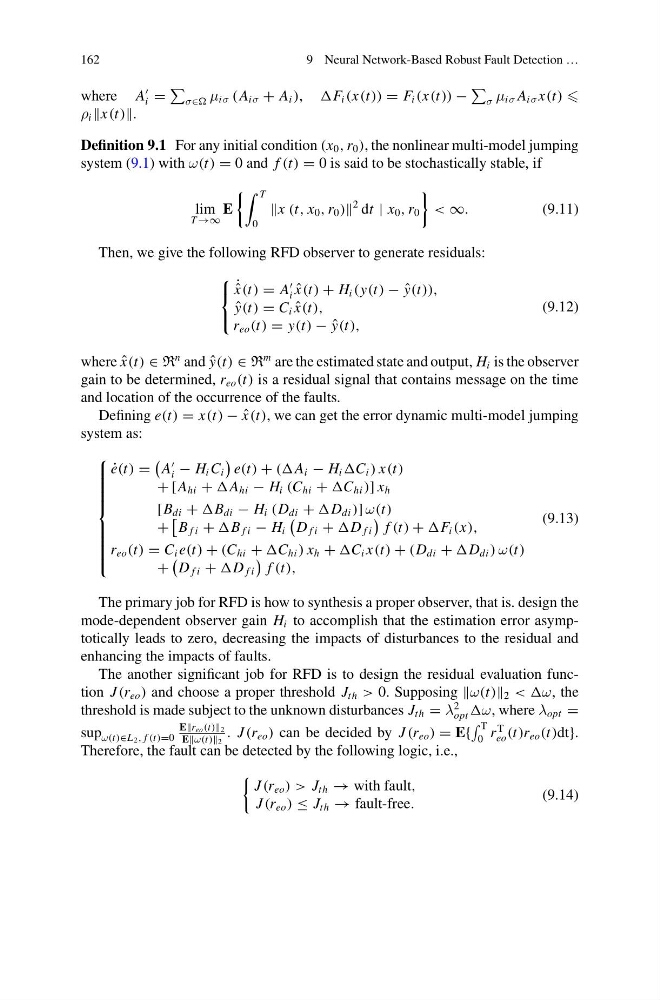
Definition 9.1 For any initial condition (x 0 , r 0 ), the nonlinear multi-model jumping
system (9.1) with ω(t) = 0 and f (t) = 0 is said to be stochastically stable, if
lim
T →∞
E
T
0
x (t, x 0 , r 0 )
2 dt | x 0 , r 0
< ∞.
(9.11)
Then, we give the following RFD observer to generate residuals:
⎧
⎨
⎩
˙ ˆ
x(t) = A
i ˆ
x(t) + H i (y(t) − ˆ
y(t)),
ˆ
y(t) = C i ˆ
x(t),
r eo (t) = y(t) − ˆ
y(t),
(9.12)
where ˆ
x(t) ∈ R
n and ˆ
y(t) ∈ R
m are the estimated state and output, H i is the observer
gain to be determined, r eo (t) is a residual signal that contains message on the time
and location of the occurrence of the faults.
Defining e(t) = x(t) − ˆ
x(t), we can get the error dynamic multi-model jumping
system as:
⎧
⎪ ⎪ ⎪ ⎪ ⎪ ⎪ ⎪ ⎨
⎪ ⎪ ⎪ ⎪ ⎪ ⎪ ⎪ ⎩
˙
e(t) =
A
i − H i C i
e(t) + (A i − H i C i ) x(t)
+ [ A hi + A hi − H i (C hi + C hi )] x h
[B di + B di − H i (D di + D di )] ω(t)
+
B f i + B f i − H i
D f i + D f i
f (t) + F i (x),
r eo (t) = C i e(t) + (C hi + C hi ) x h + C i x(t) + (D di + D di ) ω(t)
+
D f i + D f i
f (t),
(9.13)
The primary job for RFD is how to synthesis a proper observer, that is. design the
mode-dependent observer gain H i to accomplish that the estimation error asymptotically leads to zero, decreasing the impacts of disturbances to the residual and
enhancing the impacts of faults.
The another significant job for RFD is to design the residual evaluation function J (r eo ) and choose a proper threshold J th > 0. Supposing ω(t) 2 < <ω, the
threshold is made subject to the unknown disturbances J th = λ
2
opt ω, where λ opt =
sup ω(t)∈L 2 , f (t)=0
Er eo (t) 2
Eω(t) 2
. J (r eo ) can be decided by J (r eo ) = E{
T
0 r
T
eo (t)r eo (t)dt}.
Therefore, the fault can be detected by the following logic, i.e.,
J (r eo ) > J th → with fault,
J (r eo ) ≤ J th → fault-free.
(9.14)
9 Neural Network-Based Robust Fault Detection …
where A
i =
σ∈ μ iσ (A iσ + A i ), F i (x(t)) = F i (x(t)) −
σ μ iσ A iσ x(t)
ρ i x(t).
Definition 9.1 For any initial condition (x 0 , r 0 ), the nonlinear multi-model jumping
system (9.1) with ω(t) = 0 and f (t) = 0 is said to be stochastically stable, if
lim
T →∞
E
T
0
x (t, x 0 , r 0 )
2 dt | x 0 , r 0
< ∞.
(9.11)
Then, we give the following RFD observer to generate residuals:
⎧
⎨
⎩
˙ ˆ
x(t) = A
i ˆ
x(t) + H i (y(t) − ˆ
y(t)),
ˆ
y(t) = C i ˆ
x(t),
r eo (t) = y(t) − ˆ
y(t),
(9.12)
where ˆ
x(t) ∈ R
n and ˆ
y(t) ∈ R
m are the estimated state and output, H i is the observer
gain to be determined, r eo (t) is a residual signal that contains message on the time
and location of the occurrence of the faults.
Defining e(t) = x(t) − ˆ
x(t), we can get the error dynamic multi-model jumping
system as:
⎧
⎪ ⎪ ⎪ ⎪ ⎪ ⎪ ⎪ ⎨
⎪ ⎪ ⎪ ⎪ ⎪ ⎪ ⎪ ⎩
˙
e(t) =
A
i − H i C i
e(t) + (A i − H i C i ) x(t)
+ [ A hi + A hi − H i (C hi + C hi )] x h
[B di + B di − H i (D di + D di )] ω(t)
+
B f i + B f i − H i
D f i + D f i
f (t) + F i (x),
r eo (t) = C i e(t) + (C hi + C hi ) x h + C i x(t) + (D di + D di ) ω(t)
+
D f i + D f i
f (t),
(9.13)
The primary job for RFD is how to synthesis a proper observer, that is. design the
mode-dependent observer gain H i to accomplish that the estimation error asymptotically leads to zero, decreasing the impacts of disturbances to the residual and
enhancing the impacts of faults.
The another significant job for RFD is to design the residual evaluation function J (r eo ) and choose a proper threshold J th > 0. Supposing ω(t) 2 < <ω, the
threshold is made subject to the unknown disturbances J th = λ
2
opt ω, where λ opt =
sup ω(t)∈L 2 , f (t)=0
Er eo (t) 2
Eω(t) 2
. J (r eo ) can be decided by J (r eo ) = E{
T
0 r
T
eo (t)r eo (t)dt}.
Therefore, the fault can be detected by the following logic, i.e.,
J (r eo ) > J th → with fault,
J (r eo ) ≤ J th → fault-free.
(9.14)