

120
7 Observer-Based Robust Fault Detection for Fuzzy Multi-model Jumping System
where e(t) = x(t) − x(t), r eo (t) = y(t) − y(t), ˆ
x(t) =
x
T
(t) e
T
(t)
T ,
ˆ
A i j (r ) =
S
i=1 h i
S
j=1 h j
A i (r ) + A i (r )
0
0
A i (r ) − H i (r )C j (r )
,
ˆ
A hi j (r ) =
S
i=1 h i
S
j=1 h j
A hi (r ) + A hi (r )
0
0
A hi (r ) − H i (r )C h j (r )
,
ˆ
B di j (r ) =
S
i=1 h i
S
j=1 h j
B di (r )
B di (r ) − H i (r )D d j (r )
,
ˆ
B f i j (r ) =
S
i=1 h i
S
j=1 h j (r )
B f i (r )
B di − H i (r )D d j (r )
,
ˆ
C i j (r ) =
S
i=1 h i
S
j=1 h j
C i (r ) − C j (r )C j (r )
,
ˆ
C hi j (r ) =
S
i=1 h i
S
j=1 h j
C hi (r ) − C h j (r )C h j (r )
,
ˆ
D di (r ) =
S
i=1 h i
S
j=1 h j D di (r ),
ˆ
D f i (r ) =
S
i=1 h i
S
j=1 h j D f i (r ).
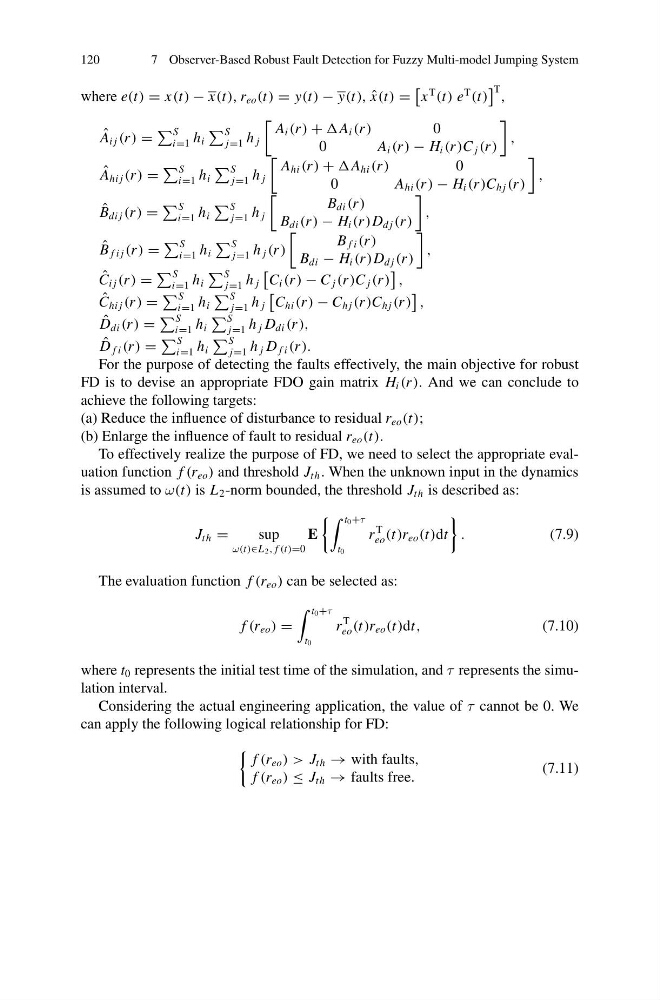
For the purpose of detecting the faults effectively, the main objective for robust
FD is to devise an appropriate FDO gain matrix H i (r ). And we can conclude to
achieve the following targets:
(a) Reduce the influence of disturbance to residual r eo (t);
(b) Enlarge the influence of fault to residual r eo (t).
To effectively realize the purpose of FD, we need to select the appropriate evaluation function f (r eo ) and threshold J th . When the unknown input in the dynamics
is assumed to ω(t) is L 2 -norm bounded, the threshold J th is described as:
J th =
sup
ω(t)∈L 2 , f (t)=0
E
t 0 +τ
t 0
r
T
eo (t)r eo (t)dt
.
(7.9)
The evaluation function f (r eo ) can be selected as:
f (r eo ) =
t 0 +τ
t 0
r
T
eo (t)r eo (t)dt,
(7.10)
where t 0 represents the initial test time of the simulation, and τ represents the simulation interval.
Considering the actual engineering application, the value of τ cannot be 0. We
can apply the following logical relationship for FD:
f (r eo ) > J th → with faults,
f (r eo ) ≤ J th → faults free.
(7.11)
7 Observer-Based Robust Fault Detection for Fuzzy Multi-model Jumping System
where e(t) = x(t) − x(t), r eo (t) = y(t) − y(t), ˆ
x(t) =
x
T
(t) e
T
(t)
T ,
ˆ
A i j (r ) =
S
i=1 h i
S
j=1 h j
A i (r ) + A i (r )
0
0
A i (r ) − H i (r )C j (r )
,
ˆ
A hi j (r ) =
S
i=1 h i
S
j=1 h j
A hi (r ) + A hi (r )
0
0
A hi (r ) − H i (r )C h j (r )
,
ˆ
B di j (r ) =
S
i=1 h i
S
j=1 h j
B di (r )
B di (r ) − H i (r )D d j (r )
,
ˆ
B f i j (r ) =
S
i=1 h i
S
j=1 h j (r )
B f i (r )
B di − H i (r )D d j (r )
,
ˆ
C i j (r ) =
S
i=1 h i
S
j=1 h j
C i (r ) − C j (r )C j (r )
,
ˆ
C hi j (r ) =
S
i=1 h i
S
j=1 h j
C hi (r ) − C h j (r )C h j (r )
,
ˆ
D di (r ) =
S
i=1 h i
S
j=1 h j D di (r ),
ˆ
D f i (r ) =
S
i=1 h i
S
j=1 h j D f i (r ).
For the purpose of detecting the faults effectively, the main objective for robust
FD is to devise an appropriate FDO gain matrix H i (r ). And we can conclude to
achieve the following targets:
(a) Reduce the influence of disturbance to residual r eo (t);
(b) Enlarge the influence of fault to residual r eo (t).
To effectively realize the purpose of FD, we need to select the appropriate evaluation function f (r eo ) and threshold J th . When the unknown input in the dynamics
is assumed to ω(t) is L 2 -norm bounded, the threshold J th is described as:
J th =
sup
ω(t)∈L 2 , f (t)=0
E
t 0 +τ
t 0
r
T
eo (t)r eo (t)dt
.
(7.9)
The evaluation function f (r eo ) can be selected as:
f (r eo ) =
t 0 +τ
t 0
r
T
eo (t)r eo (t)dt,
(7.10)
where t 0 represents the initial test time of the simulation, and τ represents the simulation interval.
Considering the actual engineering application, the value of τ cannot be 0. We
can apply the following logical relationship for FD:
f (r eo ) > J th → with faults,
f (r eo ) ≤ J th → faults free.
(7.11)