

7.1 Robust FDO Design for Fuzzy Multi-model Jumping System
119
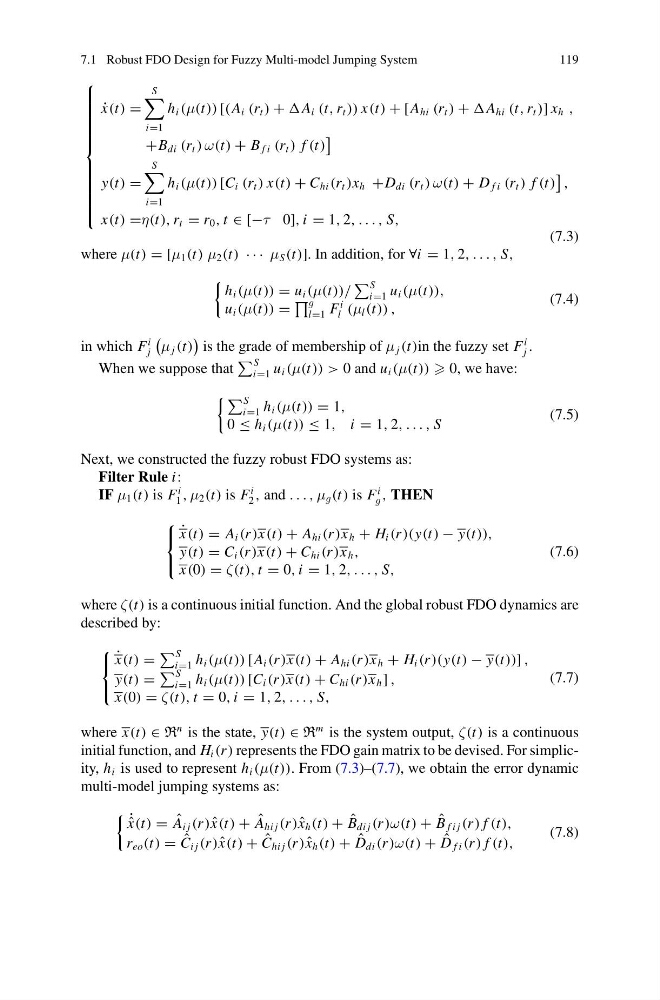
⎧
⎪ ⎪ ⎪ ⎪ ⎪ ⎪ ⎪ ⎪ ⎪ ⎪ ⎨
⎪ ⎪ ⎪ ⎪ ⎪ ⎪ ⎪ ⎪ ⎪ ⎪ ⎩
˙
x(t) =
S
i=1
h i (μ(t)) [(A i (r t ) + A i (t, r t )) x(t) + [A hi (r t ) + A hi (t, r t )] x h ,
+B di (r t ) ω(t) + B f i (r t ) f (t)
y(t) =
S
i=1
h i (μ(t)) [C i (r t ) x(t) + C hi (r t )x h +D di (r t ) ω(t) + D f i (r t ) f (t)
,
x(t) =η(t), r t = r 0 , t ∈ [−τ 0], i = 1, 2, . . . , S,
(7.3)
where μ(t) = [μ 1 (t) μ 2 (t) · · · μ S (t)]. In addition, for ∀i = 1, 2, . . . , S,
h i (μ(t)) = u i (μ(t))/
S
i=1 u i (μ(t)),
u i (μ(t)) =
g
l=1 F
i
l (μ l (t)) ,
(7.4)
in which F
i
j
μ j (t)
is the grade of membership of μ j (t)in the fuzzy set F
i
j .
When we suppose that
S
i=1 u i (μ(t)) > 0 and u i (μ(t)) 0, we have:
S
i=1 h i (μ(t)) = 1,
0 ≤ h i (μ(t)) ≤ 1, i = 1, 2, . . . , S
(7.5)
Next, we constructed the fuzzy robust FDO systems as:
Filter Rule i:
IF μ 1 (t) is F
i
1 , μ 2 (t) is F
i
2 , and . . . , μ g (t) is F
i
g , THEN
⎧
⎨
⎩
˙
x(t) = A i (r )x(t) + A hi (r )x h + H i (r )(y(t) − y(t)),
y(t) = C i (r )x(t) + C hi (r )x h ,
x(0) = ζ(t), t = 0, i = 1, 2, . . . , S,
(7.6)
where ζ(t) is a continuous initial function. And the global robust FDO dynamics are
described by:
⎧
⎨
⎩
˙
x(t) =
S
i=1 h i (μ(t)) [A i (r )x(t) + A hi (r )x h + H i (r )(y(t) − y(t))] ,
y(t) =
S
i=1 h i (μ(t)) [C i (r )x(t) + C hi (r )x h ] ,
x(0) = ζ(t), t = 0, i = 1, 2, . . . , S,
(7.7)
where x(t) ∈ R
n is the state, y(t) ∈ R
m is the system output, ζ(t) is a continuous
initial function, and H i (r ) represents the FDO gain matrix to be devised. For simplicity, h i is used to represent h i (μ(t)). From (7.3)–(7.7), we obtain the error dynamic
multi-model jumping systems as:
˙ ˆ
x(t) = ˆ
A i j (r ) ˆ
x(t) + ˆ
A hi j (r ) ˆ
x h (t) + ˆ
B di j (r )ω(t) + ˆ
B f i j (r ) f (t),
r eo (t) = ˆ
C i j (r ) ˆ
x(t) + ˆ
C hi j (r ) ˆ
x h (t) + ˆ
D di (r )ω(t) + ˆ
D f i (r ) f (t),
(7.8)
119
⎧
⎪ ⎪ ⎪ ⎪ ⎪ ⎪ ⎪ ⎪ ⎪ ⎪ ⎨
⎪ ⎪ ⎪ ⎪ ⎪ ⎪ ⎪ ⎪ ⎪ ⎪ ⎩
˙
x(t) =
S
i=1
h i (μ(t)) [(A i (r t ) + A i (t, r t )) x(t) + [A hi (r t ) + A hi (t, r t )] x h ,
+B di (r t ) ω(t) + B f i (r t ) f (t)
y(t) =
S
i=1
h i (μ(t)) [C i (r t ) x(t) + C hi (r t )x h +D di (r t ) ω(t) + D f i (r t ) f (t)
,
x(t) =η(t), r t = r 0 , t ∈ [−τ 0], i = 1, 2, . . . , S,
(7.3)
where μ(t) = [μ 1 (t) μ 2 (t) · · · μ S (t)]. In addition, for ∀i = 1, 2, . . . , S,
h i (μ(t)) = u i (μ(t))/
S
i=1 u i (μ(t)),
u i (μ(t)) =
g
l=1 F
i
l (μ l (t)) ,
(7.4)
in which F
i
j
μ j (t)
is the grade of membership of μ j (t)in the fuzzy set F
i
j .
When we suppose that
S
i=1 u i (μ(t)) > 0 and u i (μ(t)) 0, we have:
S
i=1 h i (μ(t)) = 1,
0 ≤ h i (μ(t)) ≤ 1, i = 1, 2, . . . , S
(7.5)
Next, we constructed the fuzzy robust FDO systems as:
Filter Rule i:
IF μ 1 (t) is F
i
1 , μ 2 (t) is F
i
2 , and . . . , μ g (t) is F
i
g , THEN
⎧
⎨
⎩
˙
x(t) = A i (r )x(t) + A hi (r )x h + H i (r )(y(t) − y(t)),
y(t) = C i (r )x(t) + C hi (r )x h ,
x(0) = ζ(t), t = 0, i = 1, 2, . . . , S,
(7.6)
where ζ(t) is a continuous initial function. And the global robust FDO dynamics are
described by:
⎧
⎨
⎩
˙
x(t) =
S
i=1 h i (μ(t)) [A i (r )x(t) + A hi (r )x h + H i (r )(y(t) − y(t))] ,
y(t) =
S
i=1 h i (μ(t)) [C i (r )x(t) + C hi (r )x h ] ,
x(0) = ζ(t), t = 0, i = 1, 2, . . . , S,
(7.7)
where x(t) ∈ R
n is the state, y(t) ∈ R
m is the system output, ζ(t) is a continuous
initial function, and H i (r ) represents the FDO gain matrix to be devised. For simplicity, h i is used to represent h i (μ(t)). From (7.3)–(7.7), we obtain the error dynamic
multi-model jumping systems as:
˙ ˆ
x(t) = ˆ
A i j (r ) ˆ
x(t) + ˆ
A hi j (r ) ˆ
x h (t) + ˆ
B di j (r )ω(t) + ˆ
B f i j (r ) f (t),
r eo (t) = ˆ
C i j (r ) ˆ
x(t) + ˆ
C hi j (r ) ˆ
x h (t) + ˆ
D di (r )ω(t) + ˆ
D f i (r ) f (t),
(7.8)