

trajectories to individual trajectories. There were 747 (27.9%) incident deaths among
the 2675 participants. The median duration of follow-up for incident death was
2915 days. As compared with the high-stable TMIG-IC trajectory group, the lateonset decreasing, early-onset decreasing, and low-decreasing trajectory groups had
HRs (95% CI) for all-cause mortality of 1.29 (1.07–1.56), 2.33 (1.90–2.84), and 4.67
(3.65–5.99), respectively. The analysis of cause-specific death, CVD mortality, and
other mortality showed significant associations between the four TMIG-IC trajectory
patterns.
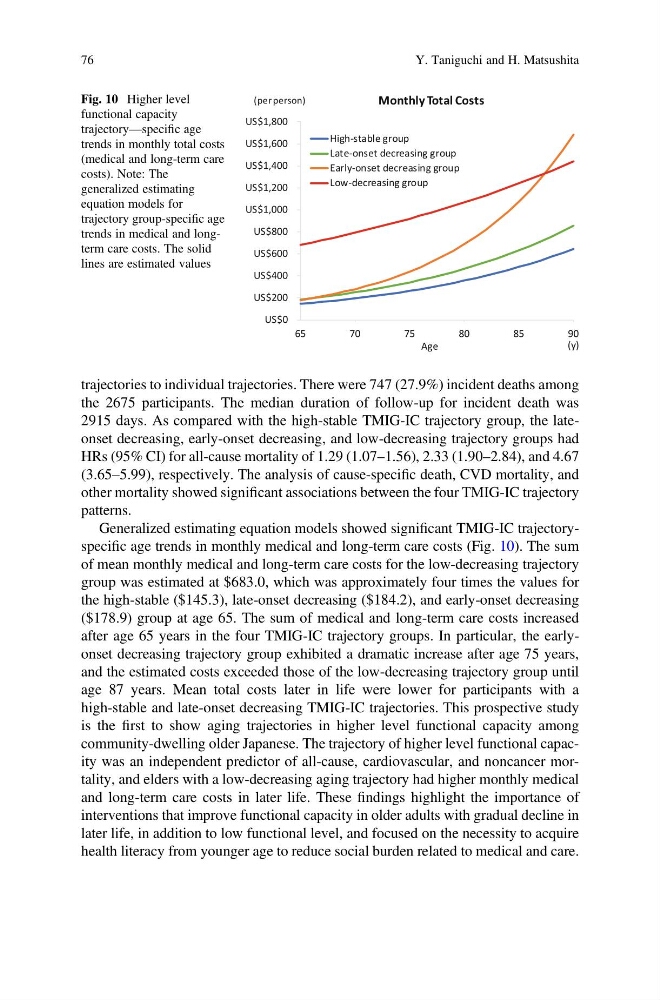
Generalized estimating equation models showed significant TMIG-IC trajectoryspecific age trends in monthly medical and long-term care costs (Fig. 10). The sum
of mean monthly medical and long-term care costs for the low-decreasing trajectory
group was estimated at $683.0, which was approximately four times the values for
the high-stable ($145.3), late-onset decreasing ($184.2), and early-onset decreasing
($178.9) group at age 65. The sum of medical and long-term care costs increased
after age 65 years in the four TMIG-IC trajectory groups. In particular, the earlyonset decreasing trajectory group exhibited a dramatic increase after age 75 years,
and the estimated costs exceeded those of the low-decreasing trajectory group until
age 87 years. Mean total costs later in life were lower for participants with a
high-stable and late-onset decreasing TMIG-IC trajectories. This prospective study
is the first to show aging trajectories in higher level functional capacity among
community-dwelling older Japanese. The trajectory of higher level functional capacity was an independent predictor of all-cause, cardiovascular, and noncancer mortality, and elders with a low-decreasing aging trajectory had higher monthly medical
and long-term care costs in later life. These findings highlight the importance of
interventions that improve functional capacity in older adults with gradual decline in
later life, in addition to low functional level, and focused on the necessity to acquire
health literacy from younger age to reduce social burden related to medical and care.
US$0
US$200
US$400
US$600
US$800
US$1,000
US$1,200
US$1,400
US$1,600
US$1,800
65
70
75
80
85
90
Monthly Total Costs
High-stable group
Late-onset decreasing group
Early-onset decreasing group
Low-decreasing group
Age
(y)
(per person)
Fig. 10 Higher level
functional capacity
trajectory—specific age
trends in monthly total costs
(medical and long-term care
costs). Note: The
generalized estimating
equation models for
trajectory group-specific age
trends in medical and longterm care costs. The solid
lines are estimated values
76
Y. Taniguchi and H. Matsushita
the 2675 participants. The median duration of follow-up for incident death was
2915 days. As compared with the high-stable TMIG-IC trajectory group, the lateonset decreasing, early-onset decreasing, and low-decreasing trajectory groups had
HRs (95% CI) for all-cause mortality of 1.29 (1.07–1.56), 2.33 (1.90–2.84), and 4.67
(3.65–5.99), respectively. The analysis of cause-specific death, CVD mortality, and
other mortality showed significant associations between the four TMIG-IC trajectory
patterns.
Generalized estimating equation models showed significant TMIG-IC trajectoryspecific age trends in monthly medical and long-term care costs (Fig. 10). The sum
of mean monthly medical and long-term care costs for the low-decreasing trajectory
group was estimated at $683.0, which was approximately four times the values for
the high-stable ($145.3), late-onset decreasing ($184.2), and early-onset decreasing
($178.9) group at age 65. The sum of medical and long-term care costs increased
after age 65 years in the four TMIG-IC trajectory groups. In particular, the earlyonset decreasing trajectory group exhibited a dramatic increase after age 75 years,
and the estimated costs exceeded those of the low-decreasing trajectory group until
age 87 years. Mean total costs later in life were lower for participants with a
high-stable and late-onset decreasing TMIG-IC trajectories. This prospective study
is the first to show aging trajectories in higher level functional capacity among
community-dwelling older Japanese. The trajectory of higher level functional capacity was an independent predictor of all-cause, cardiovascular, and noncancer mortality, and elders with a low-decreasing aging trajectory had higher monthly medical
and long-term care costs in later life. These findings highlight the importance of
interventions that improve functional capacity in older adults with gradual decline in
later life, in addition to low functional level, and focused on the necessity to acquire
health literacy from younger age to reduce social burden related to medical and care.
US$0
US$200
US$400
US$600
US$800
US$1,000
US$1,200
US$1,400
US$1,600
US$1,800
65
70
75
80
85
90
Monthly Total Costs
High-stable group
Late-onset decreasing group
Early-onset decreasing group
Low-decreasing group
Age
(y)
(per person)
Fig. 10 Higher level
functional capacity
trajectory—specific age
trends in monthly total costs
(medical and long-term care
costs). Note: The
generalized estimating
equation models for
trajectory group-specific age
trends in medical and longterm care costs. The solid
lines are estimated values
76
Y. Taniguchi and H. Matsushita