

7 Discussion
In this chapter, age trajectories in five health indexes—physical performance, gait
function, nutritional biomarkers, cognitive function, and functional capacity—
showed that functional changes during old age could be well predicted at age
65 years. Because of their higher reserve capacity, older adults with higher functioning at age 65 maintained this higher level until later in life. They had lower risks
of death and disabling dementia and lower medical and long-term care costs.
These findings suggest that, to improve the trajectory of aging, a life course
approach that includes younger than 65 years should be combined with traditional
concepts such as early detection and early intervention for older adults with lower
function. If middle-aged acquire health literacy and healthy lifestyles, the chance of a
high trajectory aging pattern in later life might be increased. To acquire such health
literacy until middle age may require less resources and effort than receiving
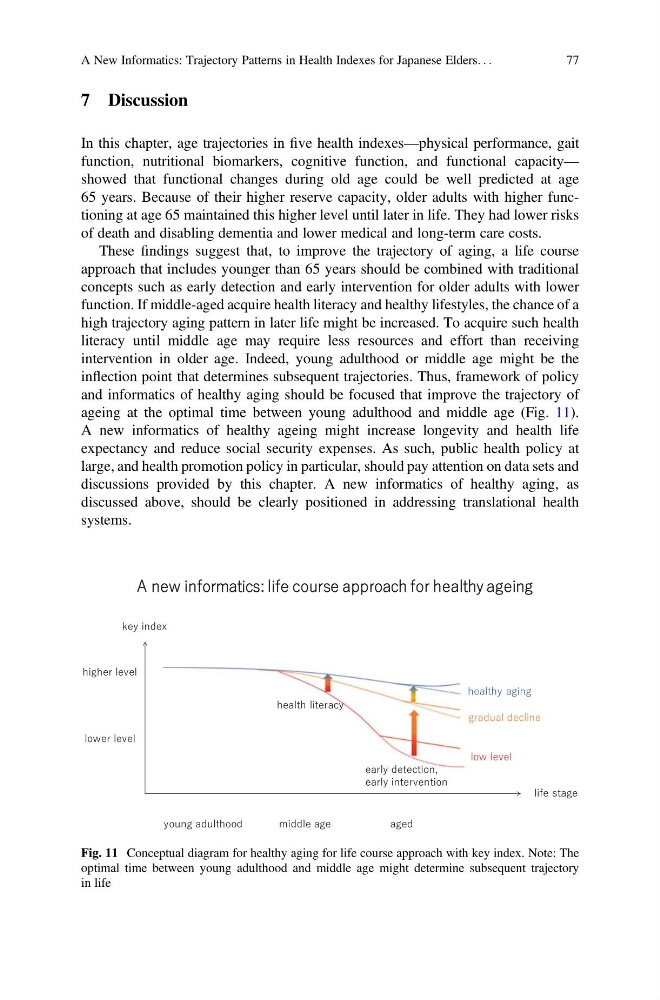
intervention in older age. Indeed, young adulthood or middle age might be the
inflection point that determines subsequent trajectories. Thus, framework of policy
and informatics of healthy aging should be focused that improve the trajectory of
ageing at the optimal time between young adulthood and middle age (Fig. 11).
A new informatics of healthy ageing might increase longevity and health life
expectancy and reduce social security expenses. As such, public health policy at
large, and health promotion policy in particular, should pay attention on data sets and
discussions provided by this chapter. A new informatics of healthy aging, as
discussed above, should be clearly positioned in addressing translational health
systems.
$ $QHZLQIRUPDWLFVOLIHFRXUVHDSSURDFKIRUKHDOWK\DJHLQJ
OLIHVWDJH
\RXQJDGXOWKRRG
PLGGOHDJH
DJHG
NH\LQGH[
KLJKHUOHYHO
ORZHUOHYHO
KHDOWK\DJLQJ
JUDGXDOGHFOLQH
ORZOHYHO
HDUO\GHWHFWLRQ
HDUO\LQWHUYHQWLRQ
KHDOWKOLWHUDF\
Fig. 11 Conceptual diagram for healthy aging for life course approach with key index. Note: The
optimal time between young adulthood and middle age might determine subsequent trajectory
in life
A New Informatics: Trajectory Patterns in Health Indexes for Japanese Elders. . .
77
In this chapter, age trajectories in five health indexes—physical performance, gait
function, nutritional biomarkers, cognitive function, and functional capacity—
showed that functional changes during old age could be well predicted at age
65 years. Because of their higher reserve capacity, older adults with higher functioning at age 65 maintained this higher level until later in life. They had lower risks
of death and disabling dementia and lower medical and long-term care costs.
These findings suggest that, to improve the trajectory of aging, a life course
approach that includes younger than 65 years should be combined with traditional
concepts such as early detection and early intervention for older adults with lower
function. If middle-aged acquire health literacy and healthy lifestyles, the chance of a
high trajectory aging pattern in later life might be increased. To acquire such health
literacy until middle age may require less resources and effort than receiving
intervention in older age. Indeed, young adulthood or middle age might be the
inflection point that determines subsequent trajectories. Thus, framework of policy
and informatics of healthy aging should be focused that improve the trajectory of
ageing at the optimal time between young adulthood and middle age (Fig. 11).
A new informatics of healthy ageing might increase longevity and health life
expectancy and reduce social security expenses. As such, public health policy at
large, and health promotion policy in particular, should pay attention on data sets and
discussions provided by this chapter. A new informatics of healthy aging, as
discussed above, should be clearly positioned in addressing translational health
systems.
$ $QHZLQIRUPDWLFVOLIHFRXUVHDSSURDFKIRUKHDOWK\DJHLQJ
OLIHVWDJH
\RXQJDGXOWKRRG
PLGGOHDJH
DJHG
NH\LQGH[
KLJKHUOHYHO
ORZHUOHYHO
KHDOWK\DJLQJ
JUDGXDOGHFOLQH
ORZOHYHO
HDUO\GHWHFWLRQ
HDUO\LQWHUYHQWLRQ
KHDOWKOLWHUDF\
Fig. 11 Conceptual diagram for healthy aging for life course approach with key index. Note: The
optimal time between young adulthood and middle age might determine subsequent trajectory
in life
A New Informatics: Trajectory Patterns in Health Indexes for Japanese Elders. . .
77