

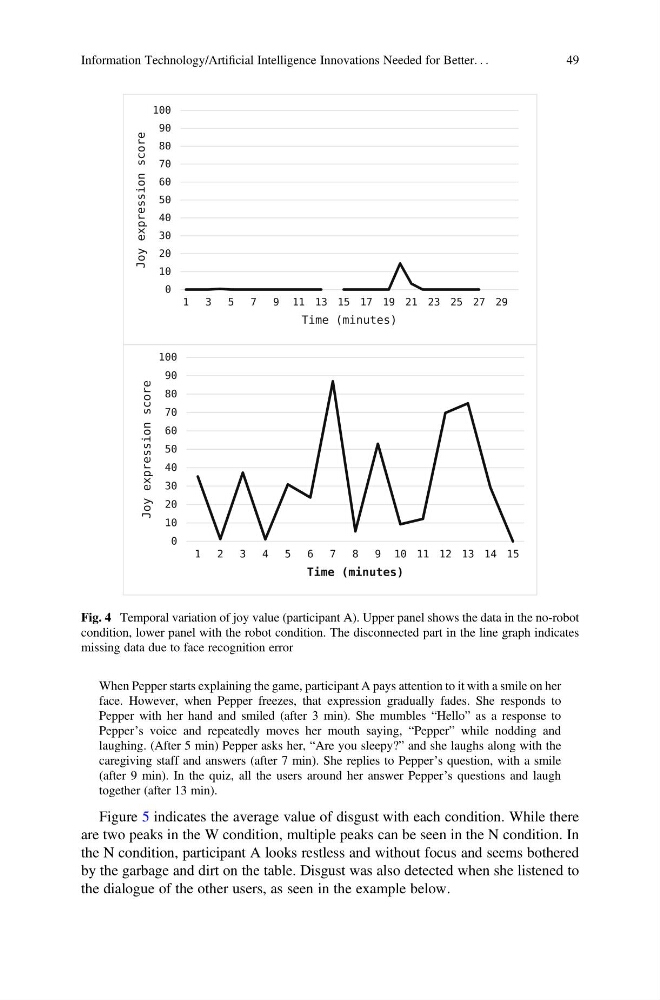
When Pepper starts explaining the game, participant A pays attention to it with a smile on her
face. However, when Pepper freezes, that expression gradually fades. She responds to
Pepper with her hand and smiled (after 3 min). She mumbles “Hello” as a response to
Pepper’s voice and repeatedly moves her mouth saying, “Pepper” while nodding and
laughing. (After 5 min) Pepper asks her, “Are you sleepy?” and she laughs along with the
caregiving staff and answers (after 7 min). She replies to Pepper’s question, with a smile
(after 9 min). In the quiz, all the users around her answer Pepper’s questions and laugh
together (after 13 min).
Figure 5 indicates the average value of disgust with each condition. While there
are two peaks in the W condition, multiple peaks can be seen in the N condition. In
the N condition, participant A looks restless and without focus and seems bothered
by the garbage and dirt on the table. Disgust was also detected when she listened to
the dialogue of the other users, as seen in the example below.
Fig. 4 Temporal variation of joy value (participant A). Upper panel shows the data in the no-robot
condition, lower panel with the robot condition. The disconnected part in the line graph indicates
missing data due to face recognition error
Information Technology/Artificial Intelligence Innovations Needed for Better. . .
49
face. However, when Pepper freezes, that expression gradually fades. She responds to
Pepper with her hand and smiled (after 3 min). She mumbles “Hello” as a response to
Pepper’s voice and repeatedly moves her mouth saying, “Pepper” while nodding and
laughing. (After 5 min) Pepper asks her, “Are you sleepy?” and she laughs along with the
caregiving staff and answers (after 7 min). She replies to Pepper’s question, with a smile
(after 9 min). In the quiz, all the users around her answer Pepper’s questions and laugh
together (after 13 min).
Figure 5 indicates the average value of disgust with each condition. While there
are two peaks in the W condition, multiple peaks can be seen in the N condition. In
the N condition, participant A looks restless and without focus and seems bothered
by the garbage and dirt on the table. Disgust was also detected when she listened to
the dialogue of the other users, as seen in the example below.
Fig. 4 Temporal variation of joy value (participant A). Upper panel shows the data in the no-robot
condition, lower panel with the robot condition. The disconnected part in the line graph indicates
missing data due to face recognition error
Information Technology/Artificial Intelligence Innovations Needed for Better. . .
49