

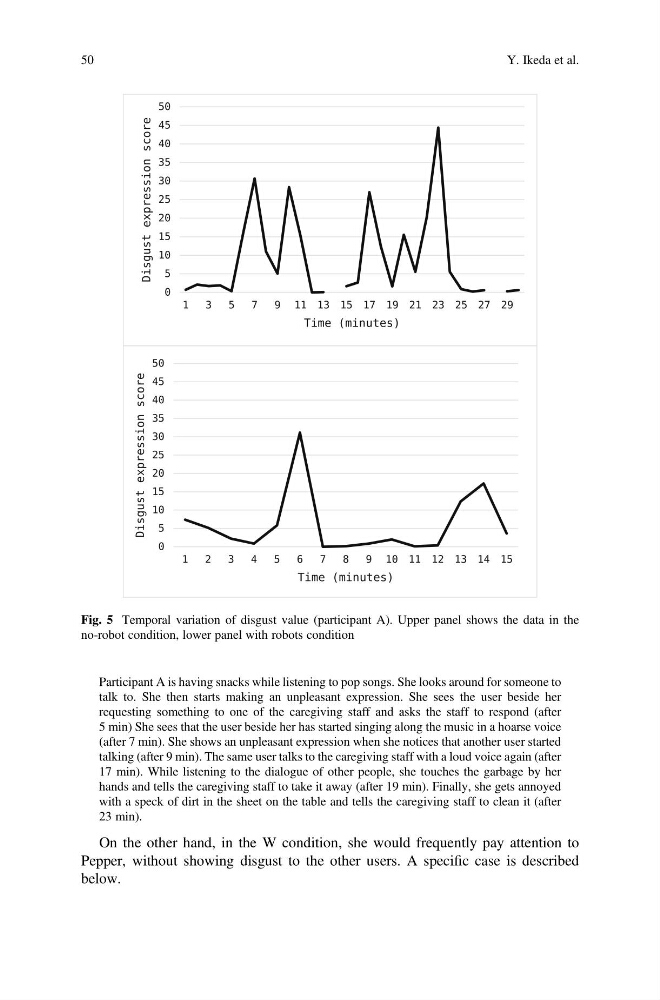
Participant A is having snacks while listening to pop songs. She looks around for someone to
talk to. She then starts making an unpleasant expression. She sees the user beside her
requesting something to one of the caregiving staff and asks the staff to respond (after
5 min) She sees that the user beside her has started singing along the music in a hoarse voice
(after 7 min). She shows an unpleasant expression when she notices that another user started
talking (after 9 min). The same user talks to the caregiving staff with a loud voice again (after
17 min). While listening to the dialogue of other people, she touches the garbage by her
hands and tells the caregiving staff to take it away (after 19 min). Finally, she gets annoyed
with a speck of dirt in the sheet on the table and tells the caregiving staff to clean it (after
23 min).
On the other hand, in the W condition, she would frequently pay attention to
Pepper, without showing disgust to the other users. A specific case is described
below.
Fig. 5 Temporal variation of disgust value (participant A). Upper panel shows the data in the
no-robot condition, lower panel with robots condition
50
Y. Ikeda et al.
talk to. She then starts making an unpleasant expression. She sees the user beside her
requesting something to one of the caregiving staff and asks the staff to respond (after
5 min) She sees that the user beside her has started singing along the music in a hoarse voice
(after 7 min). She shows an unpleasant expression when she notices that another user started
talking (after 9 min). The same user talks to the caregiving staff with a loud voice again (after
17 min). While listening to the dialogue of other people, she touches the garbage by her
hands and tells the caregiving staff to take it away (after 19 min). Finally, she gets annoyed
with a speck of dirt in the sheet on the table and tells the caregiving staff to clean it (after
23 min).
On the other hand, in the W condition, she would frequently pay attention to
Pepper, without showing disgust to the other users. A specific case is described
below.
Fig. 5 Temporal variation of disgust value (participant A). Upper panel shows the data in the
no-robot condition, lower panel with robots condition
50
Y. Ikeda et al.