

of medical knowledge and clinical practice, and the latter has limited knowledge of
diseases and disorders that are unrelated to them. The two sides cross each other and
share a commonplace, resulting in good health care services. Even in an
interprofessional collaboration team consisting of doctors, nurses, occupational
therapists, pharmacists, etc., patients can be placed in the middle, and each job
type can share value only by crossing the boundaries of specialization. Here too, the
role information plays is crucial.
3.4 Translational Actors Spin over Systems’ Boundaries
Ultimately, to cross and bridge different fields is the basis of value co-creation. If we
closely look at the examples of innovation presented in this book and the background of the innovators, we note that none of them has constrained to his or her
traditional discipline, industry, or custom. All are masters who have transcended
existing specialties. These extraordinary people who traverse to other disciplines are
called innovators. A stranger, sometimes called an outsider, in a world of information creates new meaning by transcending this world.
Innovation converge technology, and more precisely, information about technology. It should be noted that the technology itself is a system. Today, the convergence
of these technologies or systems is called converging technologies. Converging
technology is defined as the “convergence of two or more disparate sciences and
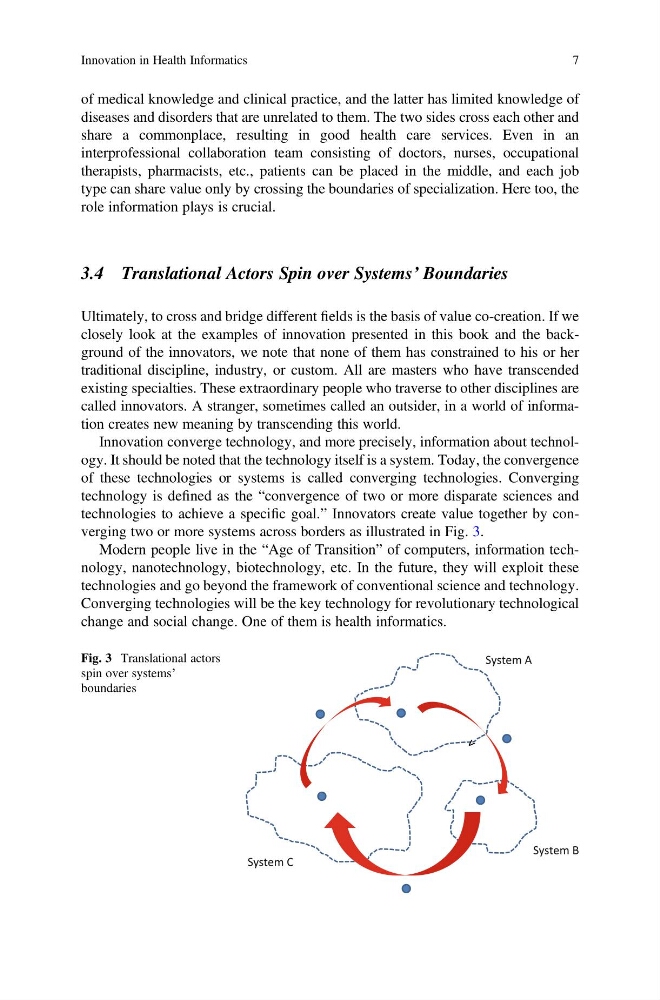
technologies to achieve a specific goal.” Innovators create value together by converging two or more systems across borders as illustrated in Fig. 3.
Modern people live in the “Age of Transition” of computers, information technology, nanotechnology, biotechnology, etc. In the future, they will exploit these
technologies and go beyond the framework of conventional science and technology.
Converging technologies will be the key technology for revolutionary technological
change and social change. One of them is health informatics.
System B
System C
System A
Fig. 3 Translational actors
spin over systems’
boundaries
Innovation in Health Informatics
7
diseases and disorders that are unrelated to them. The two sides cross each other and
share a commonplace, resulting in good health care services. Even in an
interprofessional collaboration team consisting of doctors, nurses, occupational
therapists, pharmacists, etc., patients can be placed in the middle, and each job
type can share value only by crossing the boundaries of specialization. Here too, the
role information plays is crucial.
3.4 Translational Actors Spin over Systems’ Boundaries
Ultimately, to cross and bridge different fields is the basis of value co-creation. If we
closely look at the examples of innovation presented in this book and the background of the innovators, we note that none of them has constrained to his or her
traditional discipline, industry, or custom. All are masters who have transcended
existing specialties. These extraordinary people who traverse to other disciplines are
called innovators. A stranger, sometimes called an outsider, in a world of information creates new meaning by transcending this world.
Innovation converge technology, and more precisely, information about technology. It should be noted that the technology itself is a system. Today, the convergence
of these technologies or systems is called converging technologies. Converging
technology is defined as the “convergence of two or more disparate sciences and
technologies to achieve a specific goal.” Innovators create value together by converging two or more systems across borders as illustrated in Fig. 3.
Modern people live in the “Age of Transition” of computers, information technology, nanotechnology, biotechnology, etc. In the future, they will exploit these
technologies and go beyond the framework of conventional science and technology.
Converging technologies will be the key technology for revolutionary technological
change and social change. One of them is health informatics.
System B
System C
System A
Fig. 3 Translational actors
spin over systems’
boundaries
Innovation in Health Informatics
7