

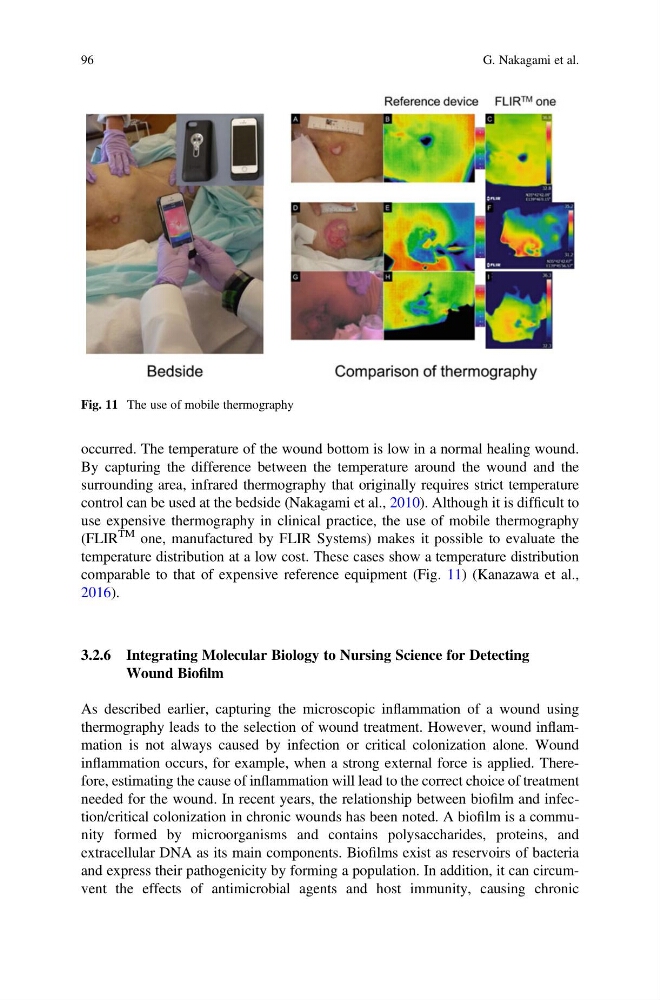
occurred. The temperature of the wound bottom is low in a normal healing wound.
By capturing the difference between the temperature around the wound and the
surrounding area, infrared thermography that originally requires strict temperature
control can be used at the bedside (Nakagami et al., 2010). Although it is difficult to
use expensive thermography in clinical practice, the use of mobile thermography
(FLIR
TM one, manufactured by FLIR Systems) makes it possible to evaluate the
temperature distribution at a low cost. These cases show a temperature distribution
comparable to that of expensive reference equipment (Fig. 11) (Kanazawa et al.,
2016).
3.2.6 Integrating Molecular Biology to Nursing Science for Detecting
Wound Biofilm
As described earlier, capturing the microscopic inflammation of a wound using
thermography leads to the selection of wound treatment. However, wound inflammation is not always caused by infection or critical colonization alone. Wound
inflammation occurs, for example, when a strong external force is applied. Therefore, estimating the cause of inflammation will lead to the correct choice of treatment
needed for the wound. In recent years, the relationship between biofilm and infection/critical colonization in chronic wounds has been noted. A biofilm is a community formed by microorganisms and contains polysaccharides, proteins, and
extracellular DNA as its main components. Biofilms exist as reservoirs of bacteria
and express their pathogenicity by forming a population. In addition, it can circumvent the effects of antimicrobial agents and host immunity, causing chronic
Fig. 11 The use of mobile thermography
96
G. Nakagami et al.
By capturing the difference between the temperature around the wound and the
surrounding area, infrared thermography that originally requires strict temperature
control can be used at the bedside (Nakagami et al., 2010). Although it is difficult to
use expensive thermography in clinical practice, the use of mobile thermography
(FLIR
TM one, manufactured by FLIR Systems) makes it possible to evaluate the
temperature distribution at a low cost. These cases show a temperature distribution
comparable to that of expensive reference equipment (Fig. 11) (Kanazawa et al.,
2016).
3.2.6 Integrating Molecular Biology to Nursing Science for Detecting
Wound Biofilm
As described earlier, capturing the microscopic inflammation of a wound using
thermography leads to the selection of wound treatment. However, wound inflammation is not always caused by infection or critical colonization alone. Wound
inflammation occurs, for example, when a strong external force is applied. Therefore, estimating the cause of inflammation will lead to the correct choice of treatment
needed for the wound. In recent years, the relationship between biofilm and infection/critical colonization in chronic wounds has been noted. A biofilm is a community formed by microorganisms and contains polysaccharides, proteins, and
extracellular DNA as its main components. Biofilms exist as reservoirs of bacteria
and express their pathogenicity by forming a population. In addition, it can circumvent the effects of antimicrobial agents and host immunity, causing chronic
Fig. 11 The use of mobile thermography
96
G. Nakagami et al.