

capable of growing are attached to the wound but do not harm the wound. On the
other hand, critical colonization is a condition that is likely to shift to wound
infection, and there are no signs of infection other than the delay of wound healing,
but clinical improvement such as the speed of healing is improved with the use of
antibiotics. Infection refers to a condition in which growing bacteria enter the tissue
and harm the wound. Patients with pressure ulcers are elderly, often undernourished,
and their poor immune function has created macroscopically unidentifiable conditions such as critical colonization. The fact that wound healing is delayed despite the
lack of gross findings indicates that some host response has occurred after exposure
to the bacteria. We thought that capturing invisible inflammation would lead to the
identification of critical colonization. As a method for estimating the state of
inflammation, we focused on the temperature of the wound site and accumulated
clinical data using infrared thermography.
In the case of a physiological test using infrared thermography, preparation of the
subject is required, such as habituation for a certain period in a constant temperature
room, but it is difficult for pressure ulcer patients to unify such conditions. Further, in
most cases, a dressing material is stuck to the wound, and it is difficult to wait until
the temperature becomes constant after removing the wound because the burden on
the patient is large. In order to solve this problem, the pressure ulcer thermography
compared the temperature with the skin around the pressure ulcer and relatively
evaluated the temperature distribution.
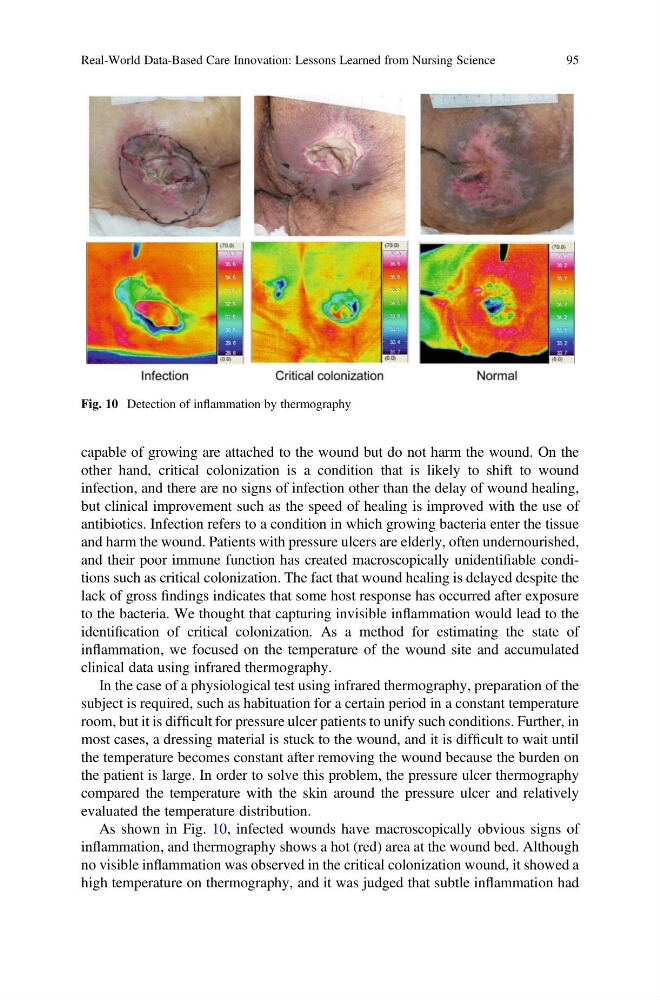
As shown in Fig. 10, infected wounds have macroscopically obvious signs of
inflammation, and thermography shows a hot (red) area at the wound bed. Although
no visible inflammation was observed in the critical colonization wound, it showed a
high temperature on thermography, and it was judged that subtle inflammation had
Fig. 10 Detection of inflammation by thermography
Real-World Data-Based Care Innovation: Lessons Learned from Nursing Science
95
other hand, critical colonization is a condition that is likely to shift to wound
infection, and there are no signs of infection other than the delay of wound healing,
but clinical improvement such as the speed of healing is improved with the use of
antibiotics. Infection refers to a condition in which growing bacteria enter the tissue
and harm the wound. Patients with pressure ulcers are elderly, often undernourished,
and their poor immune function has created macroscopically unidentifiable conditions such as critical colonization. The fact that wound healing is delayed despite the
lack of gross findings indicates that some host response has occurred after exposure
to the bacteria. We thought that capturing invisible inflammation would lead to the
identification of critical colonization. As a method for estimating the state of
inflammation, we focused on the temperature of the wound site and accumulated
clinical data using infrared thermography.
In the case of a physiological test using infrared thermography, preparation of the
subject is required, such as habituation for a certain period in a constant temperature
room, but it is difficult for pressure ulcer patients to unify such conditions. Further, in
most cases, a dressing material is stuck to the wound, and it is difficult to wait until
the temperature becomes constant after removing the wound because the burden on
the patient is large. In order to solve this problem, the pressure ulcer thermography
compared the temperature with the skin around the pressure ulcer and relatively
evaluated the temperature distribution.
As shown in Fig. 10, infected wounds have macroscopically obvious signs of
inflammation, and thermography shows a hot (red) area at the wound bed. Although
no visible inflammation was observed in the critical colonization wound, it showed a
high temperature on thermography, and it was judged that subtle inflammation had
Fig. 10 Detection of inflammation by thermography
Real-World Data-Based Care Innovation: Lessons Learned from Nursing Science
95