

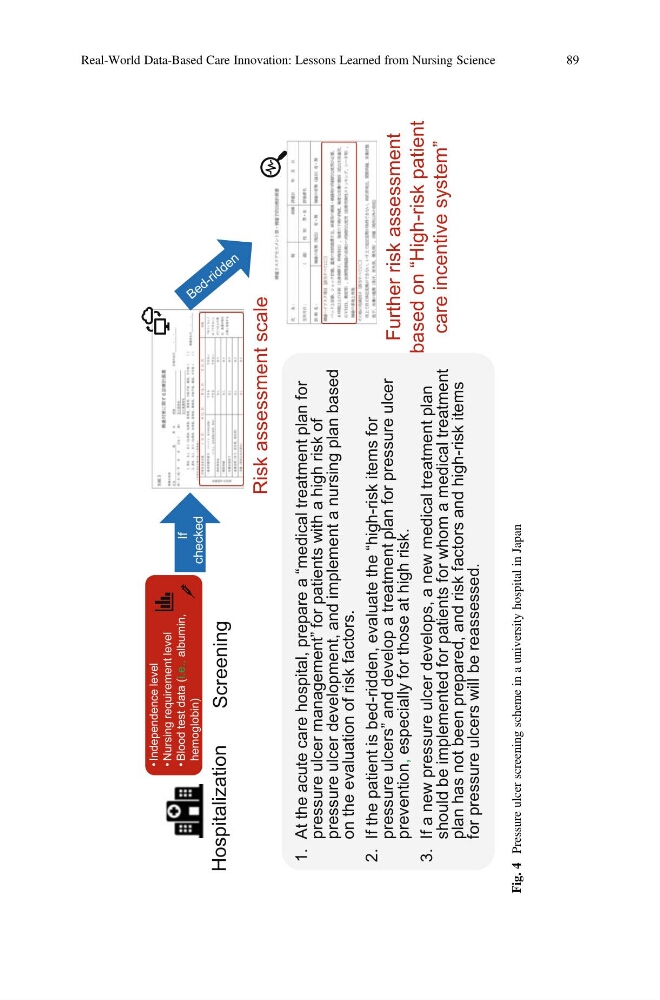
1. At the acute care hospital, prepare a “medical treatment plan for
pressure ulcer management” for patients with a high risk of
pressure ulcer development, and implement a nursing plan based
on the evaluation of risk factors.
2. If the patient is bed-ridden, evaluate the “high-risk items for
pressure ulcers” and develop a treatment plan for pressure ulcer
prevention, especially for those at high risk.
3. If a new pressure ulcer develops, a new medical treatment plan
should be implemented for patients for whom a medical treatment
plan has not been prepared, and risk factors and high-risk items
for pressure ulcers will be reassessed.
• Independence level
• Nursing requirement level
• Blood test data (i.e., albumin,
hemoglobin)
Hospitalization
Screening
If
checked
Risk assessment scale
Further risk assessment
based on “High-risk patient
care incentive system”
Fig. 4
Pressure ulcer screening scheme in a university hospital in Japan
Real-World Data-Based Care Innovation: Lessons Learned from Nursing Science
89
pressure ulcer management” for patients with a high risk of
pressure ulcer development, and implement a nursing plan based
on the evaluation of risk factors.
2. If the patient is bed-ridden, evaluate the “high-risk items for
pressure ulcers” and develop a treatment plan for pressure ulcer
prevention, especially for those at high risk.
3. If a new pressure ulcer develops, a new medical treatment plan
should be implemented for patients for whom a medical treatment
plan has not been prepared, and risk factors and high-risk items
for pressure ulcers will be reassessed.
• Independence level
• Nursing requirement level
• Blood test data (i.e., albumin,
hemoglobin)
Hospitalization
Screening
If
checked
Risk assessment scale
Further risk assessment
based on “High-risk patient
care incentive system”
Fig. 4
Pressure ulcer screening scheme in a university hospital in Japan
Real-World Data-Based Care Innovation: Lessons Learned from Nursing Science
89