

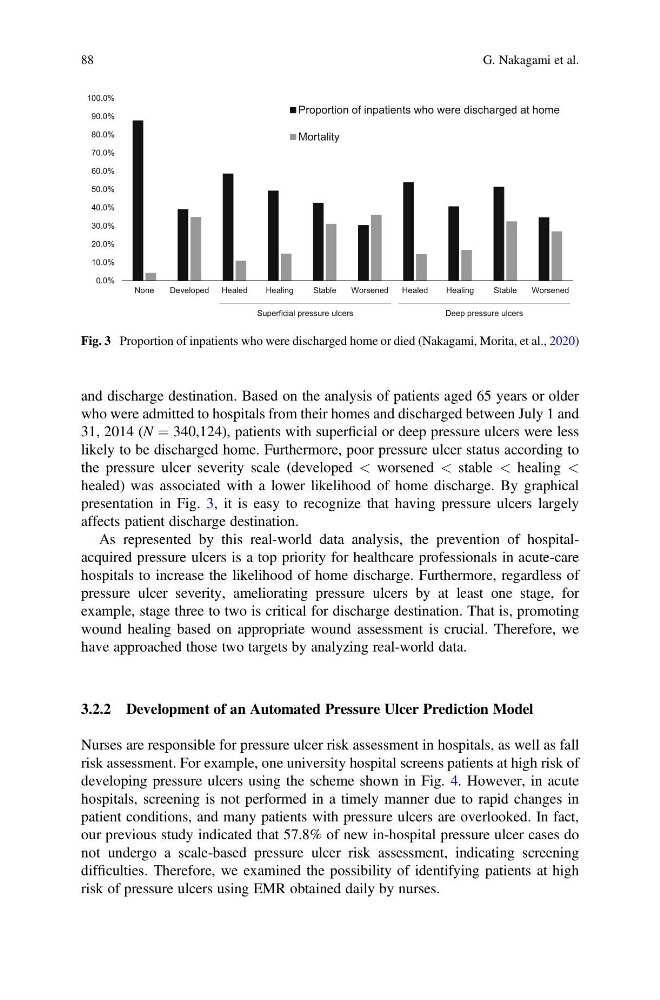
and discharge destination. Based on the analysis of patients aged 65 years or older
who were admitted to hospitals from their homes and discharged between July 1 and
31, 2014 (N ¼ 340,124), patients with superficial or deep pressure ulcers were less
likely to be discharged home. Furthermore, poor pressure ulcer status according to
the pressure ulcer severity scale (developed < worsened < stable < healing <
healed) was associated with a lower likelihood of home discharge. By graphical
presentation in Fig. 3, it is easy to recognize that having pressure ulcers largely
affects patient discharge destination.
As represented by this real-world data analysis, the prevention of hospitalacquired pressure ulcers is a top priority for healthcare professionals in acute-care
hospitals to increase the likelihood of home discharge. Furthermore, regardless of
pressure ulcer severity, ameliorating pressure ulcers by at least one stage, for
example, stage three to two is critical for discharge destination. That is, promoting
wound healing based on appropriate wound assessment is crucial. Therefore, we
have approached those two targets by analyzing real-world data.
3.2.2 Development of an Automated Pressure Ulcer Prediction Model
Nurses are responsible for pressure ulcer risk assessment in hospitals, as well as fall
risk assessment. For example, one university hospital screens patients at high risk of
developing pressure ulcers using the scheme shown in Fig. 4. However, in acute
hospitals, screening is not performed in a timely manner due to rapid changes in
patient conditions, and many patients with pressure ulcers are overlooked. In fact,
our previous study indicated that 57.8% of new in-hospital pressure ulcer cases do
not undergo a scale-based pressure ulcer risk assessment, indicating screening
difficulties. Therefore, we examined the possibility of identifying patients at high
risk of pressure ulcers using EMR obtained daily by nurses.
0.0%
10.0%
20.0%
30.0%
40.0%
50.0%
60.0%
70.0%
80.0%
90.0%
100.0%
None
Developed
Healed
Healing
Stable
Worsened
Healed
Healing
Stable
Worsened
Proportion of inpatients who were discharged at home
Mortality
Superficial pressure ulcers
Deep pressure ulcers
Fig. 3 Proportion of inpatients who were discharged home or died (Nakagami, Morita, et al., 2020)
88
G. Nakagami et al.
who were admitted to hospitals from their homes and discharged between July 1 and
31, 2014 (N ¼ 340,124), patients with superficial or deep pressure ulcers were less
likely to be discharged home. Furthermore, poor pressure ulcer status according to
the pressure ulcer severity scale (developed < worsened < stable < healing <
healed) was associated with a lower likelihood of home discharge. By graphical
presentation in Fig. 3, it is easy to recognize that having pressure ulcers largely
affects patient discharge destination.
As represented by this real-world data analysis, the prevention of hospitalacquired pressure ulcers is a top priority for healthcare professionals in acute-care
hospitals to increase the likelihood of home discharge. Furthermore, regardless of
pressure ulcer severity, ameliorating pressure ulcers by at least one stage, for
example, stage three to two is critical for discharge destination. That is, promoting
wound healing based on appropriate wound assessment is crucial. Therefore, we
have approached those two targets by analyzing real-world data.
3.2.2 Development of an Automated Pressure Ulcer Prediction Model
Nurses are responsible for pressure ulcer risk assessment in hospitals, as well as fall
risk assessment. For example, one university hospital screens patients at high risk of
developing pressure ulcers using the scheme shown in Fig. 4. However, in acute
hospitals, screening is not performed in a timely manner due to rapid changes in
patient conditions, and many patients with pressure ulcers are overlooked. In fact,
our previous study indicated that 57.8% of new in-hospital pressure ulcer cases do
not undergo a scale-based pressure ulcer risk assessment, indicating screening
difficulties. Therefore, we examined the possibility of identifying patients at high
risk of pressure ulcers using EMR obtained daily by nurses.
0.0%
10.0%
20.0%
30.0%
40.0%
50.0%
60.0%
70.0%
80.0%
90.0%
100.0%
None
Developed
Healed
Healing
Stable
Worsened
Healed
Healing
Stable
Worsened
Proportion of inpatients who were discharged at home
Mortality
Superficial pressure ulcers
Deep pressure ulcers
Fig. 3 Proportion of inpatients who were discharged home or died (Nakagami, Morita, et al., 2020)
88
G. Nakagami et al.