

Of the adult patients who were admitted/discharged to a hospital in Tokyo from
2010 to 2017, a dataset was created by collating the admission/discharge information, basic information on nursing on admission, and the medical treatment plan for
pressure ulcer management. Predictive models for the following four types of outcomes were generated: (1) new occurrences; (2) new occurrences outside the
operating department; (3) new occurrences at frequently occurring sites; and
(4) new occurrence at frequently occurring sites outside the operating department.
The frequently occurring sites were defined as the sacrum, coccyx, greater trochanter, iliac, and heel. A 1:1 holdout method was used for learning and verification. A
logistic regression analysis was used as the model.
As predictive factors, variables included in the content that nurses input immediately after patient admission were selected. Specifically, gender, age at admission,
medical department, ward, poor appetite, restricted diet, presence of dentures,
dysphagia, urination method, assisted urination, defecation method, assisted defecation, visual acuity, hearing, speech problems, paralysis, joint contracture, pain,
repositioning, standing up, moving around, going up and down the stairs, care
assistance, instrumental activities of daily living, cleanliness ability, skin condition,
pressure ulcer risk factors, Japan Coma Scale, light reflexes, respiratory problems,
and circulation problems were selected. A dataset of 87,771 patients was created, of
which 1467 newly developed pressure ulcers. The Area Under the Curve of the
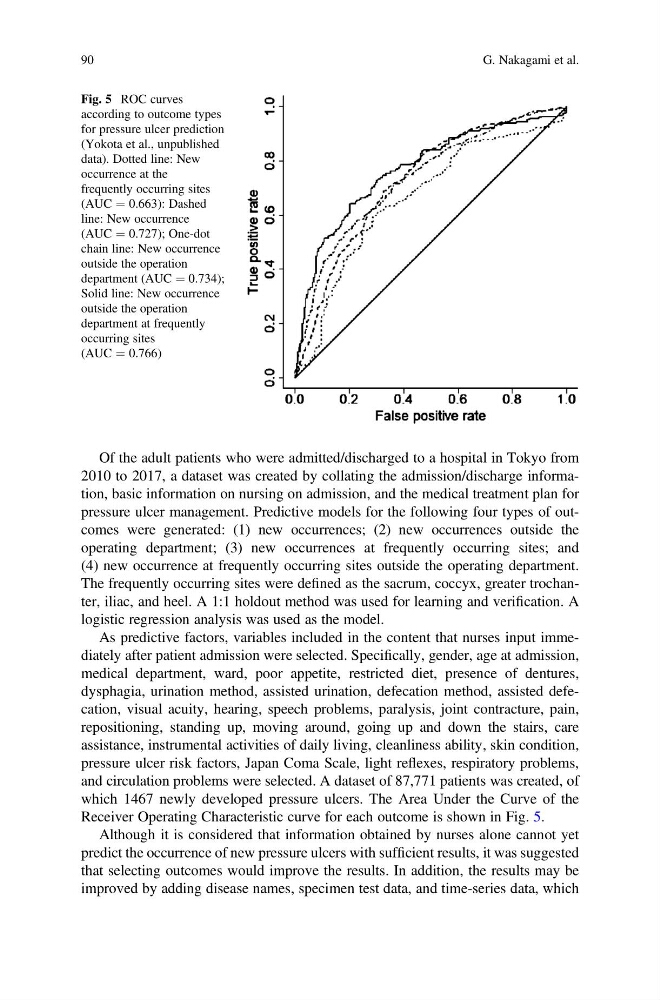
Receiver Operating Characteristic curve for each outcome is shown in Fig. 5.
Although it is considered that information obtained by nurses alone cannot yet
predict the occurrence of new pressure ulcers with sufficient results, it was suggested
that selecting outcomes would improve the results. In addition, the results may be
improved by adding disease names, specimen test data, and time-series data, which
Fig. 5 ROC curves
according to outcome types
for pressure ulcer prediction
(Yokota et al., unpublished
data). Dotted line: New
occurrence at the
frequently occurring sites
(AUC ¼ 0.663): Dashed
line: New occurrence
(AUC ¼ 0.727); One-dot
chain line: New occurrence
outside the operation
department (AUC ¼ 0.734);
Solid line: New occurrence
outside the operation
department at frequently
occurring sites
(AUC ¼ 0.766)
90
G. Nakagami et al.
2010 to 2017, a dataset was created by collating the admission/discharge information, basic information on nursing on admission, and the medical treatment plan for
pressure ulcer management. Predictive models for the following four types of outcomes were generated: (1) new occurrences; (2) new occurrences outside the
operating department; (3) new occurrences at frequently occurring sites; and
(4) new occurrence at frequently occurring sites outside the operating department.
The frequently occurring sites were defined as the sacrum, coccyx, greater trochanter, iliac, and heel. A 1:1 holdout method was used for learning and verification. A
logistic regression analysis was used as the model.
As predictive factors, variables included in the content that nurses input immediately after patient admission were selected. Specifically, gender, age at admission,
medical department, ward, poor appetite, restricted diet, presence of dentures,
dysphagia, urination method, assisted urination, defecation method, assisted defecation, visual acuity, hearing, speech problems, paralysis, joint contracture, pain,
repositioning, standing up, moving around, going up and down the stairs, care
assistance, instrumental activities of daily living, cleanliness ability, skin condition,
pressure ulcer risk factors, Japan Coma Scale, light reflexes, respiratory problems,
and circulation problems were selected. A dataset of 87,771 patients was created, of
which 1467 newly developed pressure ulcers. The Area Under the Curve of the
Receiver Operating Characteristic curve for each outcome is shown in Fig. 5.
Although it is considered that information obtained by nurses alone cannot yet
predict the occurrence of new pressure ulcers with sufficient results, it was suggested
that selecting outcomes would improve the results. In addition, the results may be
improved by adding disease names, specimen test data, and time-series data, which
Fig. 5 ROC curves
according to outcome types
for pressure ulcer prediction
(Yokota et al., unpublished
data). Dotted line: New
occurrence at the
frequently occurring sites
(AUC ¼ 0.663): Dashed
line: New occurrence
(AUC ¼ 0.727); One-dot
chain line: New occurrence
outside the operation
department (AUC ¼ 0.734);
Solid line: New occurrence
outside the operation
department at frequently
occurring sites
(AUC ¼ 0.766)
90
G. Nakagami et al.