

32
2 Conventional Approaches for Waste Management …
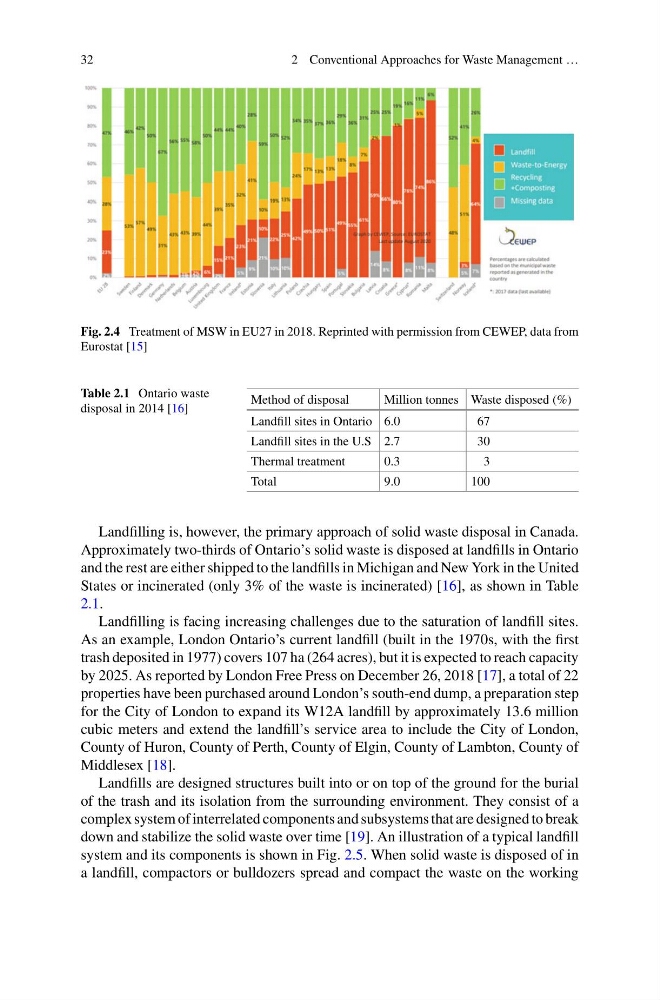
Fig. 2.4 Treatment of MSW in EU27 in 2018. Reprinted with permission from CEWEP, data from
Eurostat [15]
Table 2.1 Ontario waste
disposal in 2014 [16]
Method of disposal
Million tonnes Waste disposed (%)
Landfill sites in Ontario 6.0
67
Landfill sites in the U.S 2.7
30
Thermal treatment
0.3
3
Total
9.0
100
Landfilling is, however, the primary approach of solid waste disposal in Canada.
Approximately two-thirds of Ontario’s solid waste is disposed at landfills in Ontario
and the rest are either shipped to the landfills in Michigan and New York in the United
States or incinerated (only 3% of the waste is incinerated) [16], as shown in Table
2.1.
Landfilling is facing increasing challenges due to the saturation of landfill sites.
As an example, London Ontario’s current landfill (built in the 1970s, with the first
trash deposited in 1977) covers 107 ha (264 acres), but it is expected to reach capacity
by 2025. As reported by London Free Press on December 26, 2018 [17], a total of 22
properties have been purchased around London’s south-end dump, a preparation step
for the City of London to expand its W12A landfill by approximately 13.6 million
cubic meters and extend the landfill’s service area to include the City of London,
County of Huron, County of Perth, County of Elgin, County of Lambton, County of
Middlesex [18].
Landfills are designed structures built into or on top of the ground for the burial
of the trash and its isolation from the surrounding environment. They consist of a
complex system of interrelated components and subsystems that are designed to break
down and stabilize the solid waste over time [19]. An illustration of a typical landfill
system and its components is shown in Fig. 2.5. When solid waste is disposed of in
a landfill, compactors or bulldozers spread and compact the waste on the working
2 Conventional Approaches for Waste Management …
Fig. 2.4 Treatment of MSW in EU27 in 2018. Reprinted with permission from CEWEP, data from
Eurostat [15]
Table 2.1 Ontario waste
disposal in 2014 [16]
Method of disposal
Million tonnes Waste disposed (%)
Landfill sites in Ontario 6.0
67
Landfill sites in the U.S 2.7
30
Thermal treatment
0.3
3
Total
9.0
100
Landfilling is, however, the primary approach of solid waste disposal in Canada.
Approximately two-thirds of Ontario’s solid waste is disposed at landfills in Ontario
and the rest are either shipped to the landfills in Michigan and New York in the United
States or incinerated (only 3% of the waste is incinerated) [16], as shown in Table
2.1.
Landfilling is facing increasing challenges due to the saturation of landfill sites.
As an example, London Ontario’s current landfill (built in the 1970s, with the first
trash deposited in 1977) covers 107 ha (264 acres), but it is expected to reach capacity
by 2025. As reported by London Free Press on December 26, 2018 [17], a total of 22
properties have been purchased around London’s south-end dump, a preparation step
for the City of London to expand its W12A landfill by approximately 13.6 million
cubic meters and extend the landfill’s service area to include the City of London,
County of Huron, County of Perth, County of Elgin, County of Lambton, County of
Middlesex [18].
Landfills are designed structures built into or on top of the ground for the burial
of the trash and its isolation from the surrounding environment. They consist of a
complex system of interrelated components and subsystems that are designed to break
down and stabilize the solid waste over time [19]. An illustration of a typical landfill
system and its components is shown in Fig. 2.5. When solid waste is disposed of in
a landfill, compactors or bulldozers spread and compact the waste on the working