

1.3 Waste Management Strategies
9
1.3 Waste Management Strategies
1.3.1 Waste Management Hierarchy
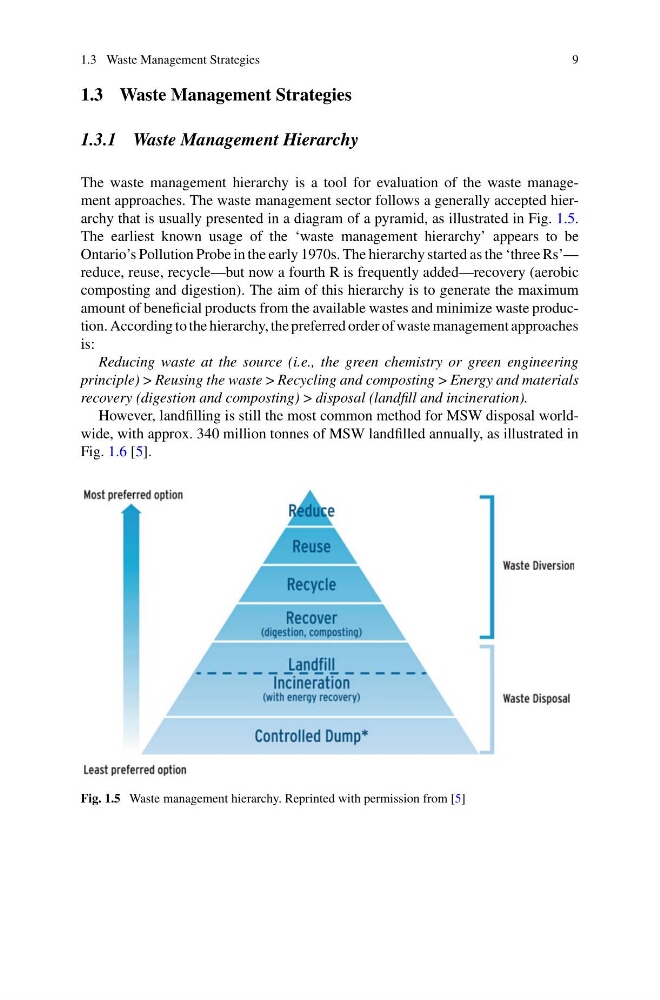
The waste management hierarchy is a tool for evaluation of the waste management approaches. The waste management sector follows a generally accepted hierarchy that is usually presented in a diagram of a pyramid, as illustrated in Fig. 1.5.
The earliest known usage of the ‘waste management hierarchy’ appears to be
Ontario’s Pollution Probe in the early 1970s. The hierarchy started as the ‘three Rs’—
reduce, reuse, recycle—but now a fourth R is frequently added—recovery (aerobic
composting and digestion). The aim of this hierarchy is to generate the maximum
amount of beneficial products from the available wastes and minimize waste production. According to the hierarchy, the preferred order of waste management approaches
is:
Reducing waste at the source (i.e., the green chemistry or green engineering
principle) > Reusing the waste > Recycling and composting > Energy and materials
recovery (digestion and composting) > disposal (landfill and incineration).
However, landfilling is still the most common method for MSW disposal worldwide, with approx. 340 million tonnes of MSW landfilled annually, as illustrated in
Fig. 1.6 [5].
Fig. 1.5 Waste management hierarchy. Reprinted with permission from [5]
9
1.3 Waste Management Strategies
1.3.1 Waste Management Hierarchy
The waste management hierarchy is a tool for evaluation of the waste management approaches. The waste management sector follows a generally accepted hierarchy that is usually presented in a diagram of a pyramid, as illustrated in Fig. 1.5.
The earliest known usage of the ‘waste management hierarchy’ appears to be
Ontario’s Pollution Probe in the early 1970s. The hierarchy started as the ‘three Rs’—
reduce, reuse, recycle—but now a fourth R is frequently added—recovery (aerobic
composting and digestion). The aim of this hierarchy is to generate the maximum
amount of beneficial products from the available wastes and minimize waste production. According to the hierarchy, the preferred order of waste management approaches
is:
Reducing waste at the source (i.e., the green chemistry or green engineering
principle) > Reusing the waste > Recycling and composting > Energy and materials
recovery (digestion and composting) > disposal (landfill and incineration).
However, landfilling is still the most common method for MSW disposal worldwide, with approx. 340 million tonnes of MSW landfilled annually, as illustrated in
Fig. 1.6 [5].
Fig. 1.5 Waste management hierarchy. Reprinted with permission from [5]