

8
1 Wastes Generation, Characterization, Management Strategies …
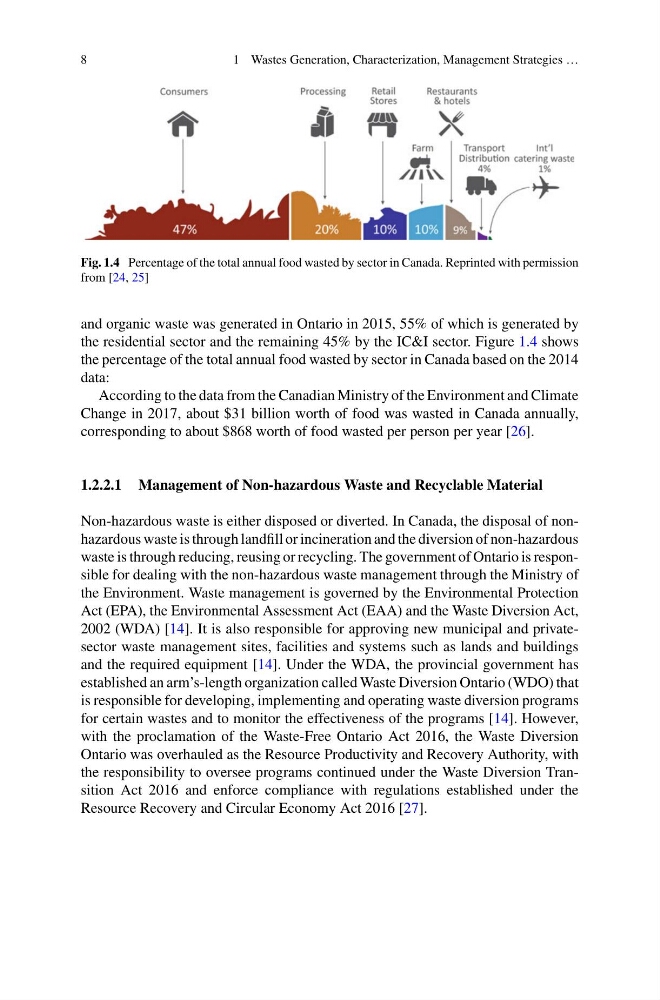
Fig. 1.4 Percentage of the total annual food wasted by sector in Canada. Reprinted with permission
from [24, 25]
and organic waste was generated in Ontario in 2015, 55% of which is generated by
the residential sector and the remaining 45% by the IC&I sector. Figure 1.4 shows
the percentage of the total annual food wasted by sector in Canada based on the 2014
data:
According to the data from the Canadian Ministry of the Environment and Climate
Change in 2017, about $31 billion worth of food was wasted in Canada annually,
corresponding to about $868 worth of food wasted per person per year [26].
1.2.2.1 Management of Non-hazardous Waste and Recyclable Material
Non-hazardous waste is either disposed or diverted. In Canada, the disposal of nonhazardous waste is through landfill or incineration and the diversion of non-hazardous
waste is through reducing, reusing or recycling. The government of Ontario is responsible for dealing with the non-hazardous waste management through the Ministry of
the Environment. Waste management is governed by the Environmental Protection
Act (EPA), the Environmental Assessment Act (EAA) and the Waste Diversion Act,
2002 (WDA) [14]. It is also responsible for approving new municipal and privatesector waste management sites, facilities and systems such as lands and buildings
and the required equipment [14]. Under the WDA, the provincial government has
established an arm’s-length organization called Waste Diversion Ontario (WDO) that
is responsible for developing, implementing and operating waste diversion programs
for certain wastes and to monitor the effectiveness of the programs [14]. However,
with the proclamation of the Waste-Free Ontario Act 2016, the Waste Diversion
Ontario was overhauled as the Resource Productivity and Recovery Authority, with
the responsibility to oversee programs continued under the Waste Diversion Transition Act 2016 and enforce compliance with regulations established under the
Resource Recovery and Circular Economy Act 2016 [27].
1 Wastes Generation, Characterization, Management Strategies …
Fig. 1.4 Percentage of the total annual food wasted by sector in Canada. Reprinted with permission
from [24, 25]
and organic waste was generated in Ontario in 2015, 55% of which is generated by
the residential sector and the remaining 45% by the IC&I sector. Figure 1.4 shows
the percentage of the total annual food wasted by sector in Canada based on the 2014
data:
According to the data from the Canadian Ministry of the Environment and Climate
Change in 2017, about $31 billion worth of food was wasted in Canada annually,
corresponding to about $868 worth of food wasted per person per year [26].
1.2.2.1 Management of Non-hazardous Waste and Recyclable Material
Non-hazardous waste is either disposed or diverted. In Canada, the disposal of nonhazardous waste is through landfill or incineration and the diversion of non-hazardous
waste is through reducing, reusing or recycling. The government of Ontario is responsible for dealing with the non-hazardous waste management through the Ministry of
the Environment. Waste management is governed by the Environmental Protection
Act (EPA), the Environmental Assessment Act (EAA) and the Waste Diversion Act,
2002 (WDA) [14]. It is also responsible for approving new municipal and privatesector waste management sites, facilities and systems such as lands and buildings
and the required equipment [14]. Under the WDA, the provincial government has
established an arm’s-length organization called Waste Diversion Ontario (WDO) that
is responsible for developing, implementing and operating waste diversion programs
for certain wastes and to monitor the effectiveness of the programs [14]. However,
with the proclamation of the Waste-Free Ontario Act 2016, the Waste Diversion
Ontario was overhauled as the Resource Productivity and Recovery Authority, with
the responsibility to oversee programs continued under the Waste Diversion Transition Act 2016 and enforce compliance with regulations established under the
Resource Recovery and Circular Economy Act 2016 [27].