

1.2 Wastes Characterization
7
such as land (including fossil fuels, minerals, etc.), water (oceans, lakes rivers, etc.),
soil, plants (including forest, crops, etc.), and animals. Examples of these residuals
include waste rocks and overburden, rejected mineral ores and mine tailings from
metal and non-metal mining, oil sands mining and processing, agricultural/forestry
residues, etc. These residuals can result in the release of chemicals and metals to
water and soil [2].
Canada’s oil sands (naturally occurring mixtures of sand, clay or other minerals,
water, and bitumen) are the third-largest proven oil reserve in the world, representing
166.3 billion barrels (or 97%) of Canada’s 171 billion barrels of proven oil reserves. It
produced 2.2 million barrels of synthetic crude oil per day from oil sands in 2014 [16].
However, as previously mentioned, Canada’s oil sands industry is the largest solid
waste producer in Canada, creating vast and fast-growing quantities of waste every
year [2]. In 2008, it generated 645 million tonnes of tailings from surface mining
operation [2]. Nevertheless, Canada’s oil sands industry is committed to reducing its
environmental footprint, reclaiming all lands affected by operations and maintaining
biodiversity, and continuing to reduce Greenhouse Gas (GHG) emissions intensity
[17].
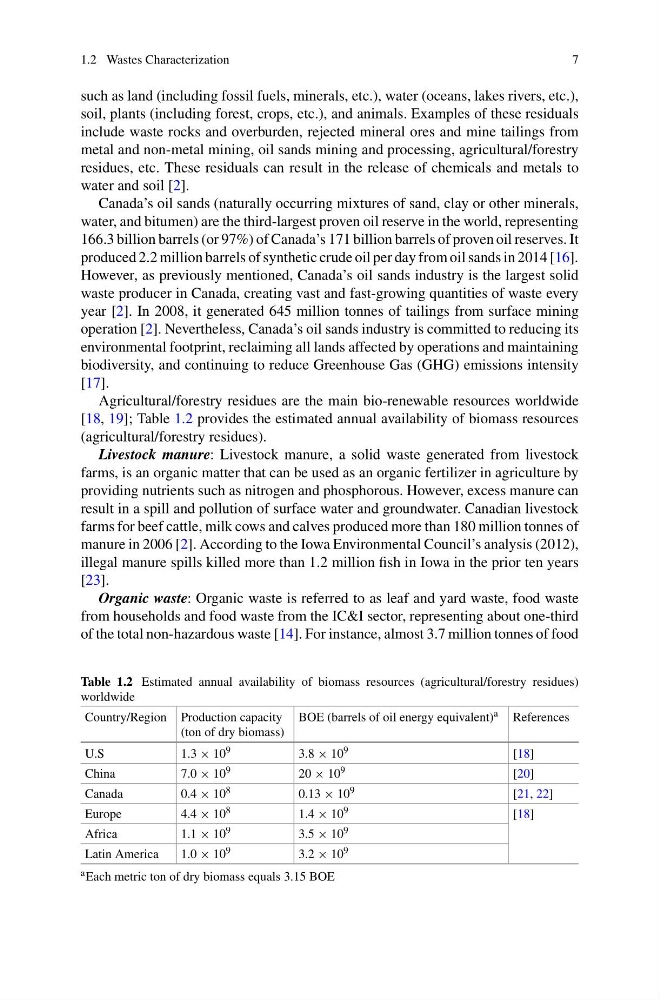
Agricultural/forestry residues are the main bio-renewable resources worldwide
[18, 19]; Table 1.2 provides the estimated annual availability of biomass resources
(agricultural/forestry residues).
Livestock manure: Livestock manure, a solid waste generated from livestock
farms, is an organic matter that can be used as an organic fertilizer in agriculture by
providing nutrients such as nitrogen and phosphorous. However, excess manure can
result in a spill and pollution of surface water and groundwater. Canadian livestock
farms for beef cattle, milk cows and calves produced more than 180 million tonnes of
manure in 2006 [2]. According to the Iowa Environmental Council’s analysis (2012),
illegal manure spills killed more than 1.2 million fish in Iowa in the prior ten years
[23].
Organic waste: Organic waste is referred to as leaf and yard waste, food waste
from households and food waste from the IC&I sector, representing about one-third
of the total non-hazardous waste [14]. For instance, almost 3.7 million tonnes of food
Table 1.2 Estimated annual availability of biomass resources (agricultural/forestry residues)
worldwide
Country/Region Production capacity
(ton of dry biomass)
BOE (barrels of oil energy equivalent) a References
U.S
1.3 × 10 9
3.8 × 10 9
[18]
China
7.0 × 10 9
20 × 10 9
[20]
Canada
0.4 × 10 8
0.13 × 10 9
[21, 22]
Europe
4.4 × 10 8
1.4 × 10 9
[18]
Africa
1.1 × 10 9
3.5 × 10 9
Latin America
1.0 × 10 9
3.2 × 10 9
a Each metric ton of dry biomass equals 3.15 BOE
7
such as land (including fossil fuels, minerals, etc.), water (oceans, lakes rivers, etc.),
soil, plants (including forest, crops, etc.), and animals. Examples of these residuals
include waste rocks and overburden, rejected mineral ores and mine tailings from
metal and non-metal mining, oil sands mining and processing, agricultural/forestry
residues, etc. These residuals can result in the release of chemicals and metals to
water and soil [2].
Canada’s oil sands (naturally occurring mixtures of sand, clay or other minerals,
water, and bitumen) are the third-largest proven oil reserve in the world, representing
166.3 billion barrels (or 97%) of Canada’s 171 billion barrels of proven oil reserves. It
produced 2.2 million barrels of synthetic crude oil per day from oil sands in 2014 [16].
However, as previously mentioned, Canada’s oil sands industry is the largest solid
waste producer in Canada, creating vast and fast-growing quantities of waste every
year [2]. In 2008, it generated 645 million tonnes of tailings from surface mining
operation [2]. Nevertheless, Canada’s oil sands industry is committed to reducing its
environmental footprint, reclaiming all lands affected by operations and maintaining
biodiversity, and continuing to reduce Greenhouse Gas (GHG) emissions intensity
[17].
Agricultural/forestry residues are the main bio-renewable resources worldwide
[18, 19]; Table 1.2 provides the estimated annual availability of biomass resources
(agricultural/forestry residues).
Livestock manure: Livestock manure, a solid waste generated from livestock
farms, is an organic matter that can be used as an organic fertilizer in agriculture by
providing nutrients such as nitrogen and phosphorous. However, excess manure can
result in a spill and pollution of surface water and groundwater. Canadian livestock
farms for beef cattle, milk cows and calves produced more than 180 million tonnes of
manure in 2006 [2]. According to the Iowa Environmental Council’s analysis (2012),
illegal manure spills killed more than 1.2 million fish in Iowa in the prior ten years
[23].
Organic waste: Organic waste is referred to as leaf and yard waste, food waste
from households and food waste from the IC&I sector, representing about one-third
of the total non-hazardous waste [14]. For instance, almost 3.7 million tonnes of food
Table 1.2 Estimated annual availability of biomass resources (agricultural/forestry residues)
worldwide
Country/Region Production capacity
(ton of dry biomass)
BOE (barrels of oil energy equivalent) a References
U.S
1.3 × 10 9
3.8 × 10 9
[18]
China
7.0 × 10 9
20 × 10 9
[20]
Canada
0.4 × 10 8
0.13 × 10 9
[21, 22]
Europe
4.4 × 10 8
1.4 × 10 9
[18]
Africa
1.1 × 10 9
3.5 × 10 9
Latin America
1.0 × 10 9
3.2 × 10 9
a Each metric ton of dry biomass equals 3.15 BOE