

5.8 Metallurgical Methods for Metals Recovery
141
5.8.2.2 Halide Leaching
Using halides such as fluorine, chlorine, bromine, iodine and astatine for gold
recovery is even older than using cyanide for the same purpose. When gold reacts
with chloride, bromide and iodide, both forms of Au (I) and Au (III) complexes are
produced [12]. Operating parameters such as the halides concentration, temperature,
leaching time, surface area and pH are important factors determining the effectiveness
of halides leaching. Among all of the halides, chlorine/chloride has the advantage
of higher leaching rate, less pollution and selective leaching of different metals by
improving the redox potential [25]. However, the chloride leaching is highly acidic
and corrosive and special materials are required for the leaching equipment. In addition, chlorine gas is highly toxic and special considerations are required to avoid
adverse impacts on the environment and human health [20]. Gold is traditionally
dissolved in aqua regia, which is a combination of concentrated hydrochloric and
nitric acids in a molar ratio of 3:1. It is an extremely corrosive, yellow-orange and
fuming liquid that can dissolve noble metals such as gold and platinum. The leaching
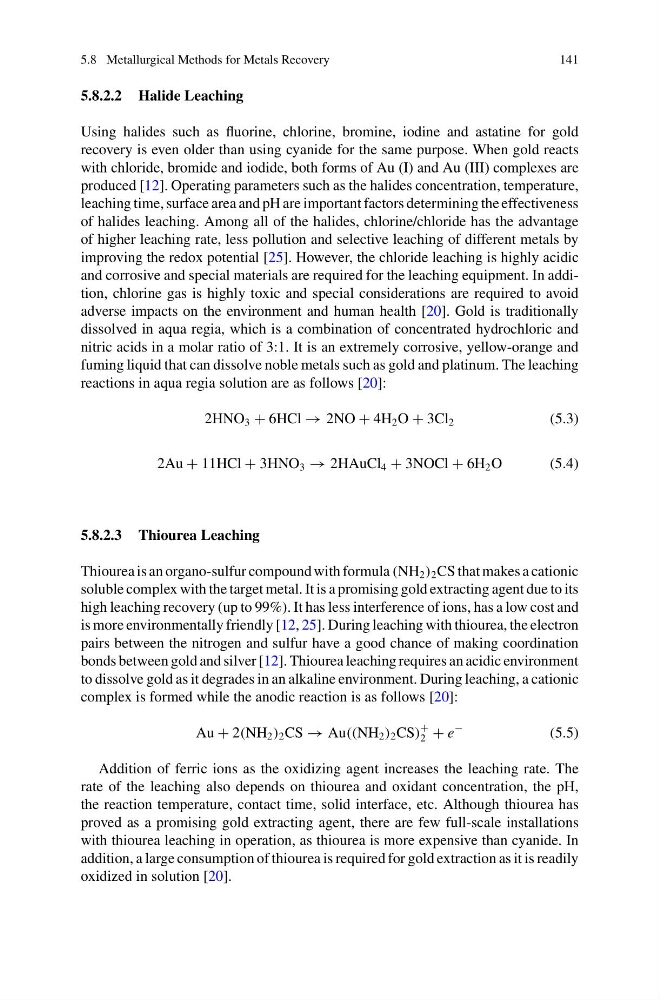
reactions in aqua regia solution are as follows [20]:
2HNO 3 + 6HCl → 2NO + 4H 2 O + 3Cl 2
(5.3)
2Au + 11HCl + 3HNO 3 → 2HAuCl 4 + 3NOCl + 6H 2 O
( 5 . 4 )
5.8.2.3 Thiourea Leaching
Thiourea is an organo-sulfur compound with formula (NH 2 ) 2 CS that makes a cationic
soluble complex with the target metal. It is a promising gold extracting agent due to its
high leaching recovery (up to 99%). It has less interference of ions, has a low cost and
is more environmentally friendly [12, 25]. During leaching with thiourea, the electron
pairs between the nitrogen and sulfur have a good chance of making coordination
bonds between gold and silver [12]. Thiourea leaching requires an acidic environment
to dissolve gold as it degrades in an alkaline environment. During leaching, a cationic
complex is formed while the anodic reaction is as follows [20]:
Au + 2(NH 2 ) 2 CS → Au((NH 2 ) 2 CS)
+
2 + e
−
(5.5)
Addition of ferric ions as the oxidizing agent increases the leaching rate. The
rate of the leaching also depends on thiourea and oxidant concentration, the pH,
the reaction temperature, contact time, solid interface, etc. Although thiourea has
proved as a promising gold extracting agent, there are few full-scale installations
with thiourea leaching in operation, as thiourea is more expensive than cyanide. In
addition, a large consumption of thiourea is required for gold extraction as it is readily
oxidized in solution [20].
141
5.8.2.2 Halide Leaching
Using halides such as fluorine, chlorine, bromine, iodine and astatine for gold
recovery is even older than using cyanide for the same purpose. When gold reacts
with chloride, bromide and iodide, both forms of Au (I) and Au (III) complexes are
produced [12]. Operating parameters such as the halides concentration, temperature,
leaching time, surface area and pH are important factors determining the effectiveness
of halides leaching. Among all of the halides, chlorine/chloride has the advantage
of higher leaching rate, less pollution and selective leaching of different metals by
improving the redox potential [25]. However, the chloride leaching is highly acidic
and corrosive and special materials are required for the leaching equipment. In addition, chlorine gas is highly toxic and special considerations are required to avoid
adverse impacts on the environment and human health [20]. Gold is traditionally
dissolved in aqua regia, which is a combination of concentrated hydrochloric and
nitric acids in a molar ratio of 3:1. It is an extremely corrosive, yellow-orange and
fuming liquid that can dissolve noble metals such as gold and platinum. The leaching
reactions in aqua regia solution are as follows [20]:
2HNO 3 + 6HCl → 2NO + 4H 2 O + 3Cl 2
(5.3)
2Au + 11HCl + 3HNO 3 → 2HAuCl 4 + 3NOCl + 6H 2 O
( 5 . 4 )
5.8.2.3 Thiourea Leaching
Thiourea is an organo-sulfur compound with formula (NH 2 ) 2 CS that makes a cationic
soluble complex with the target metal. It is a promising gold extracting agent due to its
high leaching recovery (up to 99%). It has less interference of ions, has a low cost and
is more environmentally friendly [12, 25]. During leaching with thiourea, the electron
pairs between the nitrogen and sulfur have a good chance of making coordination
bonds between gold and silver [12]. Thiourea leaching requires an acidic environment
to dissolve gold as it degrades in an alkaline environment. During leaching, a cationic
complex is formed while the anodic reaction is as follows [20]:
Au + 2(NH 2 ) 2 CS → Au((NH 2 ) 2 CS)
+
2 + e
−
(5.5)
Addition of ferric ions as the oxidizing agent increases the leaching rate. The
rate of the leaching also depends on thiourea and oxidant concentration, the pH,
the reaction temperature, contact time, solid interface, etc. Although thiourea has
proved as a promising gold extracting agent, there are few full-scale installations
with thiourea leaching in operation, as thiourea is more expensive than cyanide. In
addition, a large consumption of thiourea is required for gold extraction as it is readily
oxidized in solution [20].