

140
5 Recovery of Metals from Electronic Waste
– Toxicity of cyanide: Use of this chemical could result in contamination of surface
water and serious health problems;
– Difficulty of halide leaching: Halide leaching is associated with strong corrosive
acids and oxidizing conditions that require specific material for the equipment;
– High cost and consumption of thiourea leachant: It limits the application of
thiourea for the extraction of precious metals. In addition, further developments
are required for enhancing the current thiourea-based leaching methods;
– High consumption rate of thiosulfate: It requires higher amounts of thiosulfate
limiting its application, and the thiosulfate leaching process is slower compared
to processes with other leaching agents;
– The risk of losing precious metals: The loss of metals during dissolution and the
subsequent steps reduces the overall recovery rate of these metals.
5.8.2.1 Cyanide Leaching
Recovery of gold and silver has attracted more attention compared to other precious
metals, as they are present in considerable amounts in e-waste, especially in cell
phones [25]. Using cyanide for the recovery of gold has been established since more
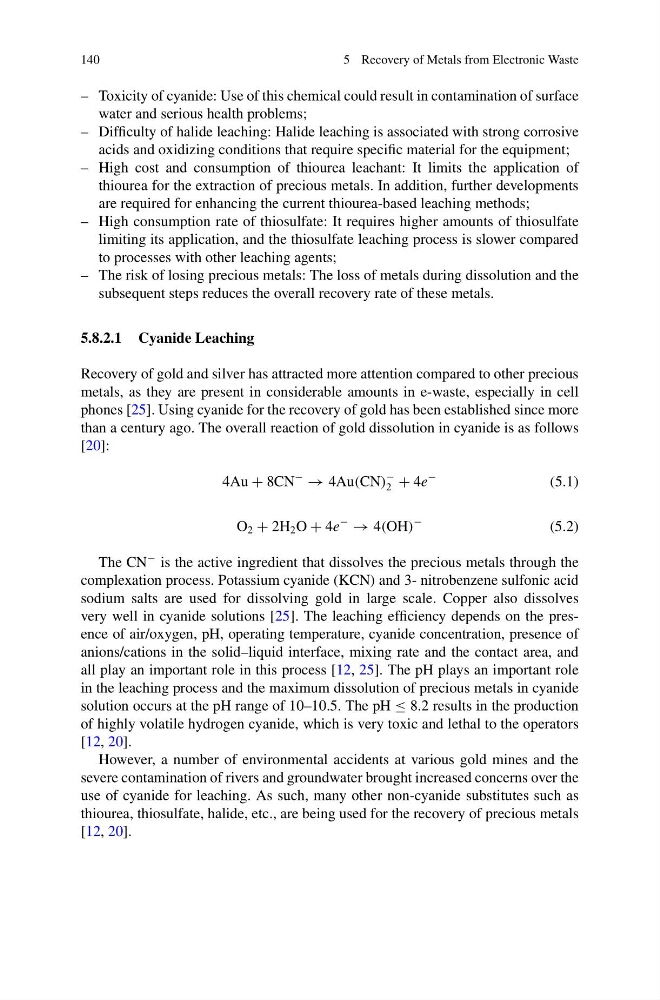
than a century ago. The overall reaction of gold dissolution in cyanide is as follows
[20]:
4Au + 8CN
−
→ 4Au(CN)
−
2 + 4e
−
(5.1)
O 2 + 2H 2 O + 4e
−
→ 4(OH)
−
(5.2)
The CN
− is the active ingredient that dissolves the precious metals through the
complexation process. Potassium cyanide (KCN) and 3- nitrobenzene sulfonic acid
sodium salts are used for dissolving gold in large scale. Copper also dissolves
very well in cyanide solutions [25]. The leaching efficiency depends on the presence of air/oxygen, pH, operating temperature, cyanide concentration, presence of
anions/cations in the solid–liquid interface, mixing rate and the contact area, and
all play an important role in this process [12, 25]. The pH plays an important role
in the leaching process and the maximum dissolution of precious metals in cyanide
solution occurs at the pH range of 10–10.5. The pH ≤ 8.2 results in the production
of highly volatile hydrogen cyanide, which is very toxic and lethal to the operators
[12, 20].
However, a number of environmental accidents at various gold mines and the
severe contamination of rivers and groundwater brought increased concerns over the
use of cyanide for leaching. As such, many other non-cyanide substitutes such as
thiourea, thiosulfate, halide, etc., are being used for the recovery of precious metals
[12, 20].
5 Recovery of Metals from Electronic Waste
– Toxicity of cyanide: Use of this chemical could result in contamination of surface
water and serious health problems;
– Difficulty of halide leaching: Halide leaching is associated with strong corrosive
acids and oxidizing conditions that require specific material for the equipment;
– High cost and consumption of thiourea leachant: It limits the application of
thiourea for the extraction of precious metals. In addition, further developments
are required for enhancing the current thiourea-based leaching methods;
– High consumption rate of thiosulfate: It requires higher amounts of thiosulfate
limiting its application, and the thiosulfate leaching process is slower compared
to processes with other leaching agents;
– The risk of losing precious metals: The loss of metals during dissolution and the
subsequent steps reduces the overall recovery rate of these metals.
5.8.2.1 Cyanide Leaching
Recovery of gold and silver has attracted more attention compared to other precious
metals, as they are present in considerable amounts in e-waste, especially in cell
phones [25]. Using cyanide for the recovery of gold has been established since more
than a century ago. The overall reaction of gold dissolution in cyanide is as follows
[20]:
4Au + 8CN
−
→ 4Au(CN)
−
2 + 4e
−
(5.1)
O 2 + 2H 2 O + 4e
−
→ 4(OH)
−
(5.2)
The CN
− is the active ingredient that dissolves the precious metals through the
complexation process. Potassium cyanide (KCN) and 3- nitrobenzene sulfonic acid
sodium salts are used for dissolving gold in large scale. Copper also dissolves
very well in cyanide solutions [25]. The leaching efficiency depends on the presence of air/oxygen, pH, operating temperature, cyanide concentration, presence of
anions/cations in the solid–liquid interface, mixing rate and the contact area, and
all play an important role in this process [12, 25]. The pH plays an important role
in the leaching process and the maximum dissolution of precious metals in cyanide
solution occurs at the pH range of 10–10.5. The pH ≤ 8.2 results in the production
of highly volatile hydrogen cyanide, which is very toxic and lethal to the operators
[12, 20].
However, a number of environmental accidents at various gold mines and the
severe contamination of rivers and groundwater brought increased concerns over the
use of cyanide for leaching. As such, many other non-cyanide substitutes such as
thiourea, thiosulfate, halide, etc., are being used for the recovery of precious metals
[12, 20].