

5.8 Metallurgical Methods for Metals Recovery
139
[12, 20, 23]. The process can be broken down into leaching, solution concentration/purification and metals recovery [11]. The general procedure of the hydrometallurgical processing is as follows: (1) Physical treatment: Prior to the hydrothermal
processes, physical treatments such as sorting, dismantling and size reduction are
performed to produce the granular form of the waste materials [11]; (2) Leaching:
The leaching process involves the extraction of a soluble component from a solid
by using a leaching agent (acid, alkali, etc.). The valuable metals are converted into
soluble salts, while impurities remain insoluble and be removed with the gangue
materials. The most common leaching agents for the recovery of precious metals
are cyanide, halide, thiourea and thiosulfate. The efficiency of the leaching depends
on the particle size, amount of the leaching agent used, temperature and contact
time between the solid and the liquid [11, 24, 25]; (3) Separation and purification:
The solutions are then subjected to the separation and purification processes such
as adsorption, solvent extraction, precipitation of impurities, ion-exchange, etc., to
isolate and concentrate the precious metals [11, 17, 20]; (4) Precious metals recovery:
The metals are finally obtained by treating the solutions by electrorefining processes,
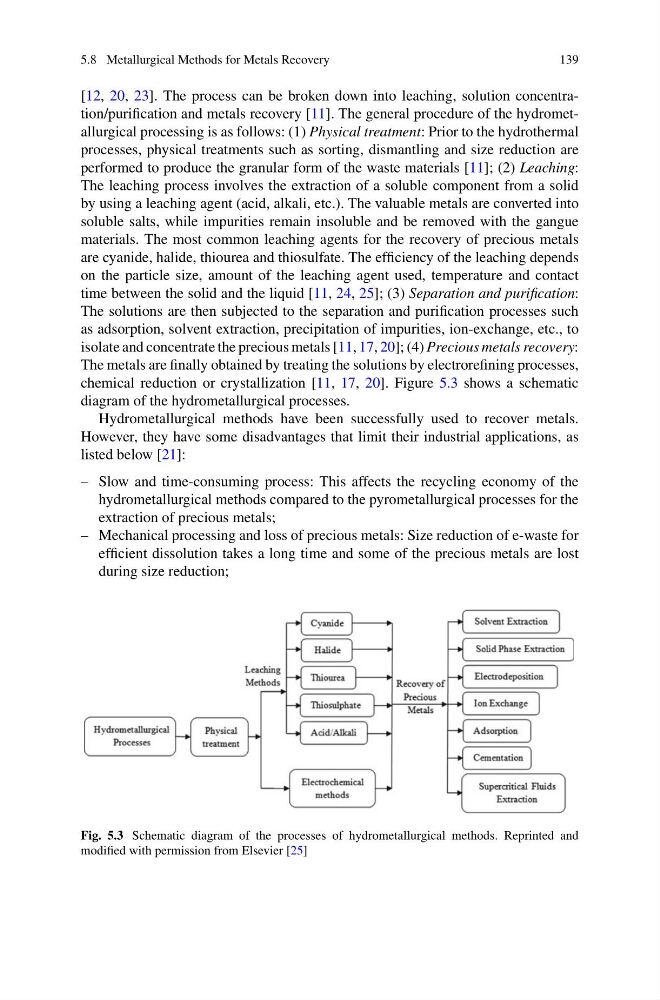
chemical reduction or crystallization [11, 17, 20]. Figure 5.3 shows a schematic
diagram of the hydrometallurgical processes.
Hydrometallurgical methods have been successfully used to recover metals.
However, they have some disadvantages that limit their industrial applications, as
listed below [21]:
– Slow and time-consuming process: This affects the recycling economy of the
hydrometallurgical methods compared to the pyrometallurgical processes for the
extraction of precious metals;
– Mechanical processing and loss of precious metals: Size reduction of e-waste for
efficient dissolution takes a long time and some of the precious metals are lost
during size reduction;
Fig. 5.3 Schematic diagram of the processes of hydrometallurgical methods. Reprinted and
modified with permission from Elsevier [25]
139
[12, 20, 23]. The process can be broken down into leaching, solution concentration/purification and metals recovery [11]. The general procedure of the hydrometallurgical processing is as follows: (1) Physical treatment: Prior to the hydrothermal
processes, physical treatments such as sorting, dismantling and size reduction are
performed to produce the granular form of the waste materials [11]; (2) Leaching:
The leaching process involves the extraction of a soluble component from a solid
by using a leaching agent (acid, alkali, etc.). The valuable metals are converted into
soluble salts, while impurities remain insoluble and be removed with the gangue
materials. The most common leaching agents for the recovery of precious metals
are cyanide, halide, thiourea and thiosulfate. The efficiency of the leaching depends
on the particle size, amount of the leaching agent used, temperature and contact
time between the solid and the liquid [11, 24, 25]; (3) Separation and purification:
The solutions are then subjected to the separation and purification processes such
as adsorption, solvent extraction, precipitation of impurities, ion-exchange, etc., to
isolate and concentrate the precious metals [11, 17, 20]; (4) Precious metals recovery:
The metals are finally obtained by treating the solutions by electrorefining processes,
chemical reduction or crystallization [11, 17, 20]. Figure 5.3 shows a schematic
diagram of the hydrometallurgical processes.
Hydrometallurgical methods have been successfully used to recover metals.
However, they have some disadvantages that limit their industrial applications, as
listed below [21]:
– Slow and time-consuming process: This affects the recycling economy of the
hydrometallurgical methods compared to the pyrometallurgical processes for the
extraction of precious metals;
– Mechanical processing and loss of precious metals: Size reduction of e-waste for
efficient dissolution takes a long time and some of the precious metals are lost
during size reduction;
Fig. 5.3 Schematic diagram of the processes of hydrometallurgical methods. Reprinted and
modified with permission from Elsevier [25]