

142
5 Recovery of Metals from Electronic Waste
5.8.2.4 Thiosulphate Leaching
Thiosulphate (S 2 O
2−
3 ) is a reducing agent used in a variety of industries including
photography and pharmaceutical industry. The gold dissolution in thiosulphate has
several advantages compared to cyanide leaching including lower toxicity, faster
dissolution rates and high gold recoveries due to less interference with the other
cationic species [25]. The two types of thiosulphate solutions that are mostly used
for gold recovery from e-waste are sodium thiosulphate and ammonia thiosulphate.
Thiosulphate leaching needs an oxidizing agent such as copper (II) and iron (III)
along with the solid surface contact as well as a co-leaching material such as ammonia
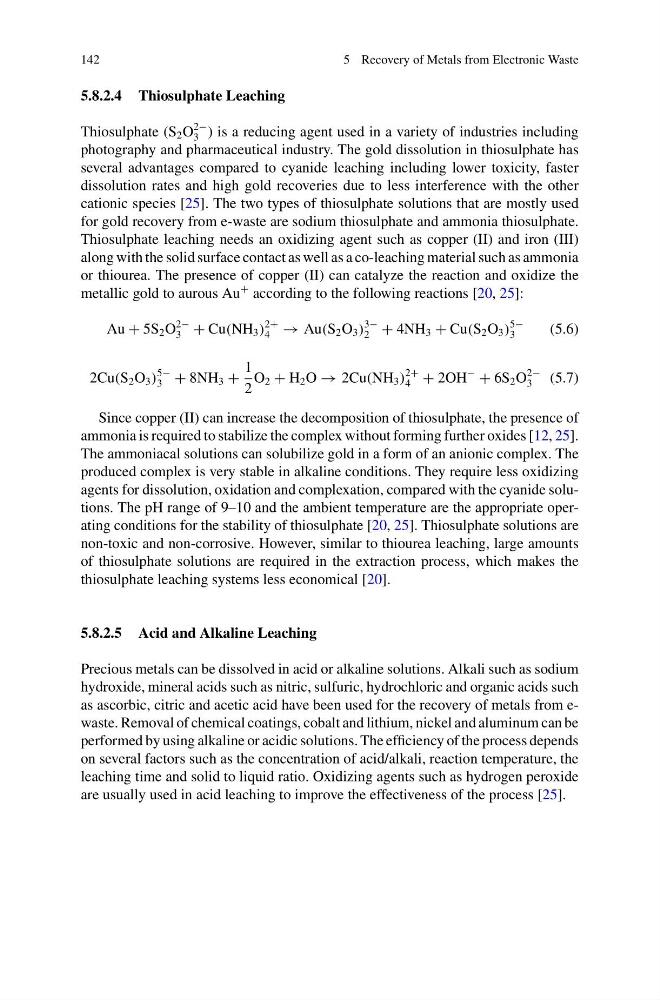
or thiourea. The presence of copper (II) can catalyze the reaction and oxidize the
metallic gold to aurous Au
+ according to the following reactions [20, 25]:
Au + 5S 2 O
2−
3 + Cu(NH 3 )
2+
4 → Au(S 2 O 3 )
3−
2 + 4NH 3 + Cu(S 2 O 3 )
5−
3
(5.6)
2Cu(S 2 O 3 )
5−
3 + 8NH 3 +
1
2
O 2 + H 2 O → 2Cu(NH 3 )
2+
4 + 2OH
−
+ 6S 2 O
2−
3
(5.7)
Since copper (II) can increase the decomposition of thiosulphate, the presence of
ammonia is required to stabilize the complex without forming further oxides [12, 25].
The ammoniacal solutions can solubilize gold in a form of an anionic complex. The
produced complex is very stable in alkaline conditions. They require less oxidizing
agents for dissolution, oxidation and complexation, compared with the cyanide solutions. The pH range of 9–10 and the ambient temperature are the appropriate operating conditions for the stability of thiosulphate [20, 25]. Thiosulphate solutions are
non-toxic and non-corrosive. However, similar to thiourea leaching, large amounts
of thiosulphate solutions are required in the extraction process, which makes the
thiosulphate leaching systems less economical [20].
5.8.2.5 Acid and Alkaline Leaching
Precious metals can be dissolved in acid or alkaline solutions. Alkali such as sodium
hydroxide, mineral acids such as nitric, sulfuric, hydrochloric and organic acids such
as ascorbic, citric and acetic acid have been used for the recovery of metals from ewaste. Removal of chemical coatings, cobalt and lithium, nickel and aluminum can be
performed by using alkaline or acidic solutions. The efficiency of the process depends
on several factors such as the concentration of acid/alkali, reaction temperature, the
leaching time and solid to liquid ratio. Oxidizing agents such as hydrogen peroxide
are usually used in acid leaching to improve the effectiveness of the process [25].
5 Recovery of Metals from Electronic Waste
5.8.2.4 Thiosulphate Leaching
Thiosulphate (S 2 O
2−
3 ) is a reducing agent used in a variety of industries including
photography and pharmaceutical industry. The gold dissolution in thiosulphate has
several advantages compared to cyanide leaching including lower toxicity, faster
dissolution rates and high gold recoveries due to less interference with the other
cationic species [25]. The two types of thiosulphate solutions that are mostly used
for gold recovery from e-waste are sodium thiosulphate and ammonia thiosulphate.
Thiosulphate leaching needs an oxidizing agent such as copper (II) and iron (III)
along with the solid surface contact as well as a co-leaching material such as ammonia
or thiourea. The presence of copper (II) can catalyze the reaction and oxidize the
metallic gold to aurous Au
+ according to the following reactions [20, 25]:
Au + 5S 2 O
2−
3 + Cu(NH 3 )
2+
4 → Au(S 2 O 3 )
3−
2 + 4NH 3 + Cu(S 2 O 3 )
5−
3
(5.6)
2Cu(S 2 O 3 )
5−
3 + 8NH 3 +
1
2
O 2 + H 2 O → 2Cu(NH 3 )
2+
4 + 2OH
−
+ 6S 2 O
2−
3
(5.7)
Since copper (II) can increase the decomposition of thiosulphate, the presence of
ammonia is required to stabilize the complex without forming further oxides [12, 25].
The ammoniacal solutions can solubilize gold in a form of an anionic complex. The
produced complex is very stable in alkaline conditions. They require less oxidizing
agents for dissolution, oxidation and complexation, compared with the cyanide solutions. The pH range of 9–10 and the ambient temperature are the appropriate operating conditions for the stability of thiosulphate [20, 25]. Thiosulphate solutions are
non-toxic and non-corrosive. However, similar to thiourea leaching, large amounts
of thiosulphate solutions are required in the extraction process, which makes the
thiosulphate leaching systems less economical [20].
5.8.2.5 Acid and Alkaline Leaching
Precious metals can be dissolved in acid or alkaline solutions. Alkali such as sodium
hydroxide, mineral acids such as nitric, sulfuric, hydrochloric and organic acids such
as ascorbic, citric and acetic acid have been used for the recovery of metals from ewaste. Removal of chemical coatings, cobalt and lithium, nickel and aluminum can be
performed by using alkaline or acidic solutions. The efficiency of the process depends
on several factors such as the concentration of acid/alkali, reaction temperature, the
leaching time and solid to liquid ratio. Oxidizing agents such as hydrogen peroxide
are usually used in acid leaching to improve the effectiveness of the process [25].