

626
14 Classical Mechanics and the Old Quantum Theory
Exercise 14.2
Show that the functions in Eq. (14.2-25) and Eq. (14.2-26) correspond to the given initial
conditions.
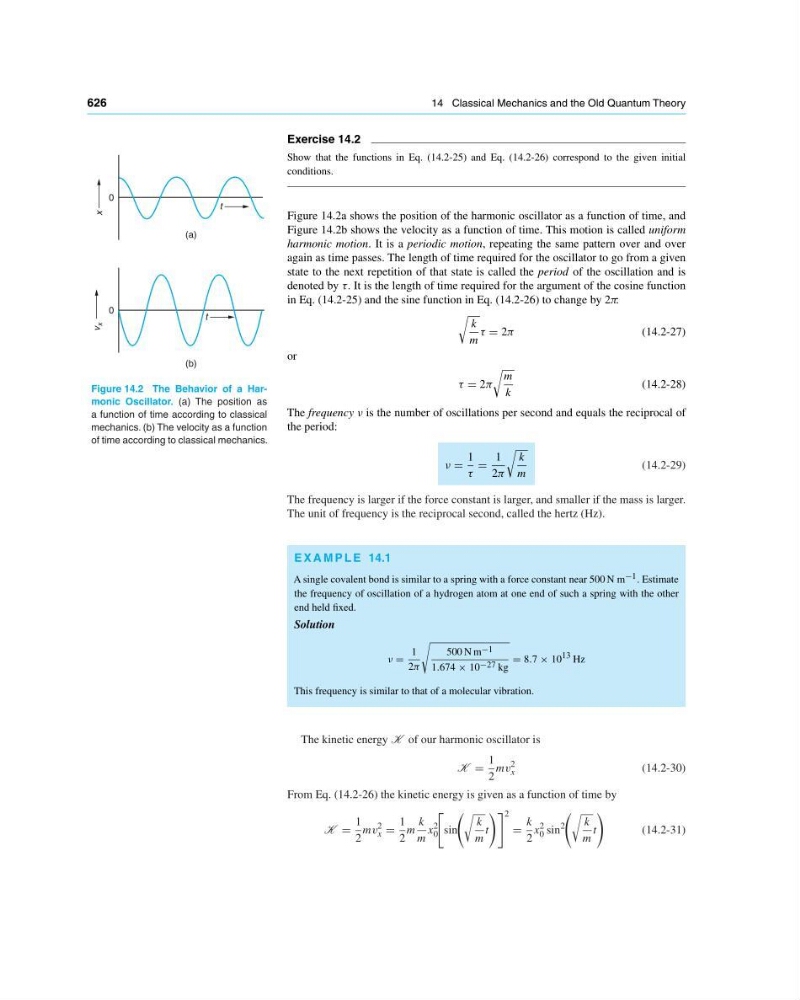
Figure 14.2a shows the position of the harmonic oscillator as a function of time, and
Figure 14.2b shows the velocity as a function of time. This motion is called uniform
harmonic motion. It is a periodic motion, repeating the same pattern over and over
again as time passes. The length of time required for the oscillator to go from a given
state to the next repetition of that state is called the period of the oscillation and is
denoted by τ. It is the length of time required for the argument of the cosine function
in Eq. (14.2-25) and the sine function in Eq. (14.2-26) to change by 2π:
k
m
τ 2π
(14.2-27)
or
τ 2π
m
k
(14.2-28)
The frequency ν is the number of oscillations per second and equals the reciprocal of
the period:
ν
1
τ
1
2π
k
m
(14.2-29)
The frequency is larger if the force constant is larger, and smaller if the mass is larger.
The unit of frequency is the reciprocal second, called the hertz (Hz).
(b)
(a)
t
0
x
0
v
x
t
Figure 14.2 The Behavior of a Harmonic Oscillator. (a) The position as
a function of time according to classical
mechanics. (b) The velocity as a function
of time according to classical mechanics.
E X A M P L E 14.1
A single covalent bond is similar to a spring with a force constant near 500 N m −1 . Estimate
the frequency of oscillation of a hydrogen atom at one end of such a spring with the other
end held fixed.
Solution
ν
1
2π
500 N m −1
1.674 × 10 −27 kg
8.7 × 10 13 Hz
This frequency is similar to that of a molecular vibration.
The kinetic energy K of our harmonic oscillator is
K
1
2
mv
2
x
(14.2-30)
From Eq. (14.2-26) the kinetic energy is given as a function of time by
K
1
2
mv
2
x
1
2
m
k
m
x
2
0
sin
k
m
t
2
k
2
x
2
0 sin
2
k
m
t
(14.2-31)