

14.2 Classical Mechanics
625
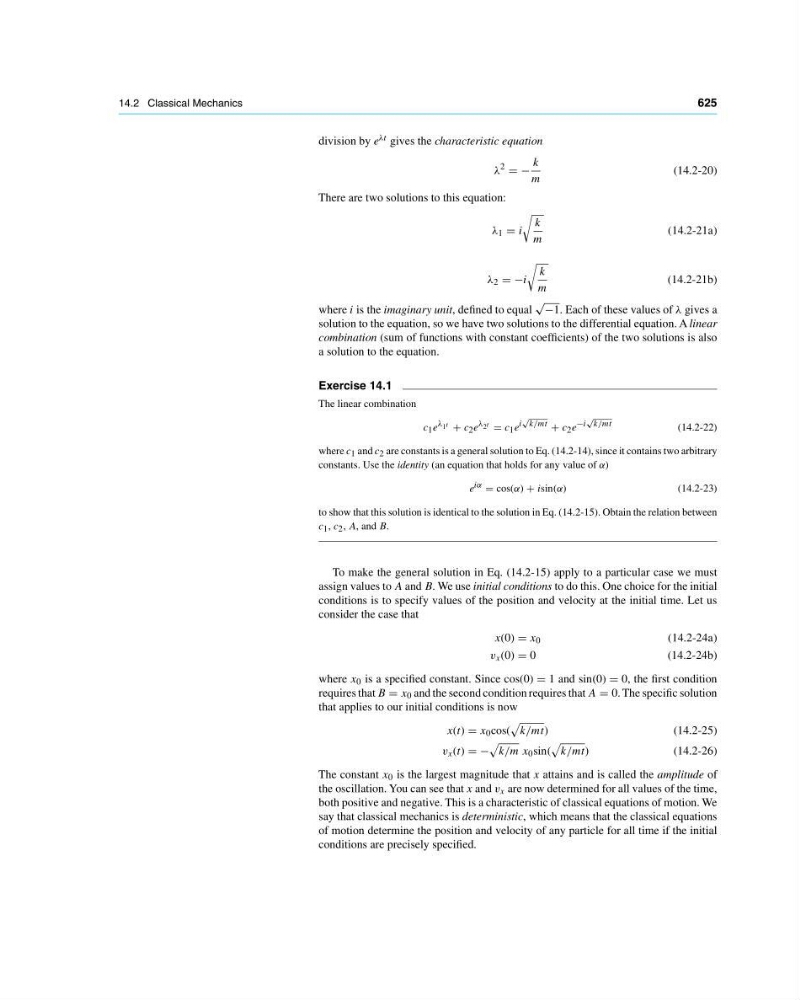
division by e λt gives the characteristic equation
λ
2
−
k
m
(14.2-20)
There are two solutions to this equation:
λ 1 i
k
m
(14.2-21a)
λ 2 −i
k
m
(14.2-21b)
where i is the imaginary unit, defined to equal
√
−1. Each of these values of λ gives a
solution to the equation, so we have two solutions to the differential equation. A linear
combination (sum of functions with constant coefficients) of the two solutions is also
a solution to the equation.
Exercise 14.1
The linear combination
c 1 e λ 1 t + c 2 e λ 2 t c 1 e i
√
k/mt + c 2 e −i
√
k/mt
(14.2-22)
where c 1 and c 2 are constants is a general solution to Eq. (14.2-14), since it contains two arbitrary
constants. Use the identity (an equation that holds for any value of α)
e iα cos(α) + isin(α)
(14.2-23)
to show that this solution is identical to the solution in Eq. (14.2-15). Obtain the relation between
c 1 , c 2 , A, and B.
To make the general solution in Eq. (14.2-15) apply to a particular case we must
assign values to A and B. We use initial conditions to do this. One choice for the initial
conditions is to specify values of the position and velocity at the initial time. Let us
consider the case that
x(0) x 0
(14.2-24a)
v x (0) 0
(14.2-24b)
where x 0 is a specified constant. Since cos(0) 1 and sin(0) 0, the first condition
requires that B x 0 and the second condition requires that A 0. The specific solution
that applies to our initial conditions is now
x(t) x 0 cos(
k/mt)
(14.2-25)
v x (t) −
k/m x 0 sin(
k/mt)
(14.2-26)
The constant x 0 is the largest magnitude that x attains and is called the amplitude of
the oscillation. You can see that x and v x are now determined for all values of the time,
both positive and negative. This is a characteristic of classical equations of motion. We
say that classical mechanics is deterministic, which means that the classical equations
of motion determine the position and velocity of any particle for all time if the initial
conditions are precisely specified.