

14.2 Classical Mechanics
627
Since a force is given as a derivative of a potential energy, a constant can be added to
a potential energy without changing the force or any other physical property.
A time-independent force is equal to the negative derivative of a potential energy.
The potential energy corresponding to the force of Eq. (14.2-13) is
V (x)
1
2
kx
2
+ V 0
(14.2-32)
where V 0 is a constant. Since the derivative of a constant is zero, we can always add
any constant to a potential energy without any physical effect. We choose to set V 0
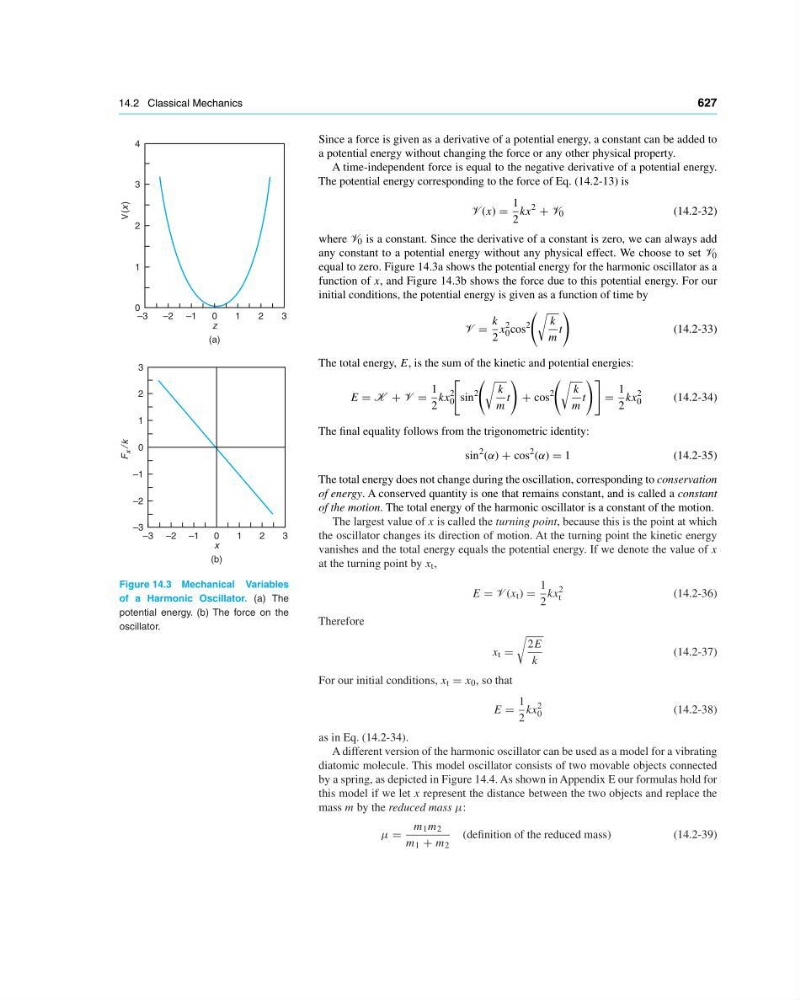
equal to zero. Figure 14.3a shows the potential energy for the harmonic oscillator as a
function of x, and Figure 14.3b shows the force due to this potential energy. For our
initial conditions, the potential energy is given as a function of time by
V
k
2
x
2
0 cos
2
k
m
t
(14.2-33)
The total energy, E, is the sum of the kinetic and potential energies:
E K + V
1
2
kx
2
0
sin
2
k
m
t
+ cos
2
k
m
t
1
2
kx
2
0
(14.2-34)
The final equality follows from the trigonometric identity:
sin
2 (α) + cos
2 (α) 1
(14.2-35)
The total energy does not change during the oscillation, corresponding to conservation
of energy. A conserved quantity is one that remains constant, and is called a constant
of the motion. The total energy of the harmonic oscillator is a constant of the motion.
–3
V (x)
F
x / k
0
z
(a)
x
(b)
1
2
3
4
–2 –1
0
1
2
3
–3
–3
–1
0
1
3
2
–2
–2 –1
0
1
2
3
Figure 14.3 Mechanical Variables
of a Harmonic Oscillator. (a) The
potential energy. (b) The force on the
oscillator.
The largest value of x is called the turning point, because this is the point at which
the oscillator changes its direction of motion. At the turning point the kinetic energy
vanishes and the total energy equals the potential energy. If we denote the value of x
at the turning point by x t ,
E V (x t )
1
2
kx
2
t
(14.2-36)
Therefore
x t
2E
k
(14.2-37)
For our initial conditions, x t x 0 , so that
E
1
2
kx
2
0
(14.2-38)
as in Eq. (14.2-34).
A different version of the harmonic oscillator can be used as a model for a vibrating
diatomic molecule. This model oscillator consists of two movable objects connected
by a spring, as depicted in Figure 14.4. As shown in Appendix E our formulas hold for
this model if we let x represent the distance between the two objects and replace the
mass m by the reduced mass µ:
µ
m 1 m 2
m 1 + m 2
(definition of the reduced mass)
(14.2-39)