

2.1 Work and the State of a System
45
Solution
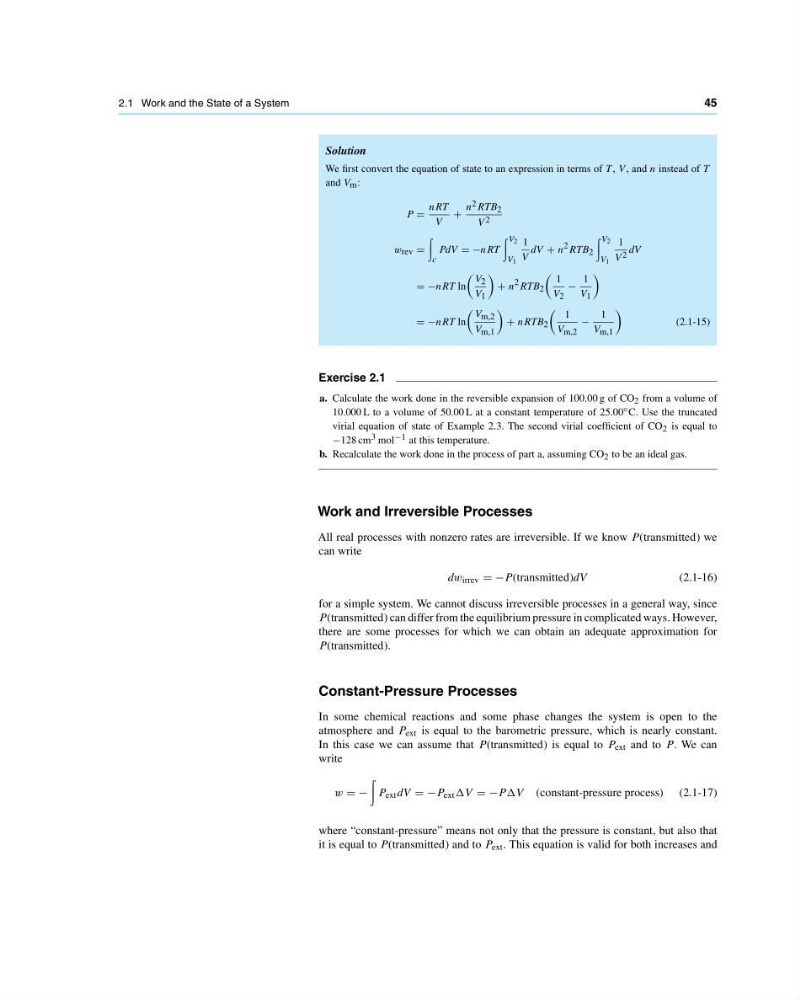
We first convert the equation of state to an expression in terms of T , V , and n instead of T
and V m :
P
nRT
V
+
n 2 RTB 2
V 2
w rev
c
PdV −nRT
V 2
V 1
1
V
dV + n 2 RTB 2
V 2
V 1
1
V 2 dV
−nRT ln
V 2
V 1
+ n 2 RTB 2
1
V 2
−
1
V 1
−nRT ln
V m,2
V m,1
+ nRTB 2
1
V m,2
−
1
V m,1
(2.1-15)
Exercise 2.1
a. Calculate the work done in the reversible expansion of 100.00 g of CO 2 from a volume of
10.000 L to a volume of 50.00 L at a constant temperature of 25.00 ◦ C. Use the truncated
virial equation of state of Example 2.3. The second virial coefficient of CO 2 is equal to
−128 cm 3 mol −1 at this temperature.
b. Recalculate the work done in the process of part a, assuming CO 2 to be an ideal gas.
Work and Irreversible Processes
All real processes with nonzero rates are irreversible. If we know P(transmitted) we
can write
dw irrev −P(transmitted)dV
(2.1-16)
for a simple system. We cannot discuss irreversible processes in a general way, since
P(transmitted) can differ from the equilibrium pressure in complicated ways. However,
there are some processes for which we can obtain an adequate approximation for
P(transmitted).
Constant-Pressure Processes
In some chemical reactions and some phase changes the system is open to the
atmosphere and P ext is equal to the barometric pressure, which is nearly constant.
In this case we can assume that P(transmitted) is equal to P ext and to P. We can
write
w −
P ext dV −P ext ∆V −P∆V (constant-pressure process) (2.1-17)
where “constant-pressure” means not only that the pressure is constant, but also that
it is equal to P(transmitted) and to P ext . This equation is valid for both increases and
45
Solution
We first convert the equation of state to an expression in terms of T , V , and n instead of T
and V m :
P
nRT
V
+
n 2 RTB 2
V 2
w rev
c
PdV −nRT
V 2
V 1
1
V
dV + n 2 RTB 2
V 2
V 1
1
V 2 dV
−nRT ln
V 2
V 1
+ n 2 RTB 2
1
V 2
−
1
V 1
−nRT ln
V m,2
V m,1
+ nRTB 2
1
V m,2
−
1
V m,1
(2.1-15)
Exercise 2.1
a. Calculate the work done in the reversible expansion of 100.00 g of CO 2 from a volume of
10.000 L to a volume of 50.00 L at a constant temperature of 25.00 ◦ C. Use the truncated
virial equation of state of Example 2.3. The second virial coefficient of CO 2 is equal to
−128 cm 3 mol −1 at this temperature.
b. Recalculate the work done in the process of part a, assuming CO 2 to be an ideal gas.
Work and Irreversible Processes
All real processes with nonzero rates are irreversible. If we know P(transmitted) we
can write
dw irrev −P(transmitted)dV
(2.1-16)
for a simple system. We cannot discuss irreversible processes in a general way, since
P(transmitted) can differ from the equilibrium pressure in complicated ways. However,
there are some processes for which we can obtain an adequate approximation for
P(transmitted).
Constant-Pressure Processes
In some chemical reactions and some phase changes the system is open to the
atmosphere and P ext is equal to the barometric pressure, which is nearly constant.
In this case we can assume that P(transmitted) is equal to P ext and to P. We can
write
w −
P ext dV −P ext ∆V −P∆V (constant-pressure process) (2.1-17)
where “constant-pressure” means not only that the pressure is constant, but also that
it is equal to P(transmitted) and to P ext . This equation is valid for both increases and