

46
2 Work, Heat, and Energy: The First Law of Thermodynamics
decreases in the volume of the system and is not restricted to reversible changes, so
long as P is constant and equal to P(transmitted).
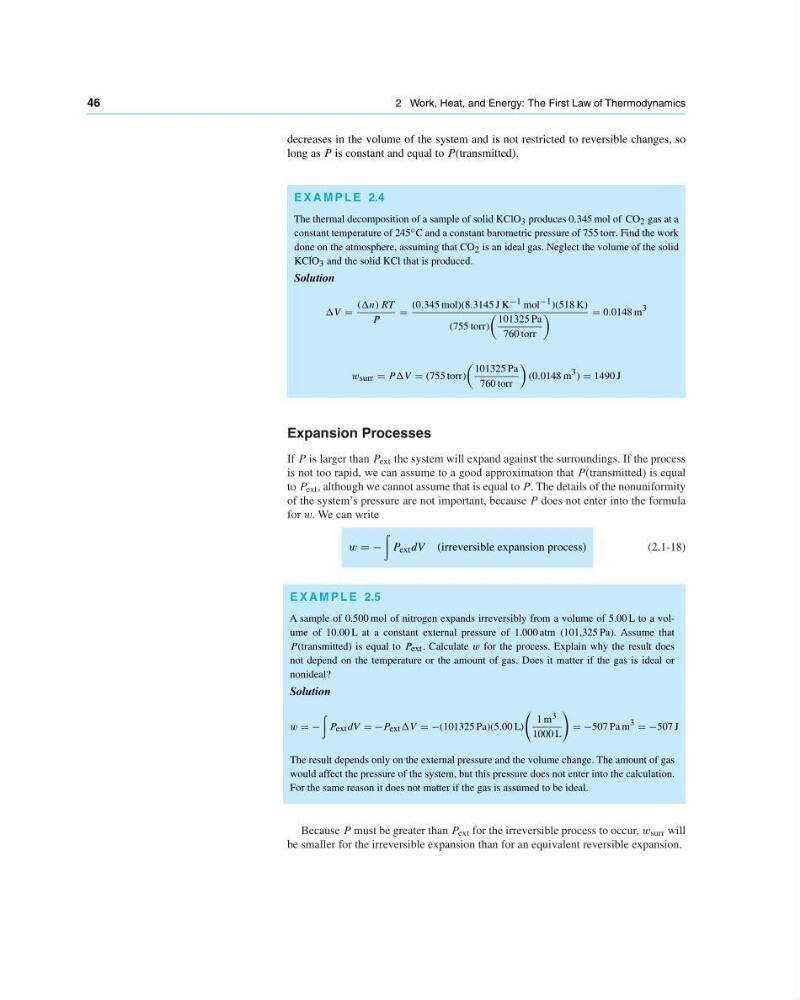
E X A M P L E 2.4
The thermal decomposition of a sample of solid KClO 3 produces 0.345 mol of CO 2 gas at a
constant temperature of 245 ◦ C and a constant barometric pressure of 755 torr. Find the work
done on the atmosphere, assuming that CO 2 is an ideal gas. Neglect the volume of the solid
KClO 3 and the solid KCl that is produced.
Solution
∆V
(∆n) RT
P
(0.345 mol)(8.3145 J K −1 mol −1 )(518 K)
(755 torr)
101325 Pa
760 torr
0.0148 m 3
w surr P∆V (755 torr)
101325 Pa
760 torr
(0.0148 m 3 ) 1490 J
Expansion Processes
If P is larger than P ext the system will expand against the surroundings. If the process
is not too rapid, we can assume to a good approximation that P(transmitted) is equal
to P ext , although we cannot assume that is equal to P. The details of the nonuniformity
of the system’s pressure are not important, because P does not enter into the formula
for w. We can write
w −
P ext dV (irreversible expansion process)
(2.1-18)
E X A M P L E 2.5
A sample of 0.500 mol of nitrogen expands irreversibly from a volume of 5.00 L to a volume of 10.00 L at a constant external pressure of 1.000 atm (101,325 Pa). Assume that
P(transmitted) is equal to P ext . Calculate w for the process. Explain why the result does
not depend on the temperature or the amount of gas. Does it matter if the gas is ideal or
nonideal?
Solution
w −
P ext dV −P ext ∆V −(101325 Pa)(5.00 L)
1 m 3
1000 L
−507 Pa m 3 −507 J
The result depends only on the external pressure and the volume change. The amount of gas
would affect the pressure of the system, but this pressure does not enter into the calculation.
For the same reason it does not matter if the gas is assumed to be ideal.
Because P must be greater than P ext for the irreversible process to occur, w surr will
be smaller for the irreversible expansion than for an equivalent reversible expansion.
2 Work, Heat, and Energy: The First Law of Thermodynamics
decreases in the volume of the system and is not restricted to reversible changes, so
long as P is constant and equal to P(transmitted).
E X A M P L E 2.4
The thermal decomposition of a sample of solid KClO 3 produces 0.345 mol of CO 2 gas at a
constant temperature of 245 ◦ C and a constant barometric pressure of 755 torr. Find the work
done on the atmosphere, assuming that CO 2 is an ideal gas. Neglect the volume of the solid
KClO 3 and the solid KCl that is produced.
Solution
∆V
(∆n) RT
P
(0.345 mol)(8.3145 J K −1 mol −1 )(518 K)
(755 torr)
101325 Pa
760 torr
0.0148 m 3
w surr P∆V (755 torr)
101325 Pa
760 torr
(0.0148 m 3 ) 1490 J
Expansion Processes
If P is larger than P ext the system will expand against the surroundings. If the process
is not too rapid, we can assume to a good approximation that P(transmitted) is equal
to P ext , although we cannot assume that is equal to P. The details of the nonuniformity
of the system’s pressure are not important, because P does not enter into the formula
for w. We can write
w −
P ext dV (irreversible expansion process)
(2.1-18)
E X A M P L E 2.5
A sample of 0.500 mol of nitrogen expands irreversibly from a volume of 5.00 L to a volume of 10.00 L at a constant external pressure of 1.000 atm (101,325 Pa). Assume that
P(transmitted) is equal to P ext . Calculate w for the process. Explain why the result does
not depend on the temperature or the amount of gas. Does it matter if the gas is ideal or
nonideal?
Solution
w −
P ext dV −P ext ∆V −(101325 Pa)(5.00 L)
1 m 3
1000 L
−507 Pa m 3 −507 J
The result depends only on the external pressure and the volume change. The amount of gas
would affect the pressure of the system, but this pressure does not enter into the calculation.
For the same reason it does not matter if the gas is assumed to be ideal.
Because P must be greater than P ext for the irreversible process to occur, w surr will
be smaller for the irreversible expansion than for an equivalent reversible expansion.