

44
2 Work, Heat, and Energy: The First Law of Thermodynamics
E X A M P L E 2.2
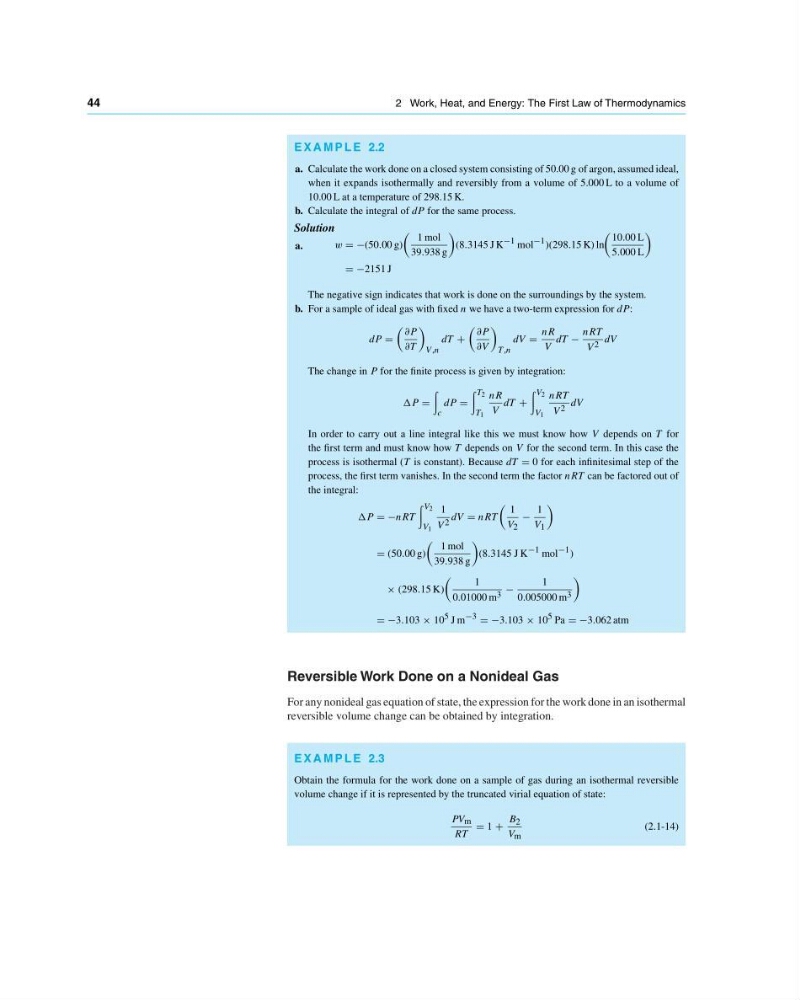
a. Calculate the work done on a closed system consisting of 50.00 g of argon, assumed ideal,
when it expands isothermally and reversibly from a volume of 5.000 L to a volume of
10.00 L at a temperature of 298.15 K.
b. Calculate the integral of dP for the same process.
Solution
a.
w −(50.00 g)
1 mol
39.938 g
(8.3145 J K −1 mol −1 )(298.15 K) ln
10.00 L
5.000 L
−2151 J
The negative sign indicates that work is done on the surroundings by the system.
b. For a sample of ideal gas with fixed n we have a two-term expression for dP:
dP
∂P
∂T
V ,n
dT +
∂P
∂V
T ,n
dV
nR
V
dT −
nRT
V 2 dV
The change in P for the finite process is given by integration:
∆P
c
dP
T 2
T 1
nR
V
dT +
V 2
V 1
nRT
V 2 dV
In order to carry out a line integral like this we must know how V depends on T for
the first term and must know how T depends on V for the second term. In this case the
process is isothermal (T is constant). Because dT 0 for each infinitesimal step of the
process, the first term vanishes. In the second term the factor nRT can be factored out of
the integral:
∆P −nRT
V 2
V 1
1
V 2 dV nRT
1
V 2
−
1
V 1
(50.00 g)
1 mol
39.938 g
(8.3145 J K −1 mol −1 )
× (298.15 K)
1
0.01000 m 3 −
1
0.005000 m 3
−3.103 × 10 5 J m −3 −3.103 × 10 5 Pa −3.062 atm
Reversible Work Done on a Nonideal Gas
For any nonideal gas equation of state, the expression for the work done in an isothermal
reversible volume change can be obtained by integration.
E X A M P L E 2.3
Obtain the formula for the work done on a sample of gas during an isothermal reversible
volume change if it is represented by the truncated virial equation of state:
PV m
RT
1 +
B 2
V m
(2.1-14)
2 Work, Heat, and Energy: The First Law of Thermodynamics
E X A M P L E 2.2
a. Calculate the work done on a closed system consisting of 50.00 g of argon, assumed ideal,
when it expands isothermally and reversibly from a volume of 5.000 L to a volume of
10.00 L at a temperature of 298.15 K.
b. Calculate the integral of dP for the same process.
Solution
a.
w −(50.00 g)
1 mol
39.938 g
(8.3145 J K −1 mol −1 )(298.15 K) ln
10.00 L
5.000 L
−2151 J
The negative sign indicates that work is done on the surroundings by the system.
b. For a sample of ideal gas with fixed n we have a two-term expression for dP:
dP
∂P
∂T
V ,n
dT +
∂P
∂V
T ,n
dV
nR
V
dT −
nRT
V 2 dV
The change in P for the finite process is given by integration:
∆P
c
dP
T 2
T 1
nR
V
dT +
V 2
V 1
nRT
V 2 dV
In order to carry out a line integral like this we must know how V depends on T for
the first term and must know how T depends on V for the second term. In this case the
process is isothermal (T is constant). Because dT 0 for each infinitesimal step of the
process, the first term vanishes. In the second term the factor nRT can be factored out of
the integral:
∆P −nRT
V 2
V 1
1
V 2 dV nRT
1
V 2
−
1
V 1
(50.00 g)
1 mol
39.938 g
(8.3145 J K −1 mol −1 )
× (298.15 K)
1
0.01000 m 3 −
1
0.005000 m 3
−3.103 × 10 5 J m −3 −3.103 × 10 5 Pa −3.062 atm
Reversible Work Done on a Nonideal Gas
For any nonideal gas equation of state, the expression for the work done in an isothermal
reversible volume change can be obtained by integration.
E X A M P L E 2.3
Obtain the formula for the work done on a sample of gas during an isothermal reversible
volume change if it is represented by the truncated virial equation of state:
PV m
RT
1 +
B 2
V m
(2.1-14)