

12.3 The Temperature Dependence of Rate Constants
535
The Collision Theory of Bimolecular Elementary
Gas-Phase Reactions
The principal assumption of the theory is that the initiation of the reaction requires
an inelastic collision in which at least a certain amount of energy is transferred from
translational motion to internal motions (rotations, vibrations, or electronic motion)
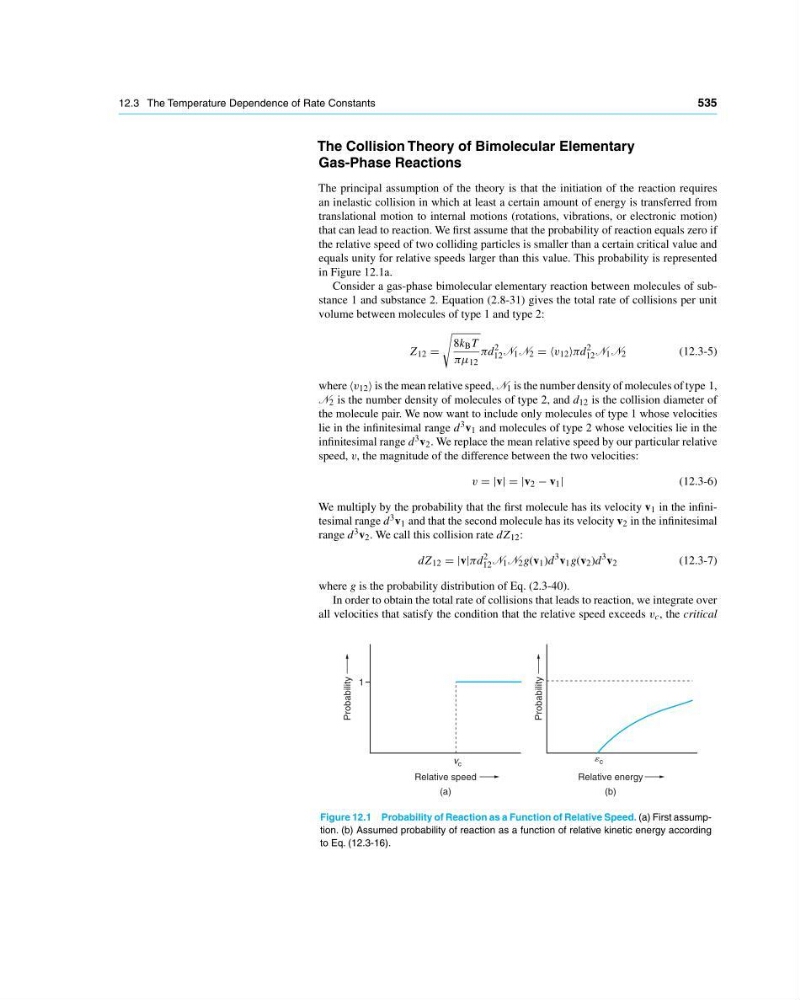
that can lead to reaction. We first assume that the probability of reaction equals zero if
the relative speed of two colliding particles is smaller than a certain critical value and
equals unity for relative speeds larger than this value. This probability is represented
in Figure 12.1a.
Consider a gas-phase bimolecular elementary reaction between molecules of substance 1 and substance 2. Equation (2.8-31) gives the total rate of collisions per unit
volume between molecules of type 1 and type 2:
Z 12
8k B T
πµ 12
πd
2
12 N 1 N 2 v 12 πd
2
12 N 1 N 2
(12.3-5)
where v 12 is the mean relative speed, N 1 is the number density of molecules of type 1,
N 2 is the number density of molecules of type 2, and d 12 is the collision diameter of
the molecule pair. We now want to include only molecules of type 1 whose velocities
lie in the infinitesimal range d 3 v 1 and molecules of type 2 whose velocities lie in the
infinitesimal range d 3 v 2 . We replace the mean relative speed by our particular relative
speed, v, the magnitude of the difference between the two velocities:
v |v| |v 2 − v 1 |
(12.3-6)
We multiply by the probability that the first molecule has its velocity v 1 in the infinitesimal range d 3 v 1 and that the second molecule has its velocity v 2 in the infinitesimal
range d 3 v 2 . We call this collision rate dZ 12 :
dZ 12 |v|πd
2
12 N 1 N 2 g(v 1 )d
3 v 1 g(v 2 )d
3 v 2
(12.3-7)
where g is the probability distribution of Eq. (2.3-40).
In order to obtain the total rate of collisions that leads to reaction, we integrate over
all velocities that satisfy the condition that the relative speed exceeds v c , the critical
1
v c
Probability
Probability
Relative speed
(a)
( b)
c
Relative energy
Figure 12.1 Probability of Reaction as a Function of Relative Speed. (a) First assumption. (b) Assumed probability of reaction as a function of relative kinetic energy according
to Eq. (12.3-16).