

536
12 Chemical Reaction Mechanisms I: Rate Laws and Mechanisms
speed, the minimum relative speed that can lead to reaction:
v > v c
(12.3-8)
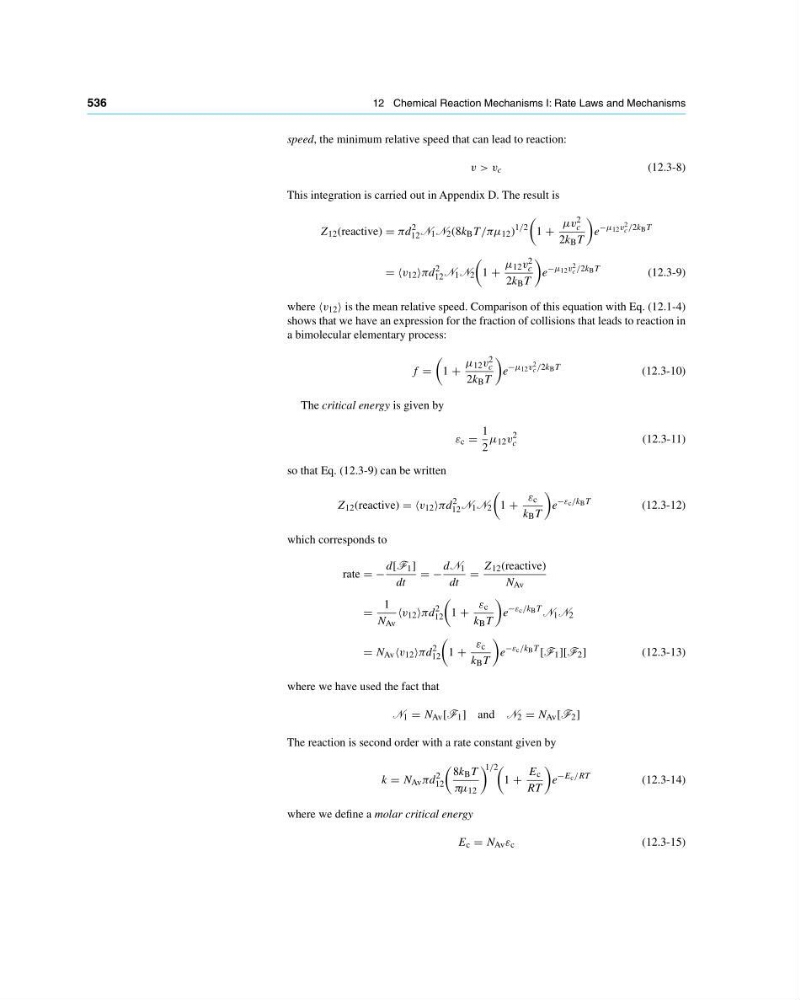
This integration is carried out in Appendix D. The result is
Z 12 (reactive) πd
2
12 N 1 N 2 (8k B T /πµ 12 )
1/2
1 +
µv 2
c
2k B T
e
−µ 12 v 2
c /2k B T
v 12 πd
2
12 N 1 N 2
1 +
µ 12 v 2
c
2k B T
e
−µ 12 v 2
c /2k B T
(12.3-9)
where v 12 is the mean relative speed. Comparison of this equation with Eq. (12.1-4)
shows that we have an expression for the fraction of collisions that leads to reaction in
a bimolecular elementary process:
f
1 +
µ 12 v 2
c
2k B T
e
−µ 12 v 2
c /2k B T
(12.3-10)
The critical energy is given by
ε c
1
2
µ 12 v
2
c
(12.3-11)
so that Eq. (12.3-9) can be written
Z 12 (reactive) v 12 πd
2
12 N 1 N 2
1 +
ε c
k B T
e
−ε c /k B T
(12.3-12)
which corresponds to
rate −
d[F 1 ]
dt
−
dN 1
dt
Z 12 (reactive)
N Av
1
N Av
v 12 πd
2
12
1 +
ε c
k B T
e
−ε c /k B T
N 1 N 2
N Av v 12 πd
2
12
1 +
ε c
k B T
e
−ε c /k B T [F 1 ][F 2 ]
(12.3-13)
where we have used the fact that
N 1 N Av [F 1 ] and N 2 N Av [F 2 ]
The reaction is second order with a rate constant given by
k N Av πd
2
12
8k B T
πµ 12
1/2
1 +
E c
RT
e
−E c /RT
(12.3-14)
where we define a molar critical energy
E c N Av ε c
(12.3-15)