

534
12 Chemical Reaction Mechanisms I: Rate Laws and Mechanisms
E X A M P L E 12.6
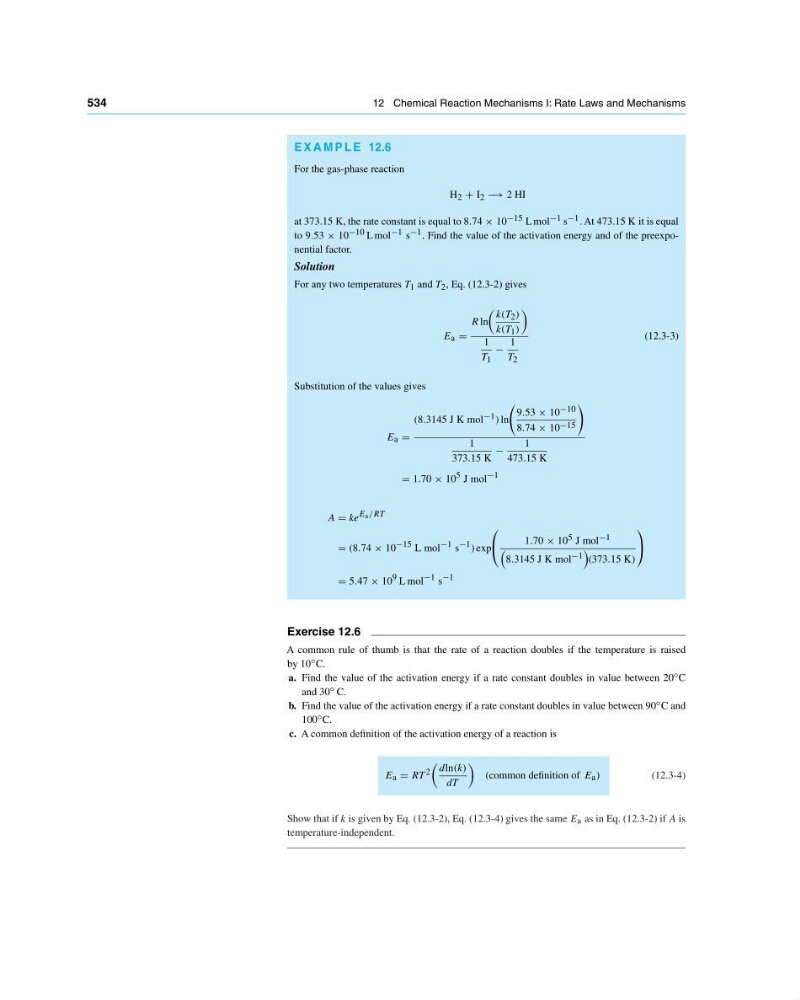
For the gas-phase reaction
H 2 + I 2 − → 2 HI
at 373.15 K, the rate constant is equal to 8.74 × 10 −15 L mol −1 s −1 . At 473.15 K it is equal
to 9.53 × 10 −10 L mol −1 s −1 . Find the value of the activation energy and of the preexponential factor.
Solution
For any two temperatures T 1 and T 2 , Eq. (12.3-2) gives
E a
R ln
k(T 2 )
k(T 1 )
1
T 1
−
1
T 2
(12.3-3)
Substitution of the values gives
E a
(8.3145 J K mol −1 ) ln
9.53 × 10 −10
8.74 × 10 −15
1
373.15 K
−
1
473.15 K
1.70 × 10 5 J mol −1
A ke E a /RT
(8.74 × 10 −15 L mol −1 s −1 ) exp
⎛
⎝
1.70 × 10 5 J mol −1
8.3145 J K mol −1
(373.15 K)
⎞
⎠
5.47 × 10 9 L mol −1 s −1
Exercise 12.6
A common rule of thumb is that the rate of a reaction doubles if the temperature is raised
by 10 ◦ C.
a. Find the value of the activation energy if a rate constant doubles in value between 20 ◦ C
and 30 ◦ C.
b. Find the value of the activation energy if a rate constant doubles in value between 90 ◦ C and
100 ◦ C.
c. A common definition of the activation energy of a reaction is
E a RT 2
dln(k)
dT
(common definition of E a )
(12.3-4)
Show that if k is given by Eq. (12.3-2), Eq. (12.3-4) gives the same E a as in Eq. (12.3-2) if A is
temperature-independent.