

11.7 The Experimental Study of Fast Reactions
517
Oscilloscope
PM
Monochromator
Sample
Analyzing
light source
Flash lamp
Spark
gap
C
High-voltage
supply
Trigger
signal
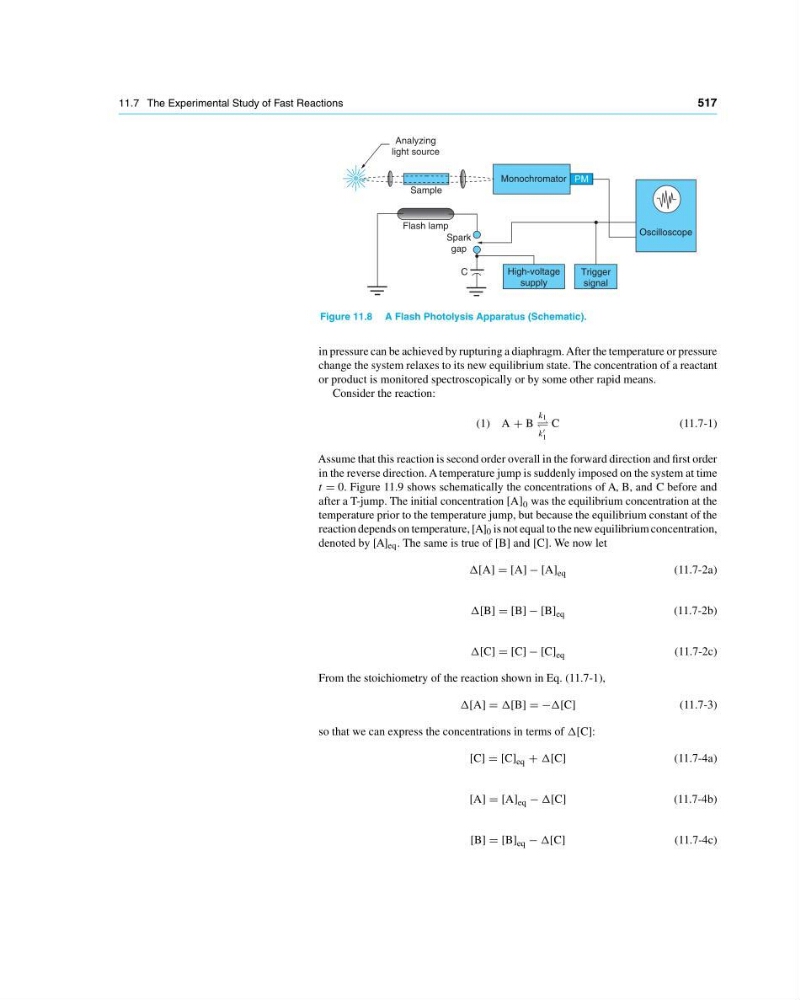
Figure 11.8 A Flash Photolysis Apparatus (Schematic).
in pressure can be achieved by rupturing a diaphragm. After the temperature or pressure
change the system relaxes to its new equilibrium state. The concentration of a reactant
or product is monitored spectroscopically or by some other rapid means.
Consider the reaction:
(1) A + B
k 1
k
1
C
(11.7-1)
Assume that this reaction is second order overall in the forward direction and first order
in the reverse direction. A temperature jump is suddenly imposed on the system at time
t 0. Figure 11.9 shows schematically the concentrations of A, B, and C before and
after a T-jump. The initial concentration [A] 0 was the equilibrium concentration at the
temperature prior to the temperature jump, but because the equilibrium constant of the
reaction depends on temperature, [A] 0 is not equal to the new equilibrium concentration,
denoted by [A] eq . The same is true of [B] and [C]. We now let
∆[A] [A] − [A] eq
(11.7-2a)
∆[B] [B] − [B] eq
(11.7-2b)
∆[C] [C] − [C] eq
(11.7-2c)
From the stoichiometry of the reaction shown in Eq. (11.7-1),
∆[A] ∆[B] −∆[C]
(11.7-3)
so that we can express the concentrations in terms of ∆[C]:
[C] [C] eq + ∆[C]
(11.7-4a)
[A] [A] eq − ∆[C]
(11.7-4b)
[B] [B] eq − ∆[C]
(11.7-4c)